


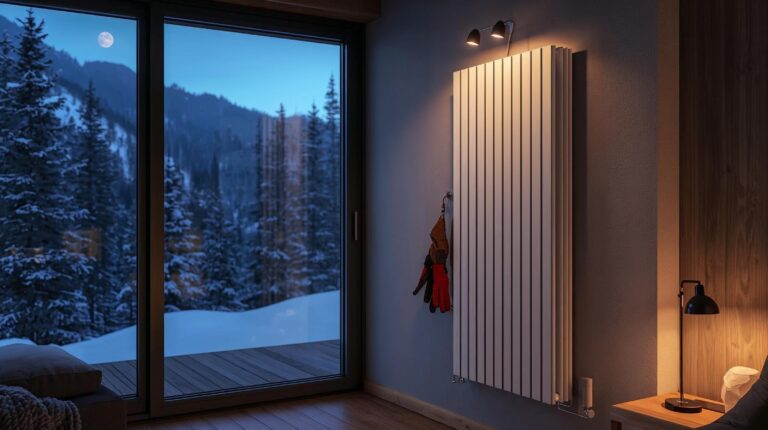
Choosing a heating system for a property in Bansko is a specific case, which differs significantly from decisions for cities such as Sofia or Plovdiv. The reason lies not only in the low temperatures (which often fall to -15°C and -20°C), and in the combination of severe cold and high humidity, typical of the Pirin Mountain region.
This article examines in detail the pros and cons of the two most common technologies: Heat pump (Air-Water) и Air conditioning (Air-Air). Our goal is to help you make an informed and economically sound decision about your home.
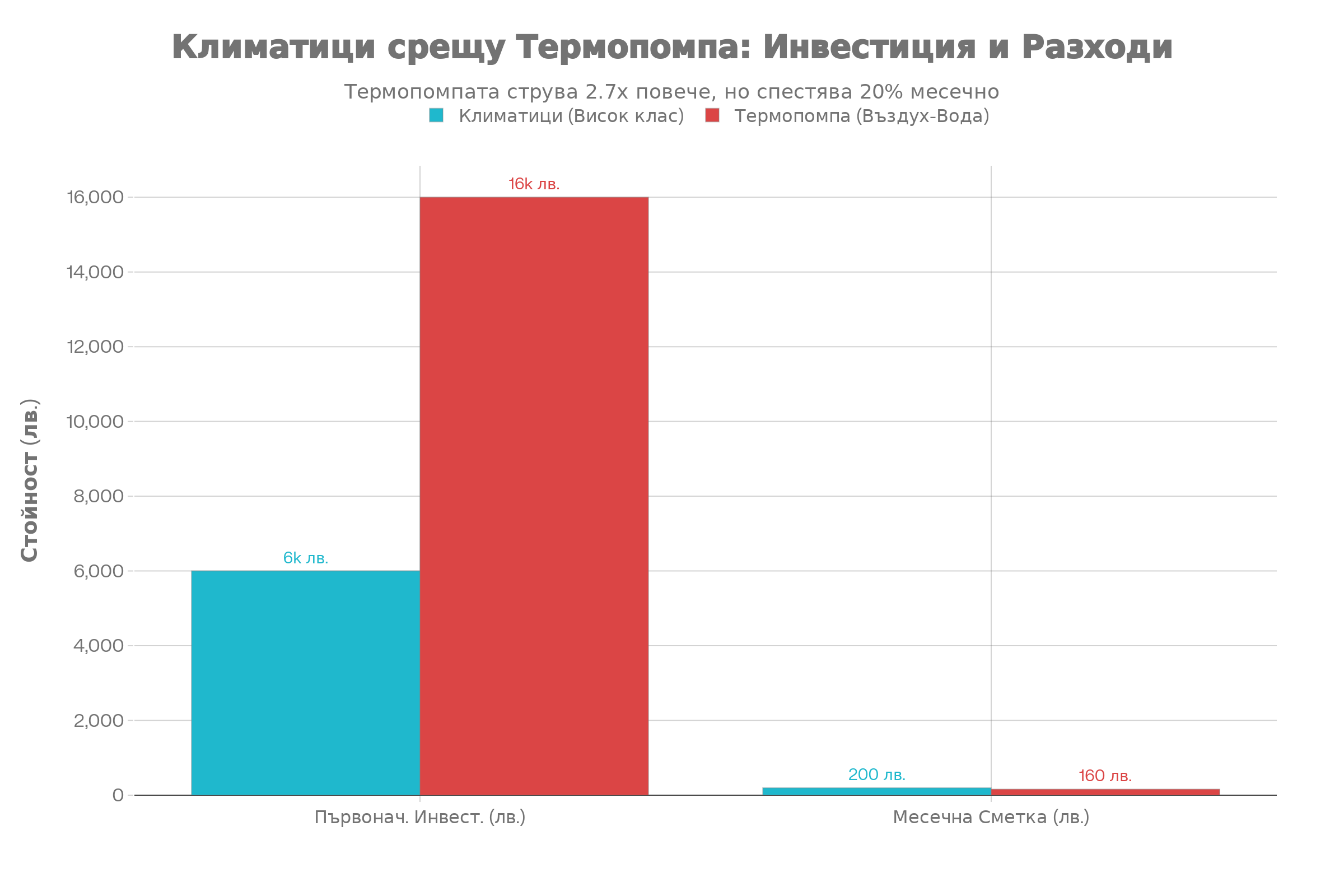
Visualization of the financial difference: The heat pump requires nearly 3 times the initial investment (16,000 BGN) compared to air conditioners (6,000 BGN), with similar monthly electricity costs.
The Key Difference: What Are You Actually Buying?
Before we move on to pricing, it's important to clarify terminology that often confuses owners:
-
Air conditioning (Heat pump air-air): This is the standard “split” system. It directly heats the air in the room.
-
Feature: Quick response when turned on, but creates a feeling of draft.
-
-
Heat pump (Air-to-water): The outdoor unit looks like an air conditioner, but the indoor unit heats water. This water circulates in radiators or underfloor heating.
-
Feature: Constant thermal comfort, no drafts, and provides domestic hot water (DHW).
-
The “Bansko” Factor: Humidity and Icing
Bansko is distinguished by its specific microclimate and high humidity during the winter months (often above 90%). This is a serious challenge for all heat pump technologies.
The challenge: The moisture in the air freezes on the heat exchanger of the outdoor unit, causing ice to build up. The system must stop heating inside to defrost itself (defrost mode). Defrost).
-
For air conditioning: When the unit enters defrost mode, it stops supplying warm air. You can feel the chill and sometimes the draft from the residual circulation. On cold, foggy days in the area of "Gramadeto" or next to the "Gondola", this can happen every 40-50 minutes, which disrupts comfort.
-
For the heat pump (air-water): Thanks to the thermal inertia of water in radiators or underfloor heating, you you don't feel The temperature in the rooms remains stable.
Comparative analysis: Comfort and operation
| Characteristics | Air conditioning (Air-Air) | Heat pump (Air-Water) |
| Heat transfer type | Convection (air movement). | Radiant energy (from radiators/floor). Even and cozy. |
| Acoustics | Noise from the fan in every room. | Completely silent in the rooms (the noise is carried outside). |
| Hot water | Separate electrical connection required boiler. | The system heats the water heater efficiently and economically. |
| Air humidity | It dries the air significantly. | Does not dry the air (especially with underfloor heating). |
| Ski equipment | Difficult drying (no hot surface). | Radiators are ideal for quickly drying gloves and equipment. |
Initial investment and operating costs (2025)
Here the difference is most noticeable. The heat pump is a premium solution, while air conditioners are the budget and practical choice. The data is averaged for a standard three-room apartment (about 100 sq m) with good insulation.
Air Conditioners (Budget Solution)
For a living room and two bedrooms, three high (hyperinverter) class machines are needed (e.g. Mitsubishi Heavy, Daikin Perfera, Gree Amber).
-
Indicative investment: 4,000 – 7,000 BGN.
Heat pump (Premium solution)
Heat pump (monoblock or split 10-12kW) plus construction of water installation (pipework, radiators/underfloor), boiler and buffer tank.
-
Equipment price: 9,000 – 14,000 BGN.
-
Final price with installation and materials: often over 18,000 – 22,000 BGN.
Important for the budget: The heat pump is 10-20% more efficient than air conditioners in terms of electricity consumption, but the difference in the monthly bill (e.g. 30-50 BGN) is too small to quickly recoup the significantly higher initial investment.
Performance in extreme conditions (-20°C)
Modern devices of both types operate down to -25°C, but with certain conditions:
-
Heat pump: Proper sizing by an engineer is mandatory. If its power is insufficient, the built-in electric heaters will be turned on, which will drastically increase the electricity bill.
-
Air conditioning: Search for models with a label “Hyper Heating”, “Nordic” or “"Zubadan"”. Standard models lose up to 50% of their power at temperatures below -15°C.
Expert opinion: What to choose?
The decision depends entirely on the purpose of the property:
Scenario A: “Holiday apartment for a weekend ski trip”
✅ Recommendation: HIGH CLASS AIR CONDITIONERS
-
Argument: When you arrive on a Friday night to a cold apartment, the air conditioner will warm the air in about 30 minutes. A heat pump, especially if it has underfloor heating, will need 6 to 12 hours to raise the temperature due to the system's high inertia.
-
Tip: Invest in air conditioners with Wi-Fi control to activate them remotely while you're crossing the Border.
Scenario B: “Year-round living or guest house”
✅ Recommendation: HEAT PUMP (Air-Water)
-
Argument: The comfort is incomparable. There is no noise and drafts, the heat is uniform in all rooms. You have unlimited hot water. The system works most economically when maintaining a constant temperature throughout the season.
-
Tip: Be sure to provide buffer tank. It is critical to the operation of the system in Bansko, as it provides the necessary thermal energy for defrosting without taking heat from the radiators.
Scenario B: “Renovation of an old house”
✅ Recommendation: HYBRID SYSTEM
-
Argument: If you already have a system with radiators (e.g. from a fireplace with a water jacket), a heat pump is a logical upgrade.
-
Attention: The heat pump works with low-temperature water (45°C) compared to solid fuel boilers (60-70°C). It is necessary to check whether the area of the existing radiators (number of gliders) is sufficient to heat the rooms with cooler water.




 English (UK)