


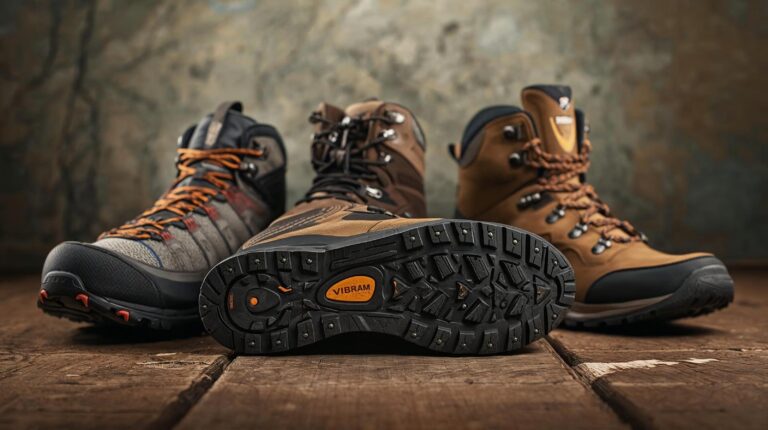
In this detailed guide, we'll break down the anatomy of the ideal Pirin shoe, look at the technologies that are worth the money, and point you to specific models that won't let you down.
1. Anatomy of the Pirin Shoe: What to look for?
When you walk into a gear store, the salespeople will bombard you with terms. Here's what they mean and why they're important for our region.
Outsole: Traction and pattern
This is the most important element. Pirin marble becomes slippery as ice when wet, and granite moraines require a rubber that "sticks".
- Vibram®: This is the gold standard – the yellow octagon on the sole. But not all Vibram is the same. For Pirin, look for the mixture Vibram Megagrip. It is specially designed to hold on wet rocks.
- Contagrip® (Salomon): An excellent alternative that offers very good traction on mixed terrain.
- The Lug Pattern:
- Depth: You need deep cleats (minimum 4-5 mm) to bite into mud and small pebbles (gravel).
- Climbing Zone: Look at the top of the sole. Good shoes have a smooth area at the front – this is used for precise stepping on small rock edges when climbing (so-called scrambling).
- Braking Heel: The heel should have backward-facing grippers that act as a brake on steep descents.
Midsole: Hardness and cushioning
This is where the difference between fatigue and comfort lies. There are two main materials used in shoes:
- EVA foam: Light and soft. It absorbs shocks well, but it crushes with the weather. Suitable for light hiking.
- PU (Polyurethane): A heavier but much more durable material. Used in serious hiking boots.
- Shank: This is a hard plate built into the sole. For Pirin you need hard shoe (Stiff sole). Grab the shoe and try to bend and twist it with your hands. If it bends like a rubber band – it is not for The horse. The hard sole acts as a bridge over sharp stones and protects the foot from being punctured.
The Board (Rand)
This is the rubber band that goes around the bottom of the shoe. For Pirin, it is highly recommended to look for a shoe with full rubber board (360 degrees). When you step on scree (small, sharp stones), they act like knives. The board protects the leather or textile of the shoe from being cut.
2. Shoe Types: What's Your Type?
| Category | Description | For Pirin (Summer/Autumn) |
|---|---|---|
| Trail Running (Marathon Women) | Super light, breathable, flexible. | Only for advanced climbers with ankle braces and light backpacks. Risk of injury on the scree. |
| Approach Shoes | Low shoes with a hard sole and a “climbing zone”. A hybrid between a sneaker and an espadrille. | Excellent for rocky edges (Guardians), but they do not protect the ankle. |
| Hiking Boots (High) | The classic. They protect the ankle, have a membrane, and are stable. | The best choice for beginners. They forgive mistakes when stepping. |
| Alpine Boots | Very hard (non-collapsible), compatible with cats. | Too heavy for summer (“overkill”), but a must for winter Pirin. |
3. The membrane: To breathe or not to let through?
Here the eternal battle is Gore-Tex (GTX) vs. “No Membrane”.
- With membrane: A must-have for spring, fall, and changeable weather. It keeps water out but allows sweat (vapor) to escape.
- Attention: In the summer, in 30-degree heat, even the best membrane gets steamy. The feet sweat more.
- Without membrane: Only for the hottest summer days (July-August). If it rains, your feet get wet immediately, but they dry out within 20 minutes of walking.
- Leather lining: Some classic models use fine leather on the inside instead of synthetics. This offers incredible comfort and adaptation to the foot, but requires more care (waxing).
4. Top brands and models (Recommended for Pirin)
Based on the experience of local guides in Bansko, here are a few proven fighters:
La Sportiva (Italy)
The leader in hiking boots. They are known for being a bit narrower (not suitable for people with very wide feet).
- TX4 / TX5: Legendary model. Excellent grip, rubber board, very comfortable. TX4 is low (approach), TX5 is high version (GTX).
- Ultra Raptor II Mid GTX: A hybrid between a sneaker and a shoe. Very light, but protects the ankle. A favorite of fast walkers.
Scarpa (Italy)
The eternal competitor of La Sportiva. They often offer a slightly wider cut.
- Mescalito Mid GTX: Designed for technical terrain. Perfect for the rocks of Pirin.
- Zodiac: A harder sole, ideal for rocky scree.
Salomon (France)
- Quest 4D GTX: This is the “tank” of comfort. A high-top shoe that feels like a sneaker but offers great ankle stability thanks to the 4D chassis.
Lowa (Germany)
- Renegade GTX: The best-selling shoe in Europe. Very comfortable “out of the box” (no need to break in), but the sole is a bit softer – better for forest trails than the sharp rocks of Koncheto.
Alpina (Slovenia)
Very popular in Bulgaria due to the good price/quality ratio. Sturdy leather shoes with Vibram that last for years, although a little heavier.
5. How to try on shoes? (Purchase algorithm)
Never buy shoes online without trying them on in person. Sizes vary dramatically between brands.
- Go to the store in the afternoon: The human foot swells and expands throughout the day – just like it does during a long hike. A shoe that fits you right in the morning will be tight in the afternoon.
- Wear your socks: Try on the thick hiking socks you'll be walking in, not thin city socks.
- The “One Finger” Rule: Loosen the laces and push your foot as far forward as possible until your toes touch. At the back, at the heel, you should be able to comfortably insert one index finger.Why? When descending (for example from Vihren to the hut), the foot slides forward. If this 1 cm advance is not there, the toes will bump into the front part, which leads to blueing and falling off of the nails.
- Ramp test: Good stores (like those in Sofia or specialized ones in Bansko) have a test ramp. Step down. Your heel should not “pop” and your toes should not rest on the front.
6. Equipment care
Pirin dust is very fine and abrasive. It dries the skin and clogs the pores of the membranes.
- Cleaning: After each hike, remove the insoles and wash the shoes with lukewarm water and a soft brush. Do not use soap unless it is specialized (Nikwax, Grangers).
- Impregnation: When you see that the water is no longer collecting in droplets, but is absorbing into the fabric, it is time for a spray (for textiles) or wax (for leather).
Next step: Now you have the basics – sturdy socks and reliable shoes. It’s time to talk about what you’ll be carrying your luggage in. Stay tuned for the next part: “The backpack – how to pack everything for Pirin without it weighing us down”.
Frequently asked questions about shoes
Do I need cat-friendly shoes?
For summer hikes – definitely not. Shoes for crampons have a very hard sole, which is uncomfortable for normal walking. If you are planning winter climbs, then you need specialized winter shoes with a groove for semi-automatic crampons.
Can I use running shoes in the park?
Not recommended. Urban sneakers have a soft sole (EVA) that will be crushed by sharp rocks, and they don't have any ankle or toe protection. Also, their soles don't have traction on wet rocks.
How long do good shoes last?
It depends on the kilometers. Usually the sole starts to lose its qualities after 800-1000 km. In the conditions of Pirin (highly abrasive rocks), the grip can wear out faster than in the Balkan Mountains.
{
“@context”: “https://schema.org”,
“@type”: “Article”,
“headline”: “Tank or sneaker? A complete guide to choosing shoes for Pirin”,
“description”: “A detailed guide to choosing hiking boots for the specific terrain of Pirin and Bansko. Comparison of brands, technologies (Vibram, Gore-Tex) and tips for trying on.”,
“author”: {
“@type”: “Person”,
“name”: “Mountain Equipment Expert”
},
“publisher”: {
“@type”: “Organization”,
“name”: “VBansko”,
“logo”: {
“@type”: “ImageObject”,
“"url": "https://vbansko.com/logo.png"”
}
}
}
 English (UK)