

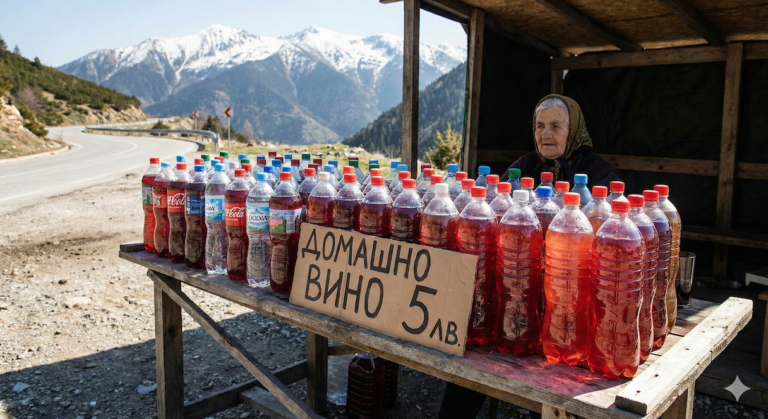
Whether you’re strolling through Bansko’s colorful Sunday market, shopping for souvenirs around the Gondola, or stopping at „Predela“ for a break, temptation is everywhere. Plastic bottles filled with ruby-colored liquid, labeled „True Homemade.“ But behind the romance of the Pirin elixir often lies an industry of counterfeits that can turn your vacation into a nightmare.
The Bulgarian has a sacred connection with wine. For us the words „"homemade wine"“ are synonymous with quality, purity and tradition. However, this blind faith has become a gold mine for illusionists across the region. In this article, we’ll examine the anatomy of the scam – from roadside stalls to resort luggage racks – and give you expert advice on how to distinguish truth from tainted chemistry.
The myth of "Melnik" in a plastic bottle
The picture is familiar: used plastic bottles of mineral water or carbonated drinks, stacked in the heat. The merchant – whether at the market in the city or on the road – swears that this is „thick Melnishko“, made by his grandfather in a village near Sandanski especially for connoisseurs.
Warning: The math doesn't work!
Let's be realistic. It takes about 1.5 kg of good grapes to produce 1 liter of quality wine. Add the labor, the weather for fermentation, storage. How then liter homemade wine in the tourist area costs 5-6 leva – often cheaper than a kilo of grapes in the store? The answer is simple: This is not wine.
Anatomy of a scam: What are they selling us in Bansko?
The mass-produced "poured wine" offered to tourists is often made using technology that would make any self-respecting oenologist scratch their head. Here are the most common schemes:
- Second strainer (Friday): This is the classic. Real wine is drained for personal consumption. Water and a huge amount of sugar are poured into the lees to start a new fermentation. The result is a sweet, intoxicating drink.
- Mendeleev Cocktail: To achieve the desired dark color, dyes (often confectionery) are added. For flavor, a few drops of Cabernet or Merlot essence, which is freely sold in the markets, are added.
- Alcohol consumption: Since the "second strainer" does not have enough alcohol content and density, cheap alcohol is added. This is the reason for the severe hangover in the morning.
The Plastic Problem: Sun and Poison
The plastic bottle (PET) itself is not a death sentence, if is only used for short-term transport. But wine sits on the stalls for days, sometimes weeks.
В Bansko and the region has large temperature swings. The sun bakes the bottles during the day and gets cold at night. This cycle, combined with the acidity of the wine, leads to the release of phthalates and microplastics directly into the alcohol. You are buying „zombie wine“ – a dead liquid maintained with chemistry.
Buyer's Guide: 4 Quality Tests
If you still decide to take the risk, here's how to do a quick field test before you pay:
| TEST | REAL WINE | MINT / CHEMISTRY |
|---|---|---|
| 1. Shaking (The Foam) | White to off-white foam that disappears quickly. | Colored foam (pink/red), which lasts a long time. A sure sign of a fight! |
| 2. Tongue and teeth | It stains slightly, but washes off with water. | It dyes in a deep blue/purple. It doesn't come off for hours. |
| 3. Fragrance | Discreet, fruity, barrel, yeasty. | A sharp smell of alcohol, acetone or overpowering perfume (essence). |
| 4. Taste | Balance, tannins (astringency). | Too sweet (sugar), lacking density, watery. |
The legend of "The Thick Melnik, Who is Carried in a Towel"„
In the Pirin region, there is a myth that the local wine is so thick that it can be carried in a towel. Merchants know that this is exactly what tourists are looking for – dark and heavy wine.
The truth is that the authentic Wide Melnik vine is a variety that produces lighter, ruby-red wine, not inky black. If the wine is opaque black and leaves greasy marks, it has often been "enhanced" with chokeberry concentrate or dye to meet the buyer's false expectations.
Where to find real wine?
The Pirin region (Struma Valley) is home to some of the best wineries in Bulgaria. There are people there who make art in a bottle. But they rarely sell their products in used Coca-Cola bottles on the street.
Editor's Tip:
If you want to experience the taste of the region, avoid dubious vendors. Instead:
- Visit the small family wineries in the villages around Melnik, Harsovo and Kapatovo.
- Look for bottled wine with a label and proven origin in specialized stores in Bansko.
- If you insist on "homemade," only buy from a person who invites you into their cellar and lets you taste from the barrel, not from plastic on the sidewalk.
Life is too short, and a vacation in Bansko is too precious to waste it with a headache from bad chemistry disguised as tradition. Stay informed and cheers with real wine!




 English (UK)