


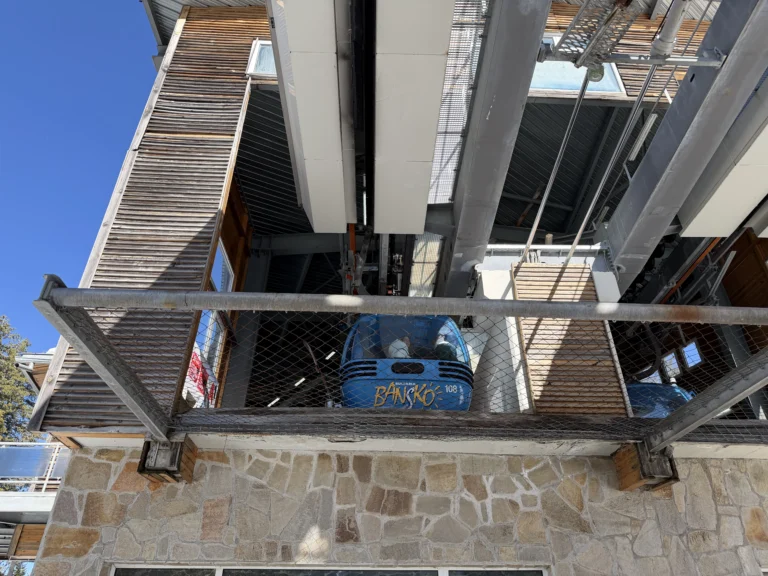
In this article, we will unravel the magic of so-called "detachable" cable cars, explain exactly how they work, and why cable cars are statistically one of the safest ways to get around in the world.
The mechanism of operation: How do the cabins "unhook"?
The main difference between the old tourist lifts and the modern gondola in ski area Bansko is the technology of detachable grip. In conventional chairlifts of the old generation, the seat is fixed statically to the rope and moves constantly at the same speed. This makes boarding and disembarking passengers difficult and requires a low overall speed of the entire facility.
At the gondola lift in Bansko, designed by the world leader Doppelmayr, the process is much smarter, faster and safer.
The step-by-step process:
- Entering the station: When the cable car approached the starting station in the city, the final station Banderishka meadow or the intermediate station "Chalin Valog", a special metal guide rail presses a lever located on the mechanism itself (the grip) on the roof of the cabin.
- Decoupling: This lever physically compresses powerful steel disc springs that open the „jaws“ holding the main rope tight. At this critical moment, the car is no longer connected to the fast-moving steel rope.
- Delay through tyrfors: The uncoupled cabin rests on an internal track and is supported by a series of rotating rubber wheels called tirfors. These smoothly and progressively reduce its speed from about 6 meters per second to just 0.5 meters per second – a speed that is perfect for the smooth and safe entry and exit of tourists with their skis and snowboards.
- Acceleration and backbiting: After the doors close automatically, another series of rubber tires at the station exit accelerates the gondola. When its speed matches that of the main rope, the rail releases the lever, the jaws close again with enormous force on the rope and the gondola soars up towards the peaks of Pirin.
Safety: Why is there no danger of the cabin falling?
One of the most common psychological fears of people riding a gondola for the first time is that the „clip“ might simply slip off the rope. However, engineers have provided several overlapping levels of protection that make such an incident practically impossible.
The force of disc springs
The grip of each cabin on the track is held tightly closed by packs of huge, pre-tensioned steel springs. Their compressive force is so colossal that the friction between the metal of the jaws and the steel rope is quite enough to withstand the weight of several full cabins at the same time. Even on the steepest slope on the track to the ski area, the mechanism does not allow any slippage.
The wind in Pirin and the protective sensors on the poles
Tourists often get nervous and wonder why the Bansko cable car stops working or slows down when down in the town. the weather It seems quiet and peaceful. The reason is simple – the weather conditions high in the mountains are radically different and on the higher poles the wind gusts can be hurricane-force.
To prevent dangerous lateral swinging of the cabins and the potential escape of the steel rope from the guide rollers, the system uses a network of intelligent protections:
- Anemometers: These are highly sensitive sensors measuring wind speed and direction, mounted on each critical pole along the route. The data from them is sent and analyzed by the central computer every millisecond.
- RPD (Rope Position Detector): Special sensors that monitor the exact position of the rope. They check whether the steel rope lies exactly in the center of the rubber rollers (balancers). In case of excessive lateral deviation caused by a sudden gust of wind, the device stops automatically to protect passengers.
Technical dictionary of the gondola in Bansko
To make you feel like a true expert the next time you ride to Banderishka Polyana, we have prepared a short glossary with the most important terms related to the facility:
| Term | What does it mean in the world of cable cars? |
|---|---|
| Grip | The powerful mechanical roof clip that connects the cabin to the main moving rope. |
| Tyres / PTO | The rubber wheels in the stations that take on, slow down, and accelerate the uncoupled cabins. |
| Bullwheel | The huge turning and driving wheel (pulley) in the station that moves the entire steel rope. |
| Anemometer | A specialized meteorological instrument for precisely measuring wind strength and direction along poles. |
Understanding the complex technology behind the gondola gives us the peace of mind we need to relax and simply enjoy the incredible snowy views of the Pirin Mountains. The Bansko Gondola is a perfect blend of raw mechanical power and fine computer precision, designed entirely for your comfort and safety.
Are you ready for your winter adventure? Check out prices, opening hours and useful information!
 English (UK)