


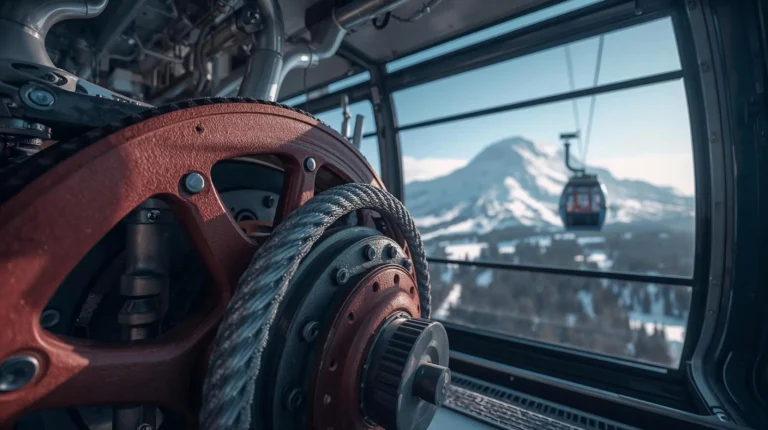
The heart of the gondola: The main engine and its power
To transport thousands of tourists every day from the city to the ski area, the lift needs colossal traction. The system, designed and built by the world leader in the industry Doppelmayr, relies on massive electric motors, which are the real “heart” of the facility. They are located in special engine rooms in the stations, where access to outsiders is strictly prohibited.
The main electric motor generates an impressive power of over 1000 kilowatts (kW). This colossal power is needed to rotate the huge drive wheel (also called the “bullwheel” or “moving wheel”). This in turn transmits the movement to the thick steel cable. Despite their enormous power, modern motors are designed to be extremely energy efficient. Intelligent computer systems vary the power delivery according to the load – if there are fewer passengers on the route or the facility is operating in summer mode, the motor consumes dramatically less electricity.
At what speed is the rope moving?
The speed of the cable car is not a constant value, but is dynamically adjusted by the operators in the control room according to the weather conditions and the load. Under normal conditions and clear weather, the steel rope moves at a speed of up to 6 meters per second. This guarantees a quick and comfortable access to the Banderishka meadow for about 25-30 minutes, depending on the specific speed on the day.
The ingenious “Grip”: How do the cabs stop at the stations?
One of the most common questions that tech-curious tourists ask is: How is it that the rope moves constantly at 6 meters per second, and the cabins slow down and stop at the stations for us to get on? The answer lies in an ingenious mechanical detail known in the cable car industry as grip or a detachable gripping mechanism.
The process is entirely mechanical and consists of several precise stages:
- Uncoupling (Decoupling): When the blue gondola approaches the starting, intermediate (Chalin Valog) or top station, a special guide rail presses the grip levers on the cabin roof. This pressure opens the jaws of the mechanism, completely releasing the steel rope.
- Slowing down with rubber wheels: Immediately after uncoupling, the cabin automatically moves onto a system of dozens of rotating rubber wheels (tirfors). These progressively reduce its speed to a minimum (below 0.5 m/s) so that passengers can enter or exit with their skis in absolute safety.
- Acceleration and hooking: After the doors close automatically, another set of wheels at the end of the station accelerates the cabin until it matches the speed of the moving main rope. Right at the exit, the grip jaws close with the force of powerful disc springs and literally “bite” the rope again, carrying you to the top.
Plan “B”: What happens during a power outage?
Passenger safety is an absolute and uncompromising priority for the management of ski area Bansko. Many people have a natural fear of heights and worry about what would happen if the central power supply in the area were to completely fail during a storm. The truth is that the facility is secured with multi-level independent protection.
The cable car is equipped with powerful, fully independent diesel generators. In the event of a power outage or a complete power outage, these units automatically switch on within minutes. They power a backup hydraulic motor that is physically independent of the main electric motor. This emergency motor rotates the system at a slower speed – sufficient to safely transport all passengers along the route to the nearest station.
Brake systems and wind sensors
To withstand the colossal weight of dozens of fully loaded cabins on the steep slopes of Pirin, the lift has duplicated hydraulic braking systems. The service brake is used for normal braking of the facility, while the emergency brake is directly connected to the drive wheel and acts instantly in extreme situations.
Along the entire route, anemometers (wind sensors) are mounted on tall poles. They provide real-time information to computers in the machine room. If wind gusts exceed safe values, the system automatically reduces the rope speed or stops operation until weather conditions improve. This is why the gondola sometimes stops temporarily during a storm – this is not a malfunction, but a flawless operation of the systems for your personal safety.
The next time you climb into the gondola, you'll know that beneath your feet is one of the most reliable, complex, and powerful engineering systems in the world, transforming the journey to the summit into more than just transportation, but a safe mountain adventure.
Looking for prices, schedules and practical advice?

 English (UK)