


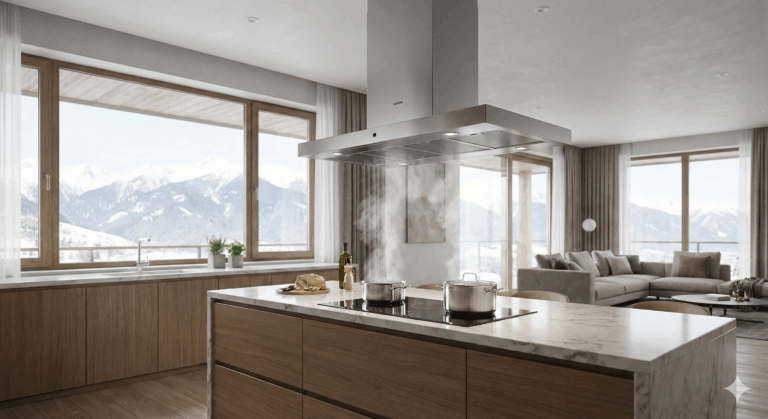
Introduction Open-plan kitchens have become the norm for modern homes.
This is a great solution for optimizing space and creating a cozy atmosphere, but it comes with one major problem: cooking odors. While frying butter, roasting peppers or preparing another aromatic dish, the smell spreads throughout the house and stubbornly lingers there. The solution? A quality kitchen hood (exhaust hood). In this guide, you will learn everything you need to choose the right appliance for your property.
Why is a range hood important? The hood is not just a cosmetic addition. It:
-
Eliminates odors and smoke, before they spread into the living area.
-
Removes water vapor, which can cause moisture and mold.
-
Captures fat particles, that would otherwise accumulate on furniture and walls.
-
Improves air quality in the kitchen and adjacent rooms.
-
Reduces the risk of fire by removing flammable vapors.
This is especially important for open-plan homes (living room with kitchenette), where there is no physical barrier between the cooking area and the relaxation area.
Types of hoods
1. Ducted hoods (Chimney type)
How they work: Smoke and odors are drawn out through a pipe that connects to the building's chimney or ventilation shaft. The air is completely removed from the dwelling.
Advantages:
-
Most effective at removing odors and moisture.
-
They do not require frequent replacement of expensive activated carbon filters.
-
Higher performance – ideal for frequent cooking and frying.
Disadvantages:
-
More complex installation – requires access to a chimney or drilling a hole in the wall.
-
Installation is impossible if the kitchen is far from a ventilation opening.
-
Efficiency decreases if the pipe route is too long or has many bends.
Recommended for: Kitchens with access to a chimney, people who cook often.
2. Ductless Hoods (Recirculating)
How they work: The air is drawn in, passes through filters (oil and activated carbon), is purified, and returned to the room.
Advantages:
-
Easy installation – no need to break or drill walls.
-
They can be installed anywhere.
-
Ideal for rental properties or when the chimney is inaccessible.
Disadvantages:
-
Less effective at removing moisture and heat.
-
They require regular replacement of activated carbon filters (every 3-4 months), which is an additional expense.
-
They are usually a little noisier.
Recommended for: Homes where there is no access to a chimney, or for people who cook less often.
Basic selection parameters
1. Power (Absorption capacity)
In Bulgaria, power is measured in cubic meters per hour (m³/h), not in CFM (American standard).
How to calculate the required power: Multiply the square footage of the room by the ceiling height to get the volume. Then multiply by 10 or 12 (the number of air purifications needed per hour).
-
Example: Kitchen 20 sq m with a height of 2.60 m = 52 cubic meters of volume.
-
Required power: 52 x 10 = 520 m³/h (minimum).
Recommendations:
-
For a small kitchenette: 300-400 m³/h.
-
For a standard kitchen: 400-600 m³/h.
-
For a large kitchen with dining area (open plan): over 700 m³/h.
2. Width of the appliance
Rule: The hood should be at least as wide as the hobs, and ideally a little wider.
-
60 cm hobs → 60 cm extractor hood (or 90 cm for better efficiency).
-
If the hood is narrower than the cooktop, the steam will escape to the side.
3. Noise level (Decibels / dB)
In Europe, noise is measured in decibels (dB), not Sones.
-
Quiet models: below 55 dB (at low level).
-
Standard: 60-65 dB.
-
Noisy: above 70 dB (like a loud vacuum cleaner).
Tip: Look for models with a noise level of around 50-60 dB during normal operation.
4. Installation height
Follow the manufacturer's instructions, but standard heights are:
-
Above electric hobs: 60-65 cm.
-
Above gas hobs: 65-75 cm.
-
Too low: Fire hazard and inconvenience when cooking.
-
Too high: Drastically reduced efficiency.
5. Materials
-
Stainless steel (Inox): Durable, classic look.
-
Glass: Elegant and modern, but requires frequent polishing.
-
Avoid: Cheap plastic models – they turn yellow and don't withstand heat.
Maintenance and cleaning
Metal filters (for grease): These filters capture grease and protect the motor.
-
Remove the filters (they usually have a click mechanism).
-
Soak them in hot soapy water or dishwashing detergent for 30 minutes.
-
Clean with a soft brush and rinse.
-
Allow to dry completely before installation.
-
Frequency: Every 1-2 months. Many of them are also dishwasher safe (on low temperature).
Activated carbon filters (recirculating models only): They they are not washable. They should be replaced with new ones every 3-4 months (depending on the intensity of cooking).
Where to buy in Bulgaria?
-
Large chains: Technopolis, Technomarket, Zora (offer all mass brands such as Bosch, Gorenje, AEG).
-
Online stores: eMAG.bg and specialized sites for built-in appliances.
-
Local shops in Bansko: Check local hardware stores or specialty furniture companies, which often offer comprehensive equipment.
Conclusion
Choosing the right extractor hood for your property in Bansko is an investment that will improve the comfort of living and save you from having to clean sticky deposits on your furniture.
Key tips:
-
If you have the opportunity, always choose ducted model (with connection to a chimney).
-
Don't compromise on power if your kitchen is connected to the living room.
-
Keep the filters clean – a clogged filter makes the unit noisy and inefficient.
With the right appliance, the air in your home will stay fresh, no matter what you're cooking!





 English (UK)