


The war with water: How to protect the seams, tongue and every fabric of our shoes?
Winter in Bansko and hiking in Pirin are unforgiving to your equipment. There is nothing more demoralizing than feeling ice water seeping into your shoes within the first hour of your hike. Many people think that if they buy expensive shoes with Gore-Tex, the problem is solved forever. The truth is that even the best membrane is helpless if the outer layer of the shoe gets wet or if water enters through the weakest points – the seams and the tongue.
This is the complete guide to “dry feet.” We’ll look at the right strategy for each material, how to seal critical areas, and what the “secret weapon” is when all else fails.
In this article you will learn:
- How to treat Smooth Skin (Waxy and Greasey).
- How to save Gore-Tex Textile (Sprays).
- Weak points: Care for seams, tongue and laces.
- “"Do it yourself": The sneaker candle trick.
- Plan B: Waterproof socks.
PART 1: Smooth Skin – The Heavy Artillery
Leather shoes are the most durable, but leather is a “living” material. If it is not nourished, it dries out, cracks and starts to drink water like a sponge. Sprays are useless here – they only work on the surface.
The Solution: Beeswax (Sno-Seal / G-Wax)
You need a thick wax or grease. The procedure is as follows:
- Cleaning: Wash your shoes thoroughly. The wax doesn't stick to dust.
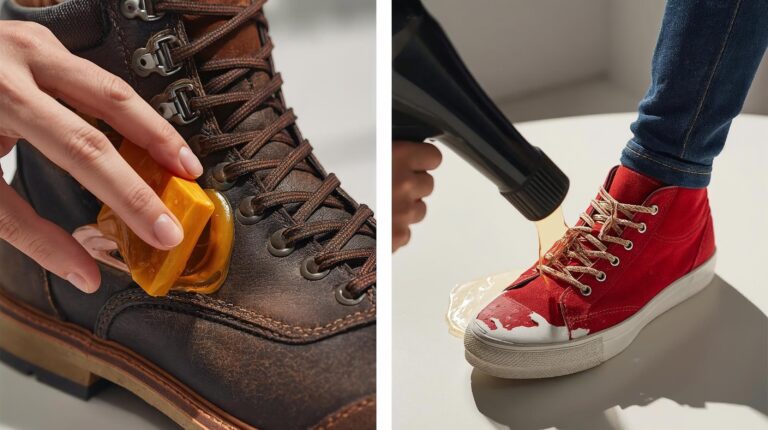
- Warming up: Heat the shoe slightly with a hair dryer (careful, don't burn it!). This opens the pores of the leather.
- Rub: Apply the wax with your fingers. The warmth of your hands helps it melt and penetrate deeply.
⚠️ Critical area: SEAMS
The stitches are literally hundreds of tiny holes that are punched into the skin by a needle. This is a highway for water. When you apply the wax, put a double or triple layer on all seams. Rub it in so that the wax literally fills the holes in the thread. This is the most important step!
PART 2: Textiles and Gore-Tex (The Technological Approach)
Modern hiking boots are made of synthetic mesh and a membrane. If you wax them, you will fill the mesh and your feet will boil in their own sweat.
The Solution: DWR Sprays (Nikwax/Grangers)
The goal here is to restore the DWR (Durable Water Repellent) coating that makes water roll off.
- Wash the shoes (by hand, with Tech Wash).
- Spray liberally with the spray while they are still damp.
- Let them dry slowly.
🧐 The Hidden Enemy: LANGUAGE AND CONNECTIONS
Often your shoes are dry, but your socks are wet on top? The reason is the tongue.
- The language: It is usually made of a softer, breathable fabric that absorbs water the fastest. Spray it on twice as much with the spray.
- The connections: Cotton laces act like a wick – they “suck” water and draw it inside the shoe. Replace them with synthetic (hydrophobic) laces or spray them liberally with waterproofing.
PART 3: “Do It Yourself” (For Canvas Sneakers Only!)
Want to wear your favorite Vans or Converse in the rain? They don't have a membrane to ruin, so you can get creative.
The candle method:
- Take a regular white candle.
- Rub the fabric aggressively until it turns white (as if you were drawing with crayon).
- Heat with a hairdryer on maximum setting.
The wax will melt and soak into the threads. The result is a fabric similar to a coated tarpaulin that repels water perfectly.
PART 4: The Last Hope – Waterproof Socks
What do you do if your shoes are old, the membrane is torn, and it's pouring rain outside? Or if you're a runner and you're wearing lightweight sneakers that let water through in seconds?
The answer is the technological miracle of recent years: Waterproof socks (like the brands DexShell or Sealskinz).
What are they?
These aren't plastic bags that will cook your foot in. These socks are three-layer sandwiches:
- 🔹 Inner layer: Merino wool or bamboo for comfort and sweat wicking.
- 🔹 Middle layer: Elastic, breathable waterproof membrane (Porelle).
- 🔹 Outer layer: Durable nylon for durability.
Why are they “Cheat Code”?
With them you can step into a deep puddle with canvas sneakers or torn boots. The shoe will get wet, it will feel heavy and you will feel cold (because the water is cold), but the skin on your feet will remain completely dry. This is the perfect option for a “Plan B” in your backpack or for urban conditions when you don’t want to wear heavy boots.
Conclusion
Dry feet are a matter of strategy, not just luck. Seal the seams of leather shoes with wax, spray the fabric with a spray, and don't forget the tongue and laces. And if all else fails, a pair of waterproof socks will save the day.





 English (UK)