


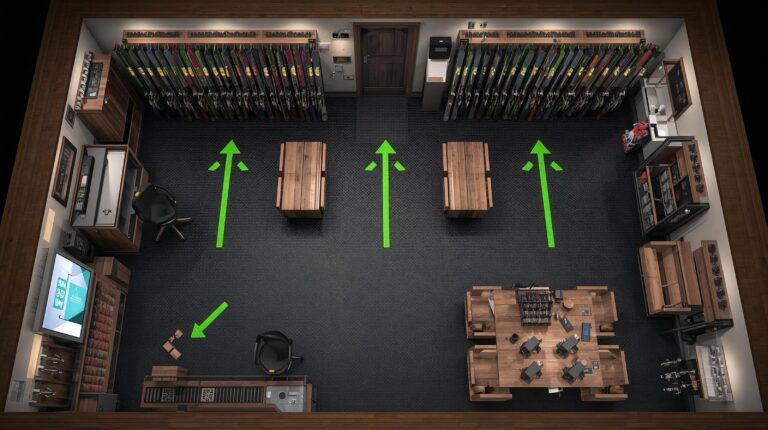
The result? High levels of stress, slow service (over 40 minutes for the group) and bad reviews on Google for “slow service”. The problem here is not the competence of the staff, nor the lack of square meters. The problem is the poor interior and flow organization (Customer Flow).
In this professional guide, we will look at how to transform your facility from a simple “ski storage” into a highly efficient “service machine” capable of handling 50 people in 30 minutes, without chaos and nerves.
1. IKEA Philosophy: One-way movement
The biggest mistake in the interior of a ski wardrobe is allowing cross-traffic. The customer never has to go back to get something they missed.
Design the customer journey as a straight line or a U-shaped curve (if the room is small). Sequence is critical:
LOGIN -> Check-in -> Boots -> Helmets/Clothing -> Ski/Board -> Binding check -> Payment -> EXIT.
If you place the ski racks before the shoe area, the customer will pick up the skis, carry them in their hands while trying on shoes, and inevitably bump into someone or block the path. Use physical barriers (low racks, benches) or color-coded floor markings to intuitively guide them through the process.
2. The “Tapata” Area: The Shoe Benches
Statistically, the customer spends the most time (10-15 minutes) trying on and lacing shoes. This is your “bottleneck.” If this area is not optimized, the entire process grinds to a halt.
How to optimize the changing area?
- Maneuvering space: Leave at least 1.5 meters of space between parallel benches. People in ski boots are clumsy, their legs are stretched forward, and they often have backpacks and jackets next to them.
- Height ergonomics: The ideal height of the benches is 45-50 cm. If they are too low, older tourists and overweight people will have difficulty getting up with the heavy plastic shoes. If they are too high, they will not be able to reach the lower rungs.
- The flooring is the key: Be sure to use thick, rubberized flooring. It's safe (it's not slippery from melted snow), soundproof (the clatter of plastic on tile is terrible), and protects the soles of your new GripWalk shoes from wear.
3. “Technical” Zone: The Sanctuary of Service
The service room and vending machine adjustment machines should be visible (to show professionalism) but physically inaccessible to customers.
4. Light and Atmosphere: Sales Psychology
Many wardrobes in Bansko, especially the older ones, resemble basements – dark, with a musty smell and cold, bluish luminescent light. This subconsciously repels the customer and reduces the perception of quality.
- Zoned lighting: Use warm light (3000K – 4000K) in the fitting area and mirrors to make people look good and their skin tone natural. In the service area, use bright, cool light (6000K) for precise technical work.
- Scent Marketing (Fragrance): Invest in an automatic professional air freshener with a scent of “pine,” “cinnamon,” or “fresh citrus.” This masks the smell of wet shoes and creates a sense of hygiene.
- Temperature: Keep the store warm (20-22°C). No one wants to take off their shoes or try on a jacket if they're cold. Warmth encourages longer stays and more purchases.
5. Shelving: Vertical vs. Horizontal
How do we fit 500 pairs of skis into 50 square meters without it looking like a scrap yard?
| Rack Type | Advantages | Disadvantages |
|---|---|---|
| Vertical (Hanging on the tops) | Saves the most space (High Density); Easily sees the design of the skate (Face out). | More difficult for short people and children to remove; Water flows towards the dispensers (risk of rust if not lubricated). |
| Horizontal (On rails/skewers) | Very easy access; Water drips directly onto the floor; Safer for vending machines. | Takes up more width; Requires long free walls. |
| Mobile (On wheels) | Flexibility – in the morning you go out in front of the advertising site, in the evening you come home. | Unstable when bumped; Requires a flat floor without thresholds. |
6. Upsell Zone
Where do socks, glasses, hats and sunscreen go in your interior of a ski locker?
The wrong place is “somewhere in the back” or in a glass case behind the salesperson’s back. The right place is at the checkout or next to the shoe benches. The psychology is simple: When a customer puts on their ski boots and feels their old cotton socks wrinkle and kill them, they will immediately buy a pair of professional ski socks for 30 leva if they are hanging within arm’s reach. This is your “golden zone” for high-margin goods.
Conclusion: Design makes money
The investment in a professional interior of a ski locker It's not a matter of vanity or aesthetics, but of pure business efficiency. Every meter of unnecessary staff movement saved and every minute of less waiting for the customer translates into higher turnover and less lost profits at the end of the day.
In the 2026 season, customers in Bansko are not just looking for ski rentals. They are looking for a stress-free experience. Give it to them through intelligent design and they will reward you with loyalty.






 English (UK)