

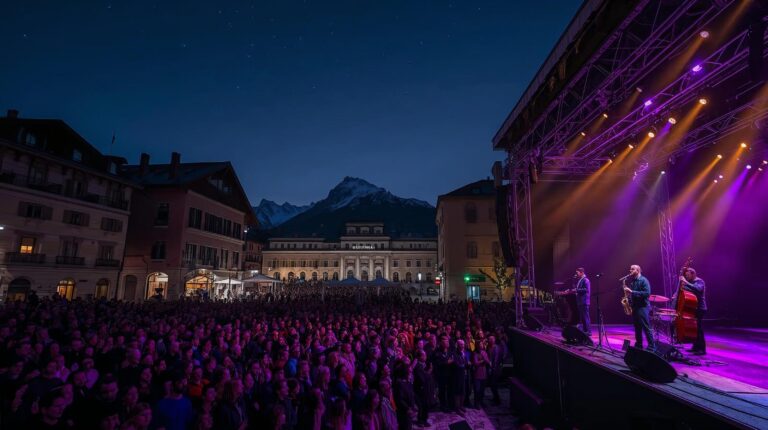
💡 Unique model: The uniqueness of Bansko jazz fest is rooted in its democratic model: concerts on the open-air stage at Nikola Vaptsarov Square are completely free for the audience – a concept that has remained intact for 28 years despite economic fluctuations.
Part I: Founding and Early Romanticism (1998–2002)
The first five years of the festival can be characterized as a period of „institutional romanticism.“ It lacked the large-scale infrastructure of modern editions, but the energy of discovery and the enthusiasm of the organizers compensated for the logistical challenges.
1998: The Beginning
The first edition was held in August 1998. The initiative started as a small-scale forum, supported by a handful of like-minded people and the local municipality, which was looking for ways to extend the tourist season.
- Concept and Participants: The program is dominated entirely by Bulgarian performers. Vili Kazasyan and his Big Band, together with Lyudmil Georgiev, are among the pioneers who legitimize the scene. This is when the tradition of the festival being opened by a big band began - a symbolic gesture of respect for the classical jazz era.
1999: Local validation
The second year was critical for the survival of the event. Despite skepticism, Dr. Iliev managed to secure funding and once again attract the elite of Bulgarian jazz.
- Program highlights: The participation of Vasil Petrov and Kamelia Todorova is starting to become a tradition. These artists become "star" of the festival, participating in almost every subsequent edition.
2000: First international breakthrough and ethno-synthesis
The year of the millennium marked a turning point with the inclusion of international stars who redefined the sound of the festival.
- Vlatko Stefanovski and Miroslav Tadic: Their participation is historic. They present a synthesis between Balkan folklore and jazz improvisation, which shows the organizers that the audience reacts extremely positively to ethno-fusion elements.
- Axel Zwingenberger: The German pianist makes his debut in Bansko, marking the beginning of the "Boogie Woogie Era." Zwingenberger becomes the most frequent guest in the festival's history.
2001: Expanding geography
The festival is beginning to attract the attention of foreign cultural institutes.
- Djabe (Hungary): The leading Hungarian jazz/world fusion band is visiting for the first time. Their participation is significant, as they win the award for best international band.
- Boris Yanev and Big Band Blagoevgrad: The role of the Blagoevgrad Big Band as the main partner of the festival is being confirmed.
2002: Balkan Bridges
The fifth edition solidifies Bansko's reputation as a crossroads of Balkan music.
- Garo Tavitjan: The Macedonian drummer and percussionist, together with his brother Diran, present a modern take on the rhythmic structures of the Balkans.
Part II: Professionalization and Euro-Atlantic Orientation (2003–2007)
This period coincides with the preparation and accession of Bulgaria to NATO and the EU, which is also reflected in the festival program through an increased presence of Western European and American performers.
2003: Eclecticism and Experiment
- Tavitjan Brothers: After Garo's success in 2002, the Tavitian brothers returned with a full lineup.
- Antonio Flinta Quartet (Italy): Italian jazz makes a strong presence with the album “Tree and Figure”.
2004: World Music Expansion
- Eftekasat (Egypt): The debut of this Cairo-based band is a culture shock in a positive sense. They mix oriental makams with jazz-rock fusion.
- Good: The Hungarians return with material from the album Sheafs Are Dancing.
2005: The Year of the Bass
- Dominique Di Piazza: The world-famous French bassist (known for his work with John McLaughlin) is visiting Bansko.
- Keiko Borjeson (Japan): The Japanese pianist living in Sweden makes one of her first memorable appearances.
2006: Technical Excellence
- Slices of Life Tour (Djabe): The Hungarian group chooses Bansko as a key stop on their international tour.
- Viktor Tóth: The multi-award winning Hungarian saxophonist represents modern European jazz.
2007: Tenth Anniversary Edition – „NATO in Bansko“
This edition is historic not only because of the anniversary, but also because of the symbolism. It takes place from August 7 to 13.
Climax: The participation of the SHAPE International Big Band – the official orchestra of NATO. This is an unprecedented event that positions the festival as part of cultural diplomacy.
Program:
- August 7: Ricciotti Ensemble (Netherlands) – 40-member student orchestra.
- August 8: Bulgarian National Radio Big Band with Dennis Gianna (Netherlands); Papa George Blues Band.
- August 9: Yehia Khalil Band (Egypt) – "The Godfather of Egyptian Jazz.".
- August 10: Jazz-x-Change (Germany) and Praful (Netherlands/India).
Part III: The Golden Age of Stars (2008–2012)
During this period, Dr. Iliev changed his strategy, focusing on more commercial names from the world of soul, funk and pop music in order to attract a mass audience for The International Jazz Festival in Bansko.
2008: The American Landing (August 8-13)
- Freddy Cole: Nat King's brother Cole brings the spirit of classic American pop.
- Joachim Menzel Trio (Poland): Representatives of the strong Polish piano school.
- Mind Trips (Bulgaria): The electronic jazz of Alexander Georgiev and Rosena Dralcheva.
2009: The Funk Explosion (August 8-13)
- Candy Dulfer: The Dutch saxophonist is the festival's first true pop-jazz superstar. Her concert sets a record for attendance.
- Jamie Davis: The baritone of the Count Basie Orchestra.
- Axel Zwingenberger: Return of the boogie-woogie tradition.
2010: Solomon Burke's Swan Song (August 8-13)
Historic moment: The participation of Solomon Burke, the king of rock and soul. He sings sitting on his throne, and his concert in Bansko is one of his last major performances before his death.
- Lila Amons (USA): Albert Ammons' granddaughter continues the boogie-woogie piano line.
- Incognito: The British acid jazz legends are making their first attempt to conquer Bansko.
2011: Pop Icons and Jazz Standards (August 6-13)
- Lili Ivanova: The prima donna of the Bulgarian pop scene opens the festival with a special jazz repertoire.
- Jackie Ryan (USA): One of the best contemporary jazz vocalists according to critics.
- Innovation: The "Midnight Jazz" program in hotels is officialized.
2012: Rock-Blues Turn (August 3-11)
- Mungo Jerry Blues Band: Ray Dorsett shows that he is a serious blues musician.
- Kekko Fornarelli Trio (Italy): Modern, cinematic jazz.
- IKS Big Band (Germany): Continuing the tradition of participation of German big bands.
Part IV: The Blockbuster Era (2013–2019)
The festival reaches its peak in terms of attendance and budget. The municipality and sponsors invest significant funds.
2013: Kings of Swing (August 8-13)
- Ray Gelato & The Giants: The energy of Italian-American jive.
- Hubert Tubbs: The former vocalist of Tower of Power.
- Sharrie Williams: “The Princess of Rock-Blues” with gospel power.
2014: Female Vocal Power (August 8-13)
- 8 Aug: Kamelia Todorova & Brass Association.
- 9 Aug: China Moses (USA): Dee Dee Bridgewater's daughter.
- 11 Aug: Iyeoka (USA): The Nigerian-American poet with the hit "Simply Falling".
- 12 Aug: Tania Maria (Brazil).
- Aug 13: Candy Dulfer (second guest appearance).
2015: Acid Jazz and a Return to the Roots
The highlight of the program are Incognito (United Kingdom), led by Jean-Paul “Bluey” Maunick. The Shelley Berg Trio presents academic jazz, and Mungo Jerry return with an even stronger blues accent.
2016: The Peak of Popularity – Joss Stone
- Joss Stone (United Kingdom): Her performance on August 13th was probably the most attended concert in the festival's history. She went barefoot on stage and sang among the audience.
- Shakatak (Great Britain): The legends of jazz-funk.
- Lara & The Jukes: Fado-jazz project by Silvia Mitev.
2017: 20th Anniversary Edition (August 5-12)
Headliners include Patti Austin (USA), Mario Biondi (Italy) with his deep baritone, the Vlatko Stefanovski Trio and the ever-present Axel Zwingenberger.
2018: Fusion and Flamenco
- The Gipsy Kings by Paco Baliardo: Authentic “rumba catalana”.
- Omar Hakim & Rachel Z “OZ Experience”: Omar Hakim raises the technical level to the stratosphere.
- Matt Bianco: Elegant pop-jazz.
2019: Funk Master
The year of Maceo Parker (USA) – James Brown's saxophonist. His concert is “98% funk and 2% jazz.” Malina Moye shows off Hendrix-style rock-funk showmanship.
Part V: Pandemic, Tragedy, and Transition (2020–2021)
2020: The Festival That Didn't Stop
In the year of COVID-19, Bansko held its edition with a focus on the Bulgarian scene – Hristo Yotsov, Dirty Purchase, Kamelia Todorova. In November 2020, Dr. Emil Iliev lost the battle with the virus, marking the end of an era.
2021: The Year of Uncertainty
The Municipality of Bansko takes the initiative. Akaga, Angel Zaberski Trio, Vasil Hadzhimanov Band (Serbia) and Hilda Kazasyan participate.
Part VI: The Great Split (2022–2025)
After the death of Dr. Iliev, a rift occurred. His heirs moved the brand to Borovets, and the Bansko Municipality organized its own International Jazz Festival in Bansko in the same place.
| Year | Bansko Jazz Festival (Bansko) | Dr. Emil Iliev Jazz Festival (Borovets) |
|---|---|---|
| 2022 | Dates: August 6-13 Headliners: Billy Cobham, Salvador Sobral, Arifa. Style: Modern jazz, fusion. |
Dates: August 5-9 Headliners: Julian Marley, Vlatko Stefanovski. Style: Reggae, ethno, nostalgia. |
| 2023 | Dates: August 5-12 Headliners: Frank Gambale, Zara McFarlane. New: Expanded “Youth Scene”. |
Dates: August 4-9 Headliners: Matt Bianco, Mikhail Yosifov. Emphasis: Cinema panorama. |
Analysis of Bansko Jazz Festival (on the square)
Under the leadership of the Bulgarian Music Scene Association, the festival in Bansko is taking on a more contemporary look.
- 2024 (August 3-10): Headliners are Theo Croker (USA), The Storytellers and Vertigong.
- 2025 (August 1-10): A record-breaking 10-day edition is planned. Announced are New York Voices, Nils Landgren Funk Unit, John Beasley Trio and Jerry Bergonzi.
Analysis of Dr. Emil Iliev Jazz Festival (Borovets)
The Borovets festival relies more on nostalgia and a classic vision, with the program including regular participants from the past, trying to bring the "spirit of Bansko" to Rila.
Part VII: The Festival Ecosystem
Bansko Jazz Fest is a complex organism with several vital organs:
- Jazz Academy: An educational platform for young musicians with lessons from masters like Hristo Yotsov.
- "Young Talents" Stage: Daytime stage in the city park (11:00-13:00), an incubator for future stars.
- Jazz in the City & Midnight Jazz: Music on the streets during the day and legendary jam sessions in the clubs after midnight.
Conclusion
The history of The International Jazz Festival in Bansko is a story of audacity, resilience and cultural evolution. From its humble beginnings in 1998, through the golden era of Candy Dulfer, to its dramatic split after 2021, the festival has proven itself to be a viable organism. By 2025, Bansko is establishing itself as a modern European jazz destination, offering free access to world-class art under the stars of Pirin.
 English (UK)