

When Jordan's Day passes, Bansko doesn't quiet down. On the contrary - it's time for St. John's Day, the celebration of "Women's Waters", twinning and the purifying power of water.
In the heart of Pirin, this day is associated with three main pillars: the ritual "bathing", the deep respect for the godfather, and, of course, the heavy Macedonian tables, at which wine is poured just as generously as water.
⚠️ Interesting for city guests
Be careful if your name is Ivan, Ivanka, Ivaylo or Yoan! In Bansko, tradition dictates that every name day should be „poured“ for health. If local friends jokingly threaten you that they will throw you in the snow or spray you with water – accept it with a smile, it is for health and longevity!
The "Kypanki" Ritual: Health through Water
The most characteristic custom for the Razlog and Bansko region on this day is the so-called "bathing". In the past, this ritual was performed literally - the newlyweds, who got married during the past winter (after the previous Midsummer's Day), were immersed in the river or the watercourse by their best men or brothers-in-law. It was believed that in this way the new family was cleansed of evil and prepared for the new life.
Today, although in a more symbolic form, the tradition is alive. Young families are sprinkled abundantly with holy water. It is a moment of laughter, joy and blessing. In some neighborhoods of Bansko you can still see groups of men who go around the homes of the Ivanovtsi and „bath“ (sprinkle) them for health, and the hosts treat them with wine and appetizers.
Godfatherhood is sacred: Visiting with gifts
If Jordan's Day is a celebration of the community in the square, then St. John's Day in Bansko is a celebration of family hierarchy and respect. The main focus of the day is the visit to the godparents. In the Bansko tradition, the godparent is a figure of respect, equal (and sometimes higher) to that of the parents.
The newlyweds are required to visit the home of their best man. But they don't go empty-handed. Here's what the traditional "proshka" or gift for the best man includes:
| Gift | Symbolism |
|---|---|
| Ceremonial bread (Kravai) | A symbol of fertility and family comfort. It is often decorated with dough shapes. |
| Red wine | „"The blood of the earth" - for health and joy. In Bansko, homemade wine is almost a must. |
| Meat (Lukanka/Starets) | A sign of well-being. Often a "Banski Starets" or roasted meat is carried. |
At the godfather's table, people sit respectfully. They discuss the past year, the future of the young family, and make vows for children and blessings.
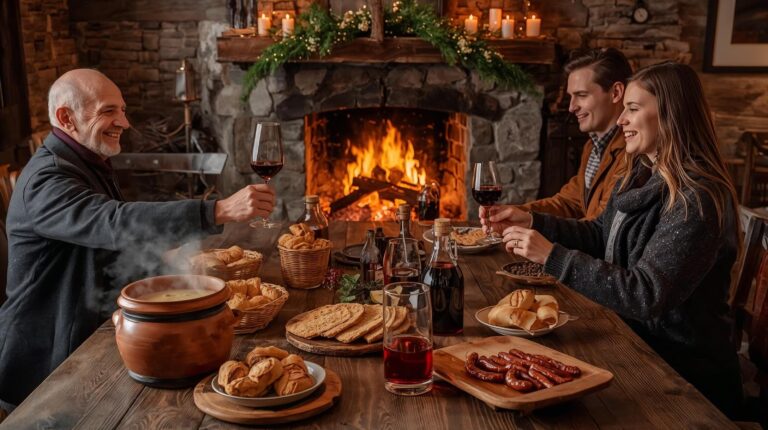
The Bansko table on St. John's Day
There is no holiday in this region without a proper meal. St. John's Day coincides with the period when winter is in abundance, and the wine in the barrels has become the best. Since the name Ivan is extremely popular (almost every house in Bansko has a name plate), the town smells of feasts.
Her Majesty takes center stage The Banska Kapama. This is not just a dish, but a ritual. It is prepared for hours in a clay pot, sealed with dough. Inside are placed sauerkraut, rice, chekane (beetroot), and several types of meat – pork, beef, chicken, blood sausage. The aroma of the kapamat, mixed with that of the fireplace, is the aroma of a real Midsummer's Eve in Bansko.
Twinning and Women's Guides
Old people call the days around Midsummer's Day "twinned days". This is the weather, when in the past men became „brothers“ and women became „sisters“. By swearing allegiance to God and their friends, they created bonds stronger than blood. Although this ritual is rare today, the spirit of friendship and strong social ties in Bansko remains visible. The taverns are full, the doors of the houses are open, and the greeting „Chestito ime!“ is heard at every step.
“In Bansko they say: 'Ivan is not a name, Ivan is a title'. This is the day when every second person is a hero of the holiday, and the hospitality of the mountain people reaches its peak.‘

 English (UK)