


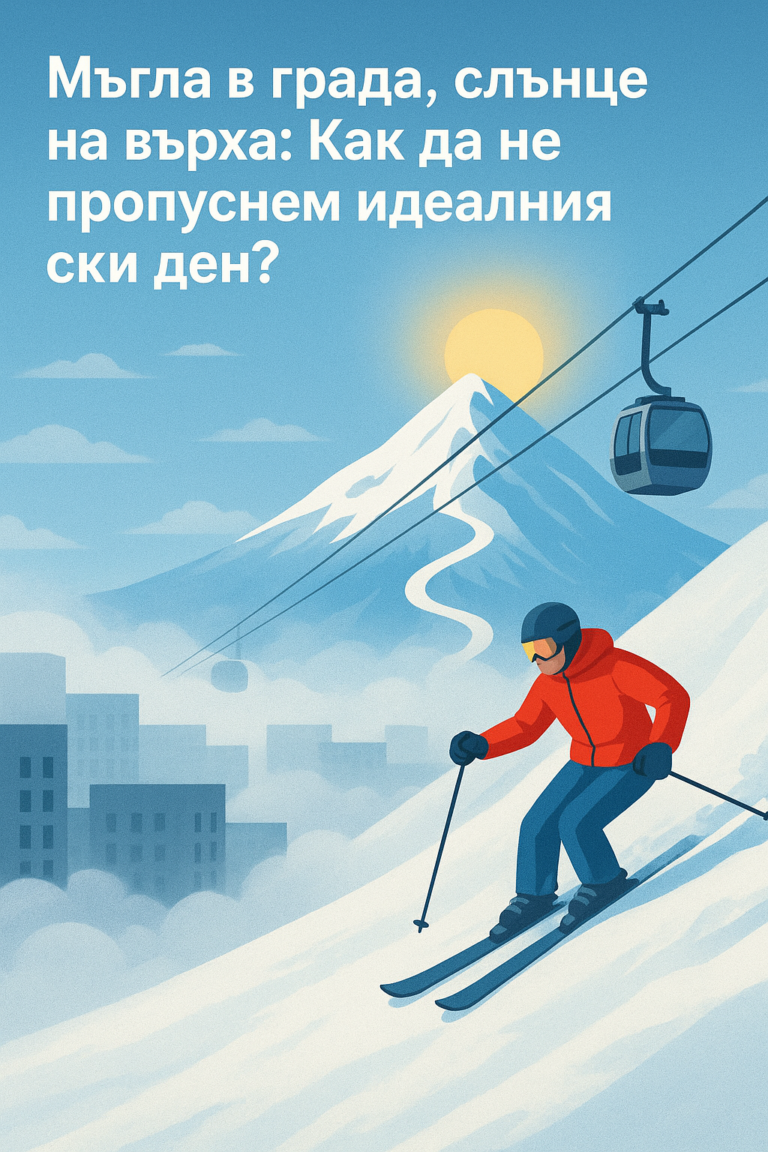
Temperature inversion: The phenomenon that fools tourists
Under normal atmospheric conditions, air temperature drops with increasing altitude (usually by about 0.6°C for every 100 meters). However, during a temperature inversion, the opposite happens. The cold, dense, and heavy air remains "trapped" low in the Razlog Basin, where the city is located.
This cold layer is pressed down from above by a warmer air mass. The moisture in the lowlands condenses and forms a dense cloud cover that resembles a lid. At the same time, the peaks and high parts of the ski area remain in the warm and dry layer of air. The result? It's winter and fog down below, and at 2000 meters it's "spring" and sunny.
Why is this happening in Bansko?
Bansko’s geographical location at the foot of the Pirin Mountains makes it an ideal „incubator“ for inversions. The town is situated in a valley surrounded by three mountains – Pirin, Rila and the Rhodopes. During the quiet anticyclonic winter nights, the ground cools down quickly, cooling the surface air and it flows to the lowest point, creating the perfect inversion environment.
When can we expect “Sea of Clouds”?
To perfectly plan your adventure and enjoy the phenomenal "sea of clouds", you need to know the cyclicity of weather in Bansko.
- Peak months: December and January are the months with the most stable and frequent temperature inversions.
- The golden hour: The phenomenon is most pronounced in the early morning hours (between 8:30 and 11:00 a.m.).
- Dynamics: Around noon, solar radiation often manages to "break through" the fog even in the city, but if the inversion is strong, it can linger for days.
For photographers, this is a dream come true. When you climb Banderishka Polyana or Todorka Peak, you see an endless white desert below you, from which only the highest Alpine peaks protrude. These are the so-called. Bluebird days – days with crystal clear visibility, which are the essence of skiing in Bansko.
The golden rule: Check the cameras, not the window!
If you want to be sure about the conditions, there is only one reliable source – live webcams. Before deciding whether to take the lift, check these key points:
| Location | Altitude | What does it show? |
|---|---|---|
| Banderishka meadow | 1620 m | The central zone. This is often the border of fog. |
| The Shiligarnika | 1730 m | It gives an idea of the conditions in the middle part of the mountain. |
| Todorka Peak | 2550 m | The highest point. Here the sun is almost guaranteed during an inversion. |
The Danger: What is Whiteout?
The inversion is beautiful when you ski above it. But sometimes the cloud layer rises and gets stuck right at the level of the main slopes (between 1600 and 2200 m). This creates the phenomenon Whiteout or "milky mist.".
In these conditions, the sky and the terrain merge into one. You lose track of speed, slope, and direction. This is when a day of skiing can become dangerous.
Expert tips for driving in fog:
- Follow the tags: The stakes on the side of the track are your only guide.
- Don't stop in the middle: If you need to rest, go as far as possible to the end of the slope. In the fog, other skiers will see you at the last moment.
- Use a suitable mask: Orange or yellow plates (S1 category) improve contrast in poor lighting conditions.
- Drive near the forest: Trees provide visual relief and depth of vision that are lacking on open plains.
Equipment according to the weather in Bansko
When there is a big difference between the temperatures in the city and in the mountains, dressing is a challenge. During an inversion, it is often -5°C down there, and +5°C up there in the sun.
Layering is a must:
- Base layer: Thermal underwear made of merino wool that wicks away moisture.
- Middle layer: Fleece for insulation.
- Outer layer: A membrane (jacket and pants) that protects against wind and moisture, but "breathes".
If you plan to spend the whole day up there, bring a backpack. You may need to take off your mid-layer while waiting in line in the sun and put it back on when you descend into the city in the cold fog.
Conclusion: Don't trust your eyes, trust the statistics
The weather in Bansko is capricious, but predictable for those who know what to look for. The temperature inversion is a gift for skiers who are not afraid of the morning darkness in the city. Remember: if it is foggy and quiet in Bansko, the chances of it being "heaven" up there are over 80%.



 English (UK)