


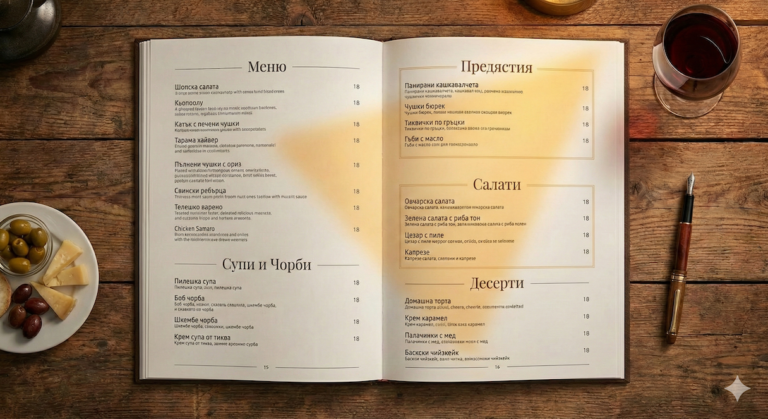
Many restaurant owners in Bansko and the region make the same fundamental mistake: they treat their menu like a simple price list or, even worse, like an Excel spreadsheet with pictures. The truth is, the menu is your most powerful advertising brochure. It is the only thing that 100% of your guests will read carefully.
This is where the science called Engineering menu. It's a strategic combination of psychology, graphic design, and mathematics, with a simple goal: to get the customer to order what brings the restaurant the most profit, while remaining extremely satisfied with their choice.
If you've been arranging your meals in a tavern or restaurant simply by following the logic of "Salads -> Starters -> Mains," you're losing money every day. Here are 4 professional tricks to turn a sheet of paper into a sales machine.
1. The “Golden Triangle”: Where does the eye look first?
Studies using modern eye-tracking techniques have shown that people read menus in a predictable pattern. They don't necessarily start from the top down, like we read a book.
The gaze usually follows the so-called. “Golden Triangle”:
- The Center (Start): The eyes instinctively fall first to the center of the right page (for a two-page menu) or to the upper third (for a single-page menu).
- Top right (Profit Zone): Then the eye moves to the top right corner. This is your most valuable advertising space.
- Top left (Anchor): Finally, attention shifts to the upper left corner.
💡 How to use it in Bansko?
Don’t put the cheapest dishes (like fries or soups) in the “Golden Triangle”! These are the places for your “Stars” – the dishes with a high margin and a presentable appearance. Put the “Banska Kapama” or the “Chef’s Speciality” (the one with the high markup) right in the top right corner, not stuck at the bottom of the list.
2. Price Psychology: Remove the dots!
One of the oldest and most harmful practices in Bulgarian menus is the use of the so-called "price path":
Shopska salad …………………………………. 12.00 lv.
This row of dots (or dashes) acts as a highway for the eye. It leads the customer’s eye directly to the price in the right column. The result? The customer scans only the prices, chooses “according to their pocket” rather than “according to their stomach,” and often orders the cheaper one.
The rules of the modern engineering menu:
- Without points: “Stick” the price immediately after the end of the dish description. (e.g. “Shopska salad – peeled tomatoes, roasted peppers, cow's cheese 12”).
- Hide currency: The lev sign (“lv.” or “BGN”) is a psychological trigger that subconsciously reminds you of “spending money” and pain. Make it smaller or remove it from the numbers entirely, mentioning it only once at the bottom of the page or in the column header.
- No alignment: Never align prices in a straight column on the right. This makes it easier to compare (“Oh, this is $15, and this is $20, so I’ll take the cheaper one”). When prices are scattered after descriptions, the customer is forced to read about the food.
3. The Anchoring Effect
Why do some elite restaurants have seafood platters on their menus for 300 leva or rare wine for 800 leva that almost no one orders? They are not there to be sold en masse. They are there to be Anchor.
Psychology works like this: When the customer sees “Mature Ribeye Steak” for 120 BGN at the top of the page, suddenly the “Pork Knuckle” for 45 BGN seems like an extremely reasonable and profitable deal.
“If your most expensive dish is 20 leva, then 15 leva seems expensive. But if you have a “Premium Specialty” for 50 leva, then 20 leva is downright cheap.”
4. Descriptions: Taste begins with reading
В Bansko The competition is fierce – every tavern smells like grilling. Your advantage can be in your words. Dry descriptions kill your appetite. Compare these two options for the same dish:
| ❌ Boring description | ✅ Selling description |
|---|---|
| Pork with potatoes Pork, potatoes, spices. |
Grandma's stew in a casserole Tender pork leg, slowly stewed with mountain herbs and fresh potatoes, baked until golden with yellow cheese. |
According to the studies of Cornell University, rich, sensory descriptions can increase sales by up to 27%. Use words that provoke salivation: “crispy”, “juicy”, “homemade”, “traditional”, “smoky”, “hand-made”.
Bonus Tip: Less is more
Don't overload the customer. The huge 20-page menus (like a "phone book") that we often see in resorts actually confuse guests. Psychologists call this “"Paradox of Choice"”.
When there are too many options, the customer gets stressed and subconsciously orders the most banal and familiar thing (chicken steak or shopska salad) because they are afraid of making a mistake with their choice. And these are usually the dishes with a lower margin for you.
The optimal option: Aim for 5 to 7 dishes per category (e.g. 7 salads, 7 entrees). If you have more, break them down into subcategories to make it easier on the customer’s brain.
Is it time for a menu overhaul?
Good menu engineering doesn't require changing the chef, just the approach to the piece of paper. Start today!



 English (UK)