


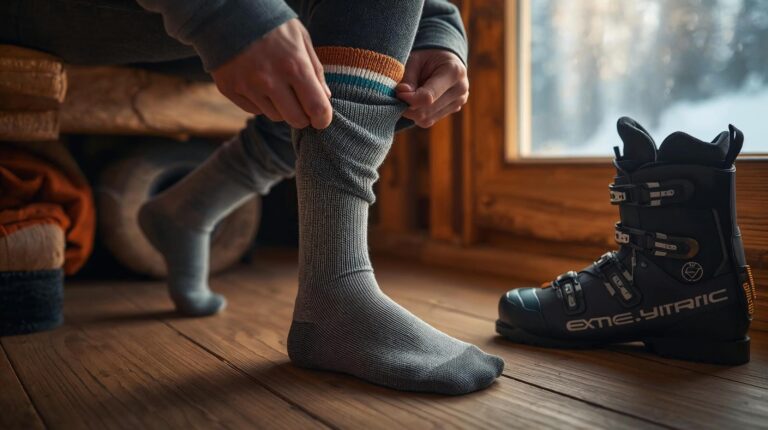
You can invest thousands of leva in the most modern ski boots and have them customized by the best experts in Bansko. But if the wrong pair stands between your foot and the boot ski socks, all that investment goes down the drain. Cold toes, blisters on the heels, and shin pain are most often due to one completely underestimated piece of equipment.
In the world of winter sports, a sock is not just a piece of fabric that keeps you warm. It is a high-tech interface that connects your body to the plastic shell of your boot. In this expert guide, we will bust the oldest myths and show you how the right choice of ski socks will save your holiday on the slopes of Pirin.
The most common and fatal mistake among novice hikers is wearing two pairs of socks with the idea of “keeping me warmer”. This has the exact opposite effect! The two pairs create friction between each other (which guarantees huge blisters) and take up too much volume. This excess volume compresses the blood vessels in your foot. When blood circulation stops, your feet freeze in a matter of minutes, even if it is a sunny spring day outside. Always wear only one pair of specialized ski socks!
1. Why is cotton absolutely banned?
If you have a habit of skiing in your regular everyday white cotton socks or terry sports models, you are dooming yourself to the cold.
Cotton is a hydrophilic material – it absorbs and retains sweat like a sponge (up to 27 times its own weight). When you ski actively on the steep sections of the Tomba slope, your feet sweat. The cotton sock holds this moisture close to your skin. The moment you sit on the open lift and stop moving, this moisture cools instantly. The result? Ice blocks instead of feet.
2. Merino Wool: The King of Materials
When making your choice, look for merino wool ski socks. This is the gold standard in mountaineering gear in recent years. Unlike traditional “grandma’s” wool, merino is extremely fine, does not itch and has magical properties:
- Brilliant thermoregulation: Merino traps body heat in air pockets between its fibers, keeping you warm in the bitter January cold of the Plateau, but not steaming you in sunny March.
- Warm even when wet: Unlike synthetics and cotton, merino wool generates heat through a chemical reaction while absorbing moisture. Even if you sweat profusely, your feet stay warm.
- Antibacterial effect: You can ski in a good pair of merino ski socks for 2-3 days in a row (if you air them out in the evening) without them smelling bad. This is invaluable for a week-long holiday in Bansko.
Note: The best ski socks on the market are usually a hybrid – containing around 40-60% merino wool for warmth and comfort, and 40-60% synthetics (nylon/elastane/lycra) for strength, elasticity and quick drying.
3. Anatomy of the perfect ski socks
A true ski sock is constructed using 3D knitting and looks more like an orthopedic device than a regular sock. Here are the must-have elements to look for:
Knee-length (Over-the-Calf)
Ski socks should always reach just below the knee. Why? The top edge of the sock must end over the top edge of the plastic ski boot. If the sock is shorter and its edge falls inside the boot, it will dig into your shin or calf under the immense pressure of the stirrups, causing severe pain.
Reinforced areas (Heel, toes and shin)
- Shin padding: The front of quality ski socks has an additional, slightly thicker layer. It acts as a cushion against the so-called “shin bang” – the painful impact of the shin on the hard tongue of the ski boot during aggressive skiing.
- Reinforced heel and toe: These are the areas with the most friction. The reinforced knit there prevents blisters and extends the life of the sock.
Elastic support (Arch & Ankle Support)
Good ski socks have tight elastic zones around the arch of the foot and above the ankle. This isn’t just for looks – these zones keep the sock in place on your foot. If the sock slips or bunches up inside your stiff ski boot, the folds will cause sores on your first descent.
4. Thickness: Thin or thick socks?
In the past, ski boots were huge and cold, so people wore thick, knitted socks. Today, things are completely different.
Modern ski boots have extremely warm and thick inner socks (liners) that adapt to the shape of your foot. Therefore, today's standard are thin to medium-thick ski socks. The thin sock does not disrupt blood circulation, allows the shoe to “hug” your foot precisely and ensures direct energy transfer from the muscles to the skis.
Premium brands (like X-Bionic, Falke, Smartwool, Icebreaker) always produce their socks with an anatomical shape – they have a specific left (L) and right (R) sock. This ensures that the reinforced areas fit perfectly to the asymmetry of your foot. Be careful how you put them on in the morning!
Conclusion
Your feet bear all the strain, vibration and cold while riding. Don't compromise with them! One or two pairs of high-quality merino wool ski socks (priced between 40 and 80 leva) are the cheapest upgrade you can make to your ski gear. Put on just one pair, stretch it well so there are no wrinkles, and enjoy the warmth and precise control on the white slopes of Bansko!




 English (UK)