


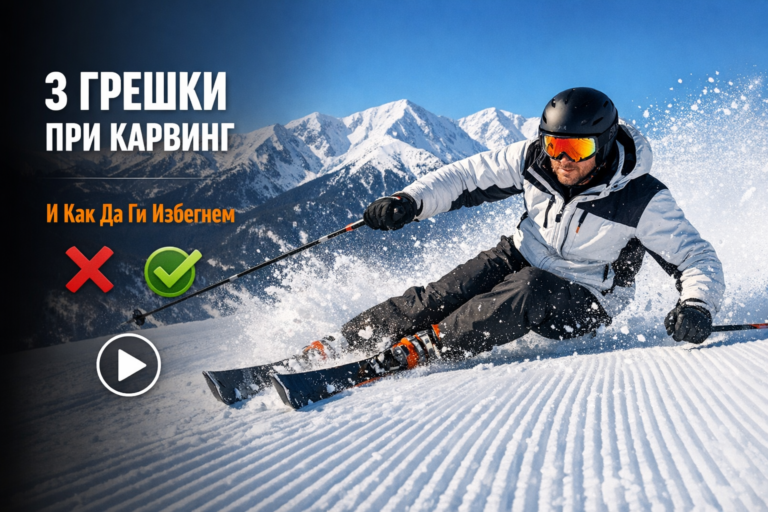
In this detailed guide, we will look at the iconic video tutorial of Stomp It Tutorials, which focuses precisely on the biggest obstacles for beginners and intermediate skiers. The video analyzes in detail the 3 most common mistakes when carving skis and offers practical exercises to correct them. Watch the lesson below carefully, and then we'll do a deep dissection of each mistake to understand the biomechanics behind it and how to correct it in practice.
Info: How to watch the video tutorial with Bulgarian subtitles
If you want to follow every explanation for clearing these carving ski errors in Bulgarian, you can easily enable automatic translation on YouTube:
- Turn on subtitles: Click on the small “CC” icon in the bottom right corner of the player.
- Open settings: Select the gear icon (Settings) next to it.
- Specify translation: Click on “Subtitles/CC” and select “Auto-translate”.
- Choose language: Find and highlight “Bulgarian” from the drop-down list.
Analysis of the three critical mistakes when carving skis
To clean up your technique, you first need to understand where you're going wrong. Here's a detailed look at the three main problems mentioned in the video and how they affect your riding.
Mistake 1: Rotating upper body
This is probably the most instinctive and therefore the most common mistake made by any novice carving skier. When you want to turn left, your brain tells you to rotate your entire shoulders, chest, and pelvis to the left. The result? Your skis lose their edge, their tails “break” off the snow, and you go into a side-slip (skidding) motion. The rotation prevents the skis from riding on their edges.
How to fix it: Your upper body (from the hips up) should be relatively relaxed and always slightly facing the valley (downhill), no matter which way your skis are pointing. Imagine your chest as the headlights of a car that should always be illuminating the way down the slope. A great exercise for the slopes in Bansko (for example, on the wide “Shiligarnik 1”) is to hold your poles horizontally in front of you with both hands, trying to always keep them parallel to the horizon and pointing down the slope during the turn.
Mistake 2: Tipping into the turn
When you watch World Cup competitors on TV, they look like they're lying on the snow. In an attempt to imitate this, many skiers simply lean their entire body (like a board) inward toward the center of the turn. This mistake results in a disastrous weight transfer to the inside ski. The outside ski (the one that should actually be carrying 80-90% of your weight and carving the turn) becomes light, loses traction, and slips out from under you.
How to fix it: The key word here is angulation (angulation). Instead of falling inward with your whole body, you should create an “C” shape with your body. Your legs and hips go inward into the turn (to angle the skis), but your upper body (torso and shoulders) “bend” at the waist and lean slightly outward, over the outside ski. This ensures that your weight remains concentrated on the outside edge, giving you the necessary traction even on icy sections (like the slopes of “Balkaniada”).
Warning: Inner Hand Syndrome
One of the clearest signs that you are leaning inward incorrectly (Mistake 2) is your inside hand dropping. If you feel your center hand falling down into the snow while your outside hand is rising high in the air, you have definitely lost pressure on your outside ski. Aim to keep both hands at the same height in front of you.
Mistake 3: Leading with the inside ski
Watch the tips of your skis as you turn. If the inside ski sticks out significantly further than the outside ski, you are making the third classic mistake. This often happens as a side effect of pelvic rotation. When the inside ski goes too far forward, you fall into what is known as a “scissors” stance. Your balance shifts back (on your heels), which kills any chance of good carving control over the front of your skis.
How to fix it: Your skis should always move parallel. To compensate for the anatomical tendency for the inside foot to come forward, you should consciously pull your inside ski (and therefore your hip) slightly back during the turn. Focus on feeling pressure on the tongue of your inside foot, pulling your foot back under your center of gravity.
Modern solutions and training in Bansko
Correcting these carving ski mistakes doesn't happen overnight. It takes deliberate practice and focusing on one detail every run. To speed up the process, you can take advantage of the following modern approaches:
- Digital sensors (like Carv): As mentioned in the video, the “Digital Ski Coach” devices that fit into your boots are an invaluable aid. They measure exactly how much weight you’re putting on your outer ski and whether you’re over-rotating, giving you a direct audio feed into your headphones as you descend from Todorka Peak.
- Ski Camps for Adults (Ski Camps): Formats like Stomp It Camps are designed specifically for intensive technique refinement. Similar groups for advanced skiers are also organized in Bansko, where certified instructors use video analysis to show you clearly whether you are falling inwards or taking the inside ski out.
- Proper equipment: Make sure your boots aren't too big. If your heel is riding up inside the boot, you physically can't apply proper pressure to the skis, no matter how hard you try to follow the theory.
Final tips for the slopes
Start the process of clearing errors on easy, well-groomed terrain. The tracks "“The plateau” or “Shiligarnik 2” in Bansko are the perfect carving laboratory – they have an even, moderate slope that allows you to think about your body, not fight survival on the steep. Focus first on a calm upper body, then on the pressure of the outer skin, and finally on the parallel legs. With perseverance and the right approach, you will soon be drawing those perfect, uncompromising arcs on the white slopes of Pirin.

 English (UK)