


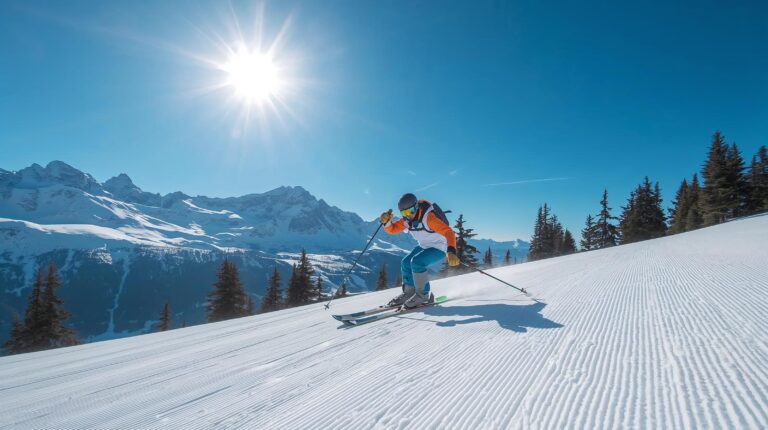
Skiing is one of the most exciting winter experiences, attracting thousands of tourists to Pirin every year. However, beginners often fall into technical and psychological traps that can turn their first contact with the mountains into a painful and disappointing memory.
Whether you are taking your first turns on the iconic "Shiligarnika" in Bansko, or you learn the "Ski Path", the knowledge of the basic skiing mistakes will protect you from injuries and accelerate your progress. In this detailed guide, we will look at the 20 most common problems and their solutions so you can truly enjoy the slopes in the 2026 season.
Why is technique more important than courage?
Skiing is a sport governed by physics. Trying to compensate for a lack of technique with strength or speed usually results in a loss of control. Learning the basics correctly is an investment that pays off in enjoyment and safety.
I. Fundamental errors in posture and balance
1. Leaning back ("Sitting" on the slope)
This is the classic mistake #1 of every beginner. The instinct for self-preservation causes the body to pull back from the slope, shifting the weight onto the heels. The result? The front of the skis lose contact with the snow, become uncontrollable and „shoot“ the skier forward, putting a severe strain on the hips.
The solution: Keep your weight on the balls of your feet. You should feel a steady, firm pressure with your shins on the „tongue“ of your ski boots. If your calves hurt, you’re standing correctly.
2. Skis spread too wide
Some beginners spread their skis too far apart in search of stability (similar to standing on a ship). However, this blocks free movement of the pelvis and makes it almost impossible to transfer weight from foot to foot.
The solution: Aim for your skis to be at hip width – this is the natural and most functional anatomical position.
3. The „stuck“ skis
The opposite extreme – skis too close together – is a legacy of the old school (the years of straight skis). Today, with carving skis, this makes balance very difficult, especially on bumps and baboons, such as often form in the afternoon on the "Plateau".
The solution: Practice proper stance on a very slight incline, leaving the poles aside and focusing only on the independence of both legs.
4. Stiff upper body
If the torso is „frozen“ with tension, entering a turn becomes difficult and unnatural. The stiffness is transmitted down to the legs.
The solution: Relax your shoulders. Breathe rhythmically. The body should be dynamic and smoothly follow the rhythm of the skis, not fight them.
5. Straight legs
Lack of flexibility in the knees is a guarantee of losing balance at the first bump. A straight leg is a „locked“ leg.
The solution: Maintain the so-called "sports stance" - slightly bent knees, ankles, and pelvis, acting as shock absorbers, ready to absorb the unevenness of the terrain.
6. Incorrect pelvic position
If your pelvis sticks out backwards (the so-called "duck butt"), your center of gravity goes out of control and the pressure on the edges disappears.
The solution: Position your pelvis centrally over your feet. Imagine that you want to push your skis down into the snow with all your weight vertically.
II. Errors in movement and turns
7. Chaotic hand movements
Many new recruits flap their arms vigorously like helicopter blades, trying to maintain balance. This has the exact opposite effect – destabilizing the torso and rotating the shoulders in the wrong direction.
The solution: Your arms should be relaxed, slightly extended forward and to the side (in your peripheral vision), approximately at waist level. Imagine you are holding a tray of drinks.
8. Incorrect weight distribution in a turn
This is a fundamental law in the physics of skiing: control comes from the outside of the turn. Beginners often press the inside (because they lean towards the slope) or stand on two feet evenly.
The solution: When making a left turn, push hard with your right (outside) foot and vice versa. That's where your control and traction are.
9. „Dead“ ankles
Ski boots are stiff, but that doesn't mean your ankles don't have to work. Lack of ankle pressure leads to a passive position and slow ski response.
The solution: Actively push your shin forward toward the tongue of the shoe to activate the tip of the skate and initiate the turn.
10. Dependence on the "plow"„
Stopping and riding in a „plow“ (V-shape) is just the first step. Staying at this level puts strain on the knees and is extremely inefficient on steeper sections.
The solution: Work on parallel turns from the early stages. Control speed through the shape of the turn (closing the turn into the slope), not through ski friction.
11. Looking at the feet
Your gaze guides your body. If you look at the tips of your skis, you are blocking your neck and are likely to fall or bump into someone.
The solution: Look ahead and plan your trajectory 2-3 turns in advance. Your gaze should be directed where you want to go.
12. Tilting towards the slope
Human instinct makes you lean towards the "safe" (towards the mountain), but this takes away the grip of the outer skin that is actually holding you.
The solution: The upper body should be slightly tilted down towards the valley ("anticipation"). This ensures maximum pressure on the edges.
III. Safety, equipment and environment in Bansko
Important for the slopes in Bansko
Bansko is a resort with specific terrain. The green "Ski Path" is long and gentle, but often busy. The blue slopes (The Shiligarnika, The plateau) are wide but require control.
13. Overestimating opportunities
Bansko offers great slopes, but getting on the "Tomba" (black run) or the steep red sections prematurely is a recipe for a serious accident.
The solution: Master the green and blue runs before you look to the steeper slopes. Ego has no place in the mountains.
14. Inappropriate clothing
Nothing ruins your day faster than being cold or drenched in sweat. Cotton t-shirts are enemy number one.
The solution: Dress in layers:
- Base layer: Thermal underwear (synthetics or merino).
- Middle layer: Fleece for warmth.
- Outer layer: Jacket with membrane (wind and waterproof).
15. Panic at the lifts
Getting off the chairlift often stresses beginners out, leading to falls and a temporary shutdown of the facility, making everyone nervous.
The solution: Don't hesitate to ask the lift attendants to slow down. When descending, stand up firmly and slide quickly to the side of the descent area.
16. Lack of helmet
The mountain is unforgiving, and the snow (especially the artificial one in the lower part of Bansko) can be as hard as concrete. Riding without a helmet is an unnecessary risk.
The solution: A helmet is a mandatory piece of equipment. It's not just for professionals, but for everyone on the track.
17. Improperly tied shoes
Shoes that are too loose do not transmit your movements to the skis (resulting in "play"), while shoes that are too tight stop blood circulation and cause pain and frostbite.
The solution: The shoe should fit your foot tightly like a tight glove, without creating any sharp pain points. Use the micro-adjustments on the stirrups.
18. Not knowing the ski pass
In Bansko, the markings are clear, but you need to know them so you don't end up in a place where you can't get off.
| Color | Difficulty level | Example in Bansko |
|---|---|---|
| Green | Beginners (First steps) | Ski Route No. 1 |
| Blue | Advanced (Easy) | Shiligarnika, The plateau |
| Red | Good skiers (Medium difficulty) | Balkaniad, Chalin Valog |
| Black | Experts (Difficult) | Tomba |
19. Skipping the warm-up
Cold muscles are much more prone to tears and injuries, especially on cold mornings.
The solution: 5-10 minutes warm-up at the stadium (Banderishka meadow) before your first descent is a critical investment in your health. Warm up your knees, lower back, and neck.
20. Self-taught and „instructor friends“
The worst favor you can do yourself is to let a friend teach you. This often leads to learning bad habits that take years to clean up, and ruined relationships.
The solution: Invest in professional ski instructor. Even 2-3 days of training will give you a technical foundation that will save you years of pain and fear.
Final tips for safe riding
Mastering ski technique is a marathon, not a sprint. Here are some final tips for your stay in Bansko:
- Patience: No one becomes Herman Mayer or Mark Girardelli in a day. Give yourself time.
- Pleasure: If you're scared, stop and rest in one of the teahouses on the slope. Skiing should bring joy.
- Mode: Don't ride until you're completely exhausted - most accidents happen on the "last descent" of the day.
- Respect: Keep an eye on the others on the track. The person in front of you always has the right of way.
Following these rules will make you safer and more confident on the slopes of Pirin. See you on the snow!
 English (UK)