


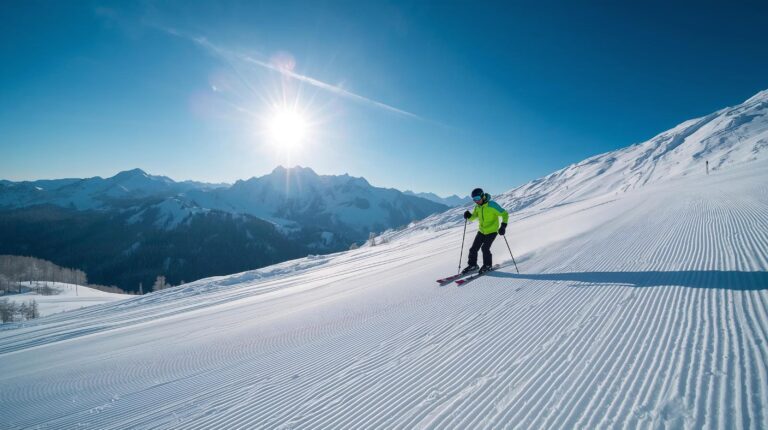
In this comprehensive guide, we will take a detailed look at the three most common posture and movement problems on the snow, based on expert analysis from professionals. We will give you precise instructions on how to correct these habits to make your next ski vacation in the Pirin Mountains a real pleasure.
💡 Video Lesson: The most common mistakes made by skiers
Check out this excellent tutorial from Stomp It Tutorials, which clearly demonstrates the problems we will discuss below.
Instructions for Bulgarian subtitles: Start the video, click on the “CC” (Subtitles/closed captions) icon in the bottom right corner. Then go to “Settings” (the gear) > Subtitles/CC > Auto-translate and select “Bulgarian” from the list.
Why is perfect technique key for the slopes in Bansko?
Bansko is a resort that offers a huge variety of terrain. The long ski path from "“Banderishka meadow” to the city requires endurance, while the upper slopes below Todorka Peak require precise speed control. If you make basic skiing mistakes, you are practically fighting gravity and your own equipment. Proper biomechanics allows you to use the design of modern carving skis (with their specific radius and side profile) so that they themselves do most of the work when turning.
Error #1: Turning the skis too quickly (Sharp rotation)
One of the biggest problems seen on blue and red runs is impatience when initiating a turn. Many skiers try to change direction by abruptly, forcefully rotating their upper body and shoulders, forcing their skis to slide sideways (so-called “sweeping” the snow).
⚠️ Warning: Why is this a problem?
When you turn your skis sharply and quickly, you lose the grip of the edges on the snow. This leads to uncontrollable sliding down the slope, rapid wear and tear on your leg muscles, and an inability to control your speed on steeper sections, such as those often found at the end of a run 10 (Yulen).
How to fix the problem:
The solution is patience. Turning on skis is not a sudden movement, but a smooth process of weight transfer. Instead of rotating your shoulders, focus on gently tilting your knees and ankles towards the new direction of travel. Let the shape of your ski cut into the snow. Think of the turn as the letter “C” – you need to go through the entire arc slowly and in control. Start practicing this on sloping slopes like “The plateau“", trying to make each turn as long and round as possible.
Error #2: Leaning too far back (“Sitting in the back seat”)
Perhaps the most common and dangerous of all skiing mistakes, also known as “backseat skiing,” this position occurs instinctively when a skier feels afraid of the speed or steepness of the slope. The body instinctively pulls back, away from the “danger” below.
⚠️ Warning: The consequences of the “back position”
Modern skis are designed so that the front part (the tips) must be loaded to initiate a turn. When you lean back, the tips of the skis become light and unmanageable. You lose all control, the skis start to “drive” you, and the load on the quadriceps (thighs) becomes brutal. After just a few descents in this position, your legs will burn with fatigue.
Techniques for shifting weight forward:
To get out of this defensive but wrong position, you need to focus on three key points in your body:
- Ankles and shins: You should feel a steady, firm pressure on your shins against the front tongues of your ski boots. If you feel pressure on your calves at the back, you are leaning too far back.
- Hands: Your arms should always be forward, slightly bent at the elbows, as if you were holding a large steering wheel or a tray of drinks. If your arms drop to your body or remain behind you after driving the cue, your center of gravity will automatically go back.
- The stand: Bend your knees and ankles, not just your waist. Your chest should be pointing down the slope.
Error #3: Leaning inward into the turn (Banking)
This mistake is often seen in skiers who have already gained some confidence and are trying to imitate the World Cup alpine skiers they watch on TV. They lean their entire body sharply towards the center of the turn, as if they were riding a motorcycle through a sharp curve.
⚠️ Warning: Why is leaning inward dangerous?
When you lean your entire body (including your shoulders and torso) inward toward the slope, you shift your center of gravity onto the inside side. In skis, however, 80-90% of your weight must be on the outside side for its edge to grip the snow firmly. The result of banking is the outside side slipping and potentially falling onto the inside side, especially on icy slopes.
Creating correct angulation:
The correct technique is called angulation or “cornering.” Your body should bend at the waist and knees. While your legs are angled inward into the turn to angle your skis, your upper body (torso and shoulders) should remain as straight as possible and slightly pointed down into the valley. Imagine that you want to touch your outside ski boot with your outside hand during the turn. This will transfer your weight to the key outside ski, giving you perfect grip and power to “cut” the slope.
🎿 Expert advice for Bansko: Pre-season preparation
Avoiding these skiing mistakes requires not only knowledge but also physical strength. Before coming to Bansko, set aside 4-6 weeks to prepare. Focus on squats, lunges, and core exercises (abdominals and lower back). A strong core will help you hold your body forward and create proper angulation without compensating with wrong movements.
The importance of gear: Shoes matter!
Even if you know all the theory in the world, you won’t be able to apply these adjustments if your equipment is sabotaging you. Very often, skiers choose ski boots that are too big for them (in their quest for comfort). When the boot is wide, your shin cannot effectively transmit pressure to the tongue of the boot, forcing you to “fall” into a backward position. Always consult a professional bootfitter in Bansko to make sure the boots hug your foot tightly and have the right flex (stiffness) for your weight and skill level.
Conclusion and next steps
Correcting skiing mistakes doesn't happen overnight. It takes conscious effort, patience, and repetition. Next time you're on the slopes in Pirin, choose an easy slope, go a little slower than usual, and focus on one specific element—like the constant feeling of pressure on your boot tongues. Over time, the weather Muscle memory will kick in and perfect technique will become second nature.
If you are determined to take your skills to the next level, there is no better way than to trust the professionals.

 English (UK)