

In Bansko, building a fountain has never been just a construction project. It is an act of deep cultural and spiritual significance – a gift to the people, the travelers and the mountain. In this article, we will take you through the most emblematic locations where you can pour yourself a glass of crystal clear spring water, following a kind of “water route” from the heart of the city to the highest accessible points.
The deep tradition: What does it mean to raise a fountain in Bansko?
Before we set off on the route, it is important to understand why there are so many beautifully constructed stone troughs in this region. In the past, it was believed that building a fountain and giving water to the thirsty was “sebap” – one of the highest good deeds a person could leave behind. It is believed that as long as water flows from the fountain, the memory of its creator will live on.
In Bansko and the region, this tradition is still alive today, thanks to the so-called “nabors”. The custom dictates that men born in the same year (nabor) get together when they are approaching their 50th birthday. They raise funds, dedicate their personal time and, with their own labor, build or restore a fountain in the mountain as a gift to the community and a sign of their friendship.
The Water Route: Exact Locations of the Best Mountain Fountains in Bansko
If you want to take a walk combined with tasting the purest Pirin water, here is the best route that starts from the city center and ends in the alpine part of the mountain.
1. In the heart of the city: The fountains next to the Holy Trinity Church“
Your journey can start right in the center of Bansko. In the immediate vicinity of the iconic Holy Trinity Church – a symbol of the city – are two beautiful stone fountains. They are extremely convenient for locals and tourists walking around the Old Town. The water here is cold and fresh, coming directly from the mountain water catchments, and is perfect for filling bottles before a long hike.
2. The beginning of the mountain: Near the restaurant "Motikata"“
Taking the picturesque asphalt road up the mountain (towards the ski area and Vihren hut), shortly after leaving the last town houses, you will reach the iconic local establishment "“The hoe. The area around it is a favorite place for walking. Very close to the establishment is a beautiful fountain with a constant, strong flow. This is the traditional first stop for drivers and pedestrians entering Pirin National Park.
3. The Forest Idyll: The Fountain of “Set 1974”
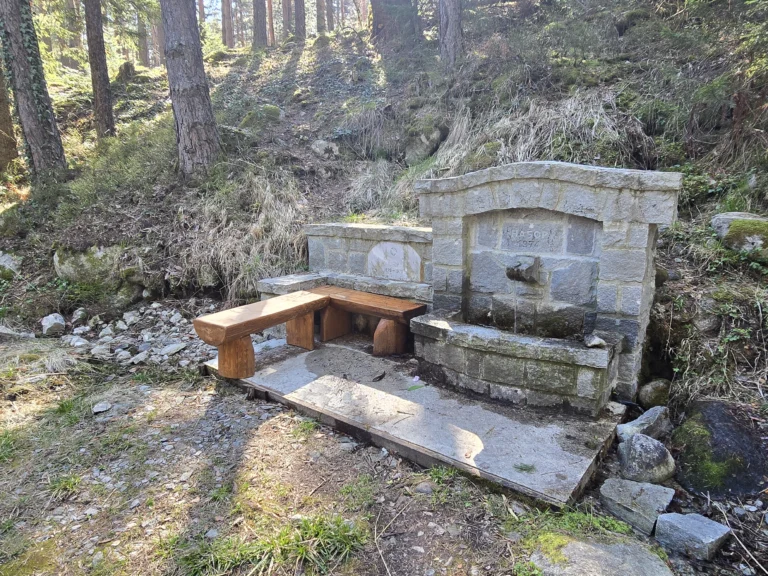
If you continue a little further up from the “Moke” and deviate slightly into the grove, you will find a real hidden gem. It is a massive stone fountain, proudly bearing the inscription “RECOLLECTION 1974”. This location is perfect because it was built with tourists in mind – next to it there is a comfortable, massive wooden bench (L-shaped), which offers an ideal place to relax in the cool shade of the centuries-old pine trees. The place is quiet, smells of resin and is great for a short meditation or a family picnic.
4. High in the mountains: At Vihren hut
Continuing along the main road uphill (14 kilometers from the city), passing by Banderishka meadow and Baykushevata mura, you will reach the end of the asphalted section – Vihren hut (1950 m above sea level). Right in front of the hut itself is one of the most important fountains for climbers. This is the last safe and abundant place to refill with water before you take the steep paths to Vihren peak, Sinanitsa or Tevno Lake. The water here is ice-cold even on the hottest August days, as it comes directly from melting snow and high mountain springs.
Where does the water come from and do the fountains work year-round?
The water in these fountains comes directly from the depths of Pirin. Unlike many other mountains in Bulgaria, the central part of Pirin above Bansko is made up mostly of granite rocks. This is of key importance for the quality of the water.
- Natural filtration: Granite does not release limestone, which means that Pirin water is extremely “soft” and has very low mineralization.
- Power supply: The springs are fed mainly by the vast massifs of snow that melt slowly in spring and summer, as well as by deep underground aquifers.
Do they work year-round? Most of the fountains listed (especially those by the church, at “Motikata” and “Nabor 1974”) have a constant flow rate throughout the year. However, you should keep in mind the harsh winter conditions. At temperatures of -15°C or lower in January and February, the external pipes and spouts can freeze. Also, the fountain at Vihren hut often remains hidden under meters of snow during the real winter.
Is Pirin water safe to drink?
In the vast majority of cases, the answer is a resounding yes. YES. The water from the mountain springs around Bansko is completely safe, crystal clear and much tastier than bottled or chlorinated city water.
1. Drink only from fountains with strong and constant flowing water.
2. Never drink stagnant water from the troughs themselves – they are intended for animals or for washing.
3. If you are high in the alpine area (above Vihren hut) and are pouring water directly from a river, make sure that there are no grazing herds (cows, horses or sheep) upstream to avoid bacterial contamination.
Who maintains these natural resources?
Apart from the “sets” themselves, who regularly look after their creations, the maintenance of the fountains in the Bansko area is a shared responsibility. The Pirin National Park Directorate takes care of the sites in the higher part. The lower fountains are often cleaned of leaves, mud and sediment by local hunting groups, volunteer organizations and mountain guides before the start of each active summer season.
As tourists, our only job is to keep things clean. Don't leave plastic waste or wet wipes around the water fountains and keep the wooden benches from getting damaged.



 English (UK)