


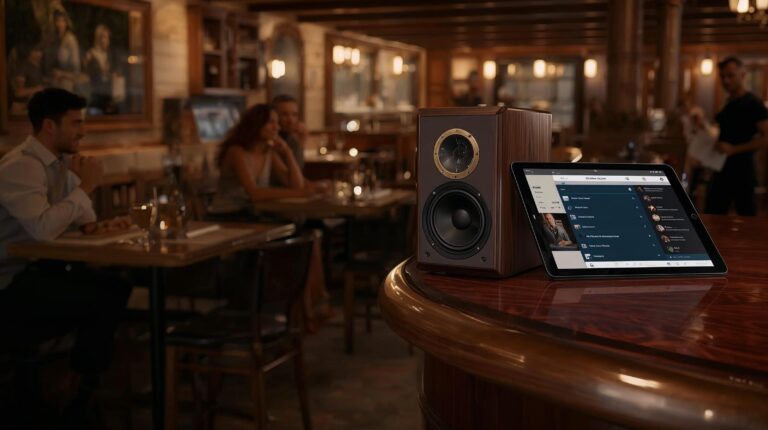
Imagine the following situation: A customer walks into your restaurant in Bansko. The interior is wooden and cozy, it smells like delicious food, but… an aggressive techno beat or a sad ballad is blaring from the speakers, which dampens the mood. The result? The guest subconsciously feels uncomfortable, orders quickly and leaves, or doesn’t sit down at all.
Many business owners overlook the factor music for a venue, leaving the choice to the waiter (“Play whatever you like”) or to a random radio. This is a fundamental mistake. Music is not just background music – it is the “invisible manager” that dictates how quickly customers eat, how much they spend, and whether they will return.
In this article from our series on successful management, we will look at both sides of the coin: the psychology of sound that sells, and the legal trap called “copyright,” which can cost you thousands of leva in fines.
1. Psychology of rhythm: How to manage turnover?
It has been scientifically proven that the human heart rate and chewing speed are synchronized with the rhythm of music (BPM – beats per minute). As a smart manager, you can use the right music for a venue as a crowd control tool.
| Fast music (over 120 BPM) | Slow music (below 80 BPM) |
|---|---|
|
Effect: Customers eat faster, talk louder, and vacate the table sooner.
Strategy: Ideal for lunch, fast food restaurants or peak hours during the ski season when you have a queue and need quick table turnover. |
Effect: Customers relax, slow down their eating and spend more time at the table.
Strategy: A must for dinner and fine dining. Increases the bill with additional orders of desserts, wine and digestibles with up to 20%. |
💡 The context of Bansko:
If you are running a traditional tavern, folk music is expected, but be careful with the volume (decibels). Live music creates emotion and brings tips, but a too-loud orchestra kills conversation. If guests can’t talk, they stop drinking and simply leave. Balance is key.
2. Why are Spotify and YouTube BANNED for business?
This is the most common and dangerous violation in Bulgaria. Many owners say: “I have paid Spotify Premium or YouTube without ads, so I can play it in my establishment.”
ERROR! When you sign up for streaming platforms like Spotify, YouTube, or Apple Music, you agree to their Terms and Conditions, which explicitly state: “For personal, non-commercial use only” (Personal use only). Playing this music to an audience in a commercial setting is considered a “Public Performance” and requires entirely different rights.
⚠️ The risk of fines
Using a personal account to voice a commercial object is illegal under the Copyright and Related Rights Act (CRA). Fines for inspections by Ministry of Culture inspectors start from 2000 BGN and can reach 30,000 BGN., often leading to the confiscation of sound equipment.
3. The Holy Trinity: MUSICIAN, PROPHON and the Decisions
To be fully legal in Bulgaria and save yourself the headaches, you must pay royalties to the collective rights management societies. It is important to know that it is not enough to pay only to one.
- MUSICIAN: They collect rewards for the authors of music and lyrics (composers, poets, arrangers).
- PROFON: They collect rewards for the producers и the performers (sound recording).
The fees are not arbitrary – they depend on the size of the establishment, the number of seats, the categorization and the opening hours. For a small café or lobby bar in Bansko The fee may be completely bearable, and the peace of mind that the “door sticker” gives you is priceless.
The Alternative: Royalty-Free Streaming for Business
If you do not want to sign contracts with PROFON and MUZIKAUTOR, there are specialized platforms for music for a venue (such as Soundtrack Your Brand, CloudCover, etc.) that offer the so-called “business license”. They arrange the rights directly (“Direct Licensing”), but you should check very carefully whether their license covers the territory of Bulgaria and whether it includes all the necessary rights for public performance.
4. Music as part of the brand
Imagine an Italian restaurant playing German heavy metal. Strange, right? The music should be a natural extension of your menu, interior, and target audience.
- For Co-working / Coffee: Choose Lo-Fi Beats, Smooth Jazz or instrumental music without vocals. This helps with concentration on digital devices. nomads.
- For Après-ski bar: High-energy pop, dance or rock music. The goal here is a party atmosphere and quick drink consumption.
- For a Family Restaurant: Retro pop, soft rock, golden evergreens. Music that is familiar to all generations and doesn't annoy anyone.
Music is just the beginning: What's next?
The music, the menu, and the decor are the stage on which your business spectacle is played out. But even the best stage remains empty without good actors.
That's why our series on successful management it doesn't end there. After optimizing the "hardware" of the establishment (food, sound, vision), in the following articles we will focus on the "software" - the human factor.
It's time to talk about sales.
Have you set up the playlist?
Now that the atmosphere is perfect, let's make sure the staff knows how to sell.



 English (UK)