

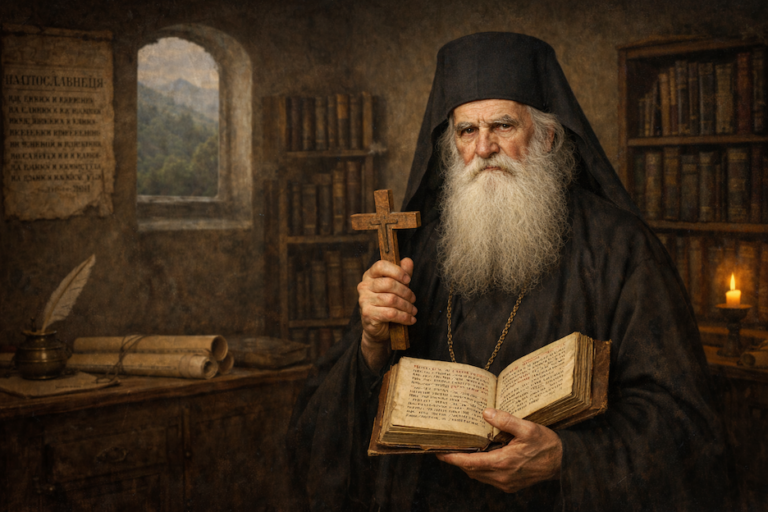
When we talk about Bansko, we often think of skiing, mountains and tourism. But the real wealth of our town lies in its history and in the giants of the spirit who have left here. The brightest star among them is undoubtedly Neophyte Rilski (1793–1881) – the man whom Konstantin Irechek rightly calls „"Patriarch of Bulgarian Writers and Educators"“.
In this extensive article we will tell you about the life of Nikola Pop Petrov Benin (the secular name of Neofit), about his contribution to the Bulgarian language and why every Bulgarian should visit his birthplace in Bansko.
📘 Encyclopedic personality:
It is difficult to define Neofit Rilski's profession in one word. He was:
- Cleric and Abbot of Rila Monastery;
- Teacher and education reformer;
- Artist and icon painter;
- Architect and builder;
- Musician and notator;
- Translator and philologist.
The Roots: The Benin Family and the Rise of Bansko
Born in 1793 in Bansko, Nikola Benin grew up in an environment that would determine his future. At that time, Bansko was not just a village, but a thriving trading and craft settlement with contacts throughout Europe.
His pedigree is impressive and unites two of the most influential families in the region:
- On the paternal side (Benin): Wealthy cotton merchants with offices in Vienna and Central Europe. His father, Father Peter, was a priest and teacher who gave his son his first education in a home monastery school.
- On the maternal line (Germans/Golevis): An influential family, whose representatives actively participate even in the political life of Serbia (Mihail German is a confidant of the Serbian prince Miloš Obrenović).
This family environment provided young Nikola with access to books, languages, and a broad culture – something rare in enslaved Bulgaria.
From icon painter to monk: The road to the Rila Monastery
Initially, young Nikola embarked on the path of art. He left for Rila Monastery with a group of Bansko icon painters (including Toma Vishanov – Molera) to master icon painting. But his thirst for knowledge goes beyond the brush and paints.
The monastery at that time was the greatest cultural center of the nation. There he immersed himself in the rich library and during 1818 took monastic vows under the name Neophyte. From that moment on, he dedicated his life to a single goal – „the public good.“.
The revolution in education: Gabrovo School
The key moment in the life of Neofit Rilski occurred in 1834. Vasil Aprilov, looking for the most suitable person to open the first new Bulgarian secular school, settled on the one in Banska Bystrica.
Neofit does not take the task lightly. He goes to Bucharest, where he studies modern the weather his "Mutual Teaching Method" (Bell-Lancaster System). There he created 78 cross-curricular tables – the first visual aids in Bulgarian education.
On January 2, 1835, the Gabrovo School opened its doors, and Neofit Rilski became the first teacher to teach in spoken Bulgarian, rejecting Greek influence. He also wrote the first school regulations, introducing order and discipline into the educational process.
„"Bulgarian Grammar" and the codification of the language
While in Kragujevac (Serbia) and later in Gabrovo, Neofit realized that without uniform linguistic rules, enlightenment was impossible. In 1835 he published his fundamental „"Bulgarian Grammar"“. With it, he practically laid the foundations of the modern Bulgarian literary language, striving to unite the eastern and western dialects.
In addition to grammar, he worked tirelessly on a huge Bulgarian-Greek dictionary, called by him "Lexicon", which proves the richness of our language.
Neophyte's Globe: A Symbol of Seeing
One of the most amazing facts about Neofit Rilski is his dexterity and engineering mind. While teaching, he realized the need for visual aids for geography. Since he had nowhere to buy them, he made them himself. the first Bulgarian globe in 1836.
This globe is now kept in the museum of the Rila Monastery. It is made of cardboard and paper, with the cartography drawn by hand with extreme precision. This act symbolizes the aspiration of the Bulgarian to see the world, to break out of the shell of slavery.
The Professor in Halki and the Last Years
Neophyte's fame extended beyond the borders of the Bulgarian lands. Between 1848 and 1852, he was invited to head the Department of Slavic Languages at the Higher Theological School on the island of Halki (near Constantinople). This was a high recognition of his erudition.
After his return, he settled permanently in the Rila Monastery, where he continued his literary activity until his death on January 4, 1881. He was buried next to the monastery church itself - an honor bestowed only on the greatest.
The Benin House in Bansko: Fortress of the Spirit
To truly understand the scale of Neofit Rilski, you must visit his birthplace in Bansko. The Neofit Rilski House-Museum (known as The Benin House) is an architectural masterpiece.
It is a typical representative of the Bansko fortified house (“tower”):
- Thick stone walls and massive gates;
- Secret passages (hiding places) for escape in case of danger;
- A spacious veranda overlooking Pirin Mountain;
- The authentic monastery school where his father taught.
Today, the museum preserves Neophyte's personal belongings, editions of his grammar, and copies of the mutual teaching tables.

 English (UK)