


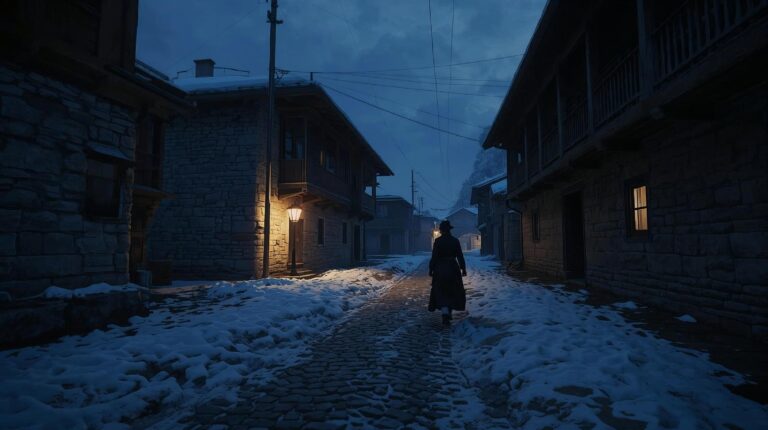
Today, when Bansko – the pearl of the winter Balkans – is „bursting at the seams“ with festive bustle, it is difficult to hear the whisper of the stone. The streets are crowded with tourists, the hotels are lit up with neon, and the conversations revolve mainly around the prices of lift tickets, reservations and large-scale investments. In this whirlwind of commercial success, we often forget that the greatness of this city has never been measured by the number of visitors or overnight stays. The true, invisible wealth of Bansko it has always been something else – the community.
Going back to the weather, towards the 18th and 19th centuries, we discover a world that sounds almost like a utopia to modern man. A world of dignity, where a word weighs more than a notarized contract, and personal success is meaningless if it does not contribute to the common good.
The house as a fortress of the spirit
The architecture of Old Bansko is the most faithful chronicler of this lost morality. The Bansko house is not just a building; it is a manifesto of character. Built of solid stone and wood, these homes resemble small fortresses. The high walls and heavy gates, clad in iron, were necessary in times of Ottoman rule and insecurity. They guarded not only the property, but also the honor of the family.
This construction speaks of people who lived with the clear awareness that they were masters of their own destiny, regardless of the political situation outside. They did not wait for someone to "save" them - they created their own, inaccessible reality.
Banska Bystrica: A Citizen of Europe with Roots in Pirin
Historians and ethnographers agree that Bansko is an economic and spiritual phenomenon. But how did a mountain town become the cradle of the Enlightenment? The answer lies in the people.
The Bansko merchants were truly cosmopolitan. They traveled with caravans throughout the Balkan Peninsula, reaching Vienna, Budapest, Leipzig and London. They exported cotton and tobacco, but they imported something much more valuable than gold – culture and progress. These men had seen how the free world lived and brought this model home.
The Code of the Old Banska Bystrica
„"Being rich in Staro Bansko was not a sin, but a responsibility." The wealthy Bansko resident did not accumulate wealth for its own sake. He was obliged to be a benefactor - to donate to a school, to help build a church, to support orphans.
The most striking example of this is the construction of the Holy Trinity Church. Legends and chronicles tell how the entire community united – some gave money, others labored, and still others carried stones with ox carts. This was not just a construction project, but an act of community declaration: „We are here, we are united, and our faith is stronger than anything.“.
Woman – the silent guardian of traditions
While men were absent for months and years on the trade routes of Europe, women were the backbone of Bansko. In this seemingly patriarchal world, the Bansko woman had the role of manager. She held the key to the home and the ancestral memory.
The upbringing of the children was entirely her responsibility, and it was Spartan and deeply moral. Being a respected person meant meeting three basic criteria:
- ✔ Honesty: Lying was considered a disgrace that stained the entire family.
- ✔ Hard work: Laziness was considered a disease.
- ✔ Usefulness: The point is to serve others.
It was these mothers who raised the giants of the Bulgarian spirit such as Paisius of Hilendar and Neophyte of Rila. These personalities did not appear by chance; they are the fruit of an environment in which knowledge and spirituality were elevated to a cult.
The Clash of Ages: Then and Now
| Value system | Old Bansko (18th-19th centuries) | Modern Bansko (2025) |
|---|---|---|
| Success | Measured by contribution to the community and the honor of the clan. | Measured through personal financial prosperity and investments. |
| Relationships | The word is law. Deals with a handshake. | Contracts, notaries and the search for a quick profit. |
| The environment | Silence, cobblestones and impenetrable stone walls. | Noise, tourist flow, neon and concrete. |
Today, the world of Old Bansko comes to life mainly in museum exhibitions and in the stories of old Bansko residents, who nostalgically remember the time of the "given word". We now live in the era of individualism. The tourist flow brings income, but it also inexorably washes away authenticity. The noise of the establishments drowns out the silence necessary for reflection.
And yet, the spirit of the city has not completely disappeared. It is there – in the cobblestones we walk on, in the old clock towers that still tell the time, and in that specific pride of the locals that cannot be bought with money.
A world of dignity and community may sound like a utopia in 2025, but perhaps this is exactly the „utopia“ we need the most today. Because hotels are built and torn down, investments come and go, but the spirit embedded in the foundations of a city is the only thing that remains forever.
Maybe the next time we walk around Bansko, we should stop for a moment, touch a wall, and think: What can we take from them to heal our day today?
 English (UK)