


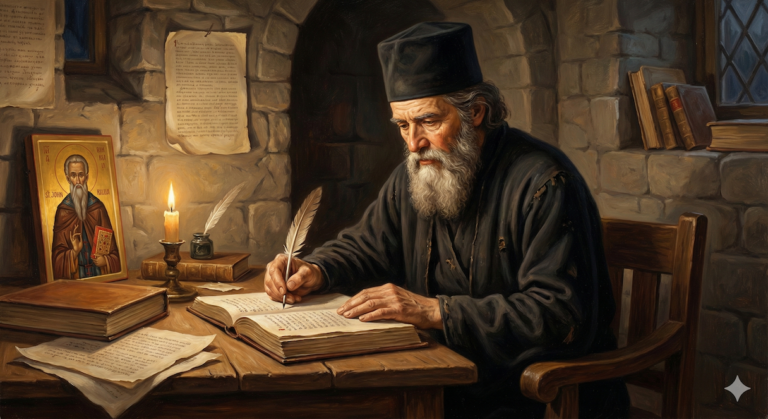
Paisii of Hilendar (1722–1773) is not just a historical figure, but the spark that ignited the fire of the Bulgarian National Revival. For us, the inhabitants of Bansko, he is more than just a monk and a writer – he is a symbol of the awakened spirit of our city, proof of the economic and spiritual power of Banska Bystrica in the 18th century.
In this detailed article, we will examine the life of Saint Paisius, his origin from the wealthy Baanov family, and the enormous importance of his work "Slavic-Bulgarian History.".
💡 Fast facts about Paisios:
- Born: 1722 in Bansko.
- Deceased: 1773 (probably in Amberino, near Asenovgrad).
- Main case: The writing of "Slavo-Bulgarian History" (1762).
- Canonization: Declared a saint by the Bulgarian Orthodox Church in 1962.
The Roots of Paisius: The Wealthy Family from Bansko
For a long time, historical science has been arguing about the birthplace of Paisios, but today the facts point categorically to Bansko. He was the youngest son in the family of Bilyo Baanov – an influential and wealthy merchant from Bansko, and his wife Katerina Kundeva.
It is no coincidence that Paisius came from a wealthy family. Bansko in the 18th century was a thriving commercial center, maintaining ties with Vienna and Venice. The environment in which the future historiographer grew up was saturated with patriotism and a desire for education.
The Brothers of Paisius – Pillars of Bulgarianness
Paisios was not the only one in his family who dedicated his life to faith and people. His brothers played a key role in his life:
- Lawrence (Lazarus): The older brother who became the abbot of the Hilendar Monastery. It was he who received the young Paisios in Mount Athos and gave him spiritual support. His name is mentioned many times in the monastery's kondics.
- Hadji Valcho: The middle son of Bilyo Baanov. He was one of the most generous benefactors (donors) not only of the Hilendar and Zograf monasteries, but also of churches throughout the region. His wealth ensured the independence of the Bulgarian monks on Mount Athos.
The path to Athos and monasticism
In his "History", Paisios himself notes that he arrived in Mount Athos in 1745 year, when he was 23 years old. He went to his brother Lavrenty in the Hilendar Monastery, which at that time was the center of Serbian and Bulgarian literature.
His life there is not only prayer. Paisios becomes taxi driver – a traveling monk who collects donations and leads pilgrims. These travels through the Bulgarian lands open his eyes to the plight of the people, their ignorance and lack of self-confidence in the face of the Greeks and Serbs.
In 1761, Paisius was sent to Sremski Karlovci (present-day Serbia) on monastery matters. But his real goal was another – the library of the Serbian Patriarchate. There he found sources such as the works of Mavro Orbini and Caesar Baronius, which provided him with the necessary historical facts for writing his work.
Slavic-Bulgarian History: The Weapon of Awakening
After returning from Sremski Karlovci, the situation in Hilendar became tense due to disputes with the Serbian monks. In 1762 year Paisios moved to The Zograf Monastery – the Bulgarian fortress on Mount Athos. There, in his cell, he completed his epochal work.
Why is this book so important?
„"Slavic-Bulgarian History" is not just a chronology of kings and battles. It is a political manifesto. Paisius writes with anger, with love, and with pain. He addresses the reader directly:
„"Oh, you foolish and foolish one! Why are you ashamed to call yourself a Bulgarian and do not read or speak your own language?"“
The book's objectives are threefold:
- To restore the historical memory of the Bulgarians.
- To counteract Greek cultural assimilation.
- To prove that the Bulgarians had a glorious past, a state and a patriarchy.
Missionary Paisios: Spreading the Word
Paisius of Hilendar did not let his manuscript gather dust. He was a man with a bright mind and a restless spirit. He set out alone through the Bulgarian lands, carrying the book as a sacred object. He gave it to bright Bulgarians to copy.
The first copy was made by priest Stoyko Vladislavov (the future Sophrony of Vrachanski) in Kotel in 1765. Subsequently, dozens of copies and revisions appeared, which testifies to the great hunger of the people for such reading. The people called him their Patriarch, although he never held a high church position.
The legacy of Paisios in today's Bansko
We, the people of Bansko, zealously guard the memory of our great fellow citizen. The draft of "Slavic-Bulgarian History" is still kept in the library of the Zograf Monastery as the most valuable relic, but the spirit of Paisios is alive in Bansko.
If you visit our city, you must see:
- The Memorial of Paisii Hilendarski: A modern museum built on the site of his birthplace.
- The monument in the center: The majestic figure of the monk, staring into the future.
Paisius of Hilendar is proof that change begins with one person, armed with knowledge and faith. He is the eternal awakener, whose words still resonate in 2026.



 English (UK)