


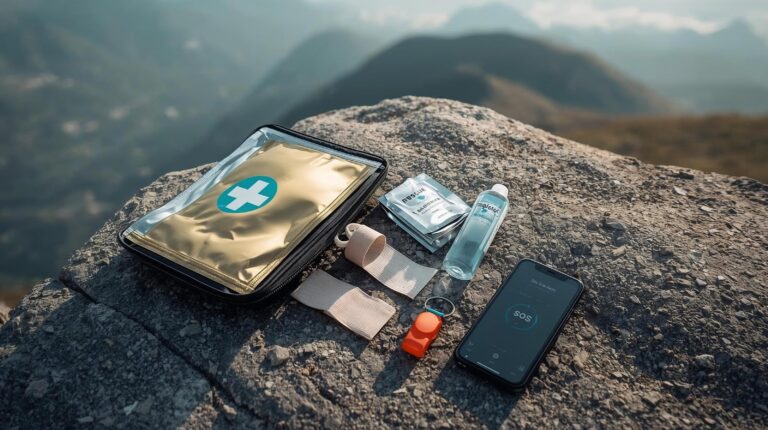
1. The Holy Trinity of Survival
Before we talk about pills and patches, we need to put in our backpack the three things that are mandatory even for a short walk.
1. Space Blanket
It looks like a large piece of foil, weighs 50 grams and costs 5 leva. But it saves lives.
- Why do you need it? If someone breaks their leg and you have to wait 3-4 hours for help, the biggest enemy is hypothermia (frostbite). The foil reflects up to 90% of body heat.
- How is it used? The gold side out – warms (attracts the sun). The silver side out – protects from heat.
2. The MES application and a charged phone
In the mountains, time is life. The free Mountain Rescue Service (MRS) app has a button that sends your exact GPS coordinates directly to the rescue center.
Important number: Save the phone number to the PSS: 1470 (or 02/ 963 2000).
3. Whistle
Most backpacks have a whistle built into the chest strap. Check to see if yours has one. If you fall into a ravine or the fog is thick, your voice will go hoarse after 15 minutes of shouting. The whistle can be heard for miles.
2. The “Repair Kit” for the Legs
In Pirin, the most common injuries are two: corns and sprained ankles.
4. Callus Patches (Second Skin Type)
Regular patches fall off after 5 minutes of walking. You need specialized hydrocolloid patches (e.g. Compeed). They stick for days, provide instant pain relief, and create a “cushion” over the wound. Without them, a single heel rub can make getting down the stairs a living hell.
5. Elastic bandage
Pirin is the kingdom of stones. Spraining an ankle is a classic. A tight elastic bandage will allow you to “limp” to the hut or car, instead of having to be carried on a stretcher.
3. Medications (The Minimum)
*Note: Always consult a doctor about allergies and dosage.
| Problem | What should we wear? | Why? |
|---|---|---|
| Pain / Trauma | Analgin / Nurofen (Aulin) | In case of severe headaches from altitude or a leg injury, so that you can descend. |
| Allergy | Antihistamine | A bee/wasp sting can be dangerous. |
| Stomach | Imodium / Smecta | Stomach upset in the mountains dehydrates the body very quickly. |
| Wounds | Betadine / Rivanol (small bottle) | For disinfecting scratches from squatting or stones. |
4. The Hidden Helper: Mountain Insurance
This is not a physical object, but it is the most important “piece of paper” in your pocket.
Did you know that?
The rescue operation in the mountain is free only if you have insurance. Without it, if transport by stretcher or helicopter is necessary, the bill could exceed 3000-5000 leva, that you pay out of pocket.
Mountain insurance costs around 4-6 leva per day and can be done online in 5 minutes.
Where should we put all this?
All of the above items (excluding your phone) fit into a small, palm-sized bag that weighs less than 300 grams. Keep the first aid kit in a waterproof zip-lock bag in an easily accessible place in your backpack – ideally in the top lid (the so-called “brain” of the backpack).
The Council of vBansko
Don’t buy pre-made car first aid kits – they’re full of things you don’t need in the mountains and lack the essentials (like corn patches and painkillers). Put together your own first aid kit with quality products. We hope you carry it around for years without ever opening it!


 English (UK)