

This place is not just a tourist attraction, but a real functioning part of the daily lives of the local people. Here, tradition, nature, and social life intertwine in an amazing way, offering visitors an unadulterated glimpse into the true way of life of the region.
What is the Laundry in Dobrinishte?
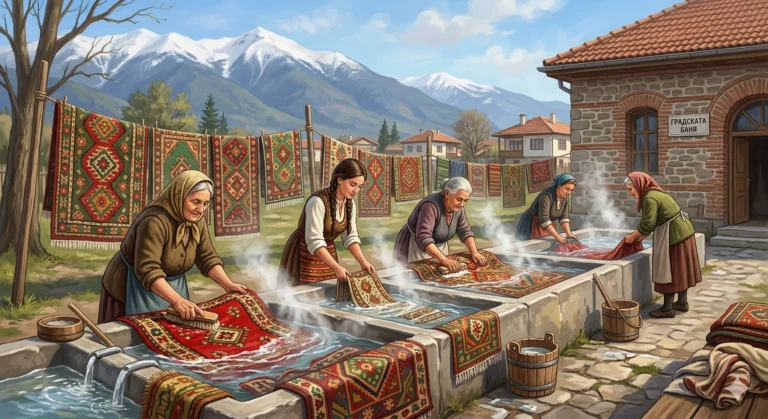
Unlike closed ethnographic museums, where the past is sealed behind glass cases, the "Laundry House" is a living, breathing and steamy space. It is a complex of famous natural pools (basins), which are filled with abundant, hot mineral water. The water springs directly from the bowels of the earth at a temperature ideal for cleaning and washing, and flows into specially built stone and concrete facilities.
The heart of the community
Historically, public mineral baths and laundries were key social centers in many Bulgarian villages. Today, most of them are destroyed or dried up, but in Dobrinishte the tradition is fully preserved. For local women, it is not only a place for housework, but also a kind of open-air club - a space where news is exchanged, joys and worries are shared, and the young unknowingly absorb the knowledge of the elders.
How is the free mineral water used?
If you walk past the City Baths on the weekend or in the days before major holidays, there is a huge chance that you will witness a scene from the past. Locals continue to bring their heavy carpets, long paths, traditional woolen rugs and kitenics here. The washing process takes place entirely in the traditional way - relying on the flow of water, its natural heat and the strength of human hands.
The most impressive thing in the modern world, where every service has its price, is that this priceless natural gift is completely free and freely available to everyone. There are no entrance fees, no fixed opening hours – the hot water flows tirelessly, ready to serve people, just as it did hundreds of years ago.
Why is this object a phenomenon in the modern world?
The laundry in Dobrinishte is much more than a place to wash carpets. It is a symbol of sustainability and connection with nature. Here are a few reasons why this place deserves your attention:
- Absolute environmental friendliness: Doing laundry here is proof of the environmentally friendly lifestyle of our ancestors. They do not use aggressive detergents that pollute groundwater, but rely entirely on the power of nature.
- Photographic value: For photography enthusiasts, the steam rising from the hot water on cool mornings, combined with the bright colors of traditional Bulgarian rugs, creates incredible shots.
- Cultural Bridge: The place offers the modern tourist the rare opportunity to observe real life, not a staged reenactment for guests.
How to get to the natural troughs?
The location is extremely easy to find. The property is located in close proximity to the public City Bath (also known as the Mineral Bath) in Dobrinishte. If you are staying in Bansko, Dobrinishte is only about a 10-minute drive away (approximately 8 kilometers). You can also use the regular bus transport between the two settlements, as well as the picturesque narrow-gauge railway, which has a station in the city.
Once you arrive in the center of Dobrinishte, just ask any of the locals for directions to the bathhouse – everyone will guide you with a smile. And as you approach, the sound of running water and the light steam in the air will lead you to the right place.
Combine the visit with relaxation
After visiting the unique laundry, don't miss out on taking advantage of the City Bath itself or the open-air mineral pools in the area. The water in Dobrinishte is known for its beneficial effects on the musculoskeletal system and the nervous system. This way you will combine cultural and historical enrichment with complete physical relaxation.
In a time when everything is automated and digitalized, the Dobrinishte Laundry remains a beautiful and precious reminder of the power of community and our connection to nature. It is an experience that you should definitely include in your itinerary on your next visit to the Bansko and Pirin region.
 English (UK)