


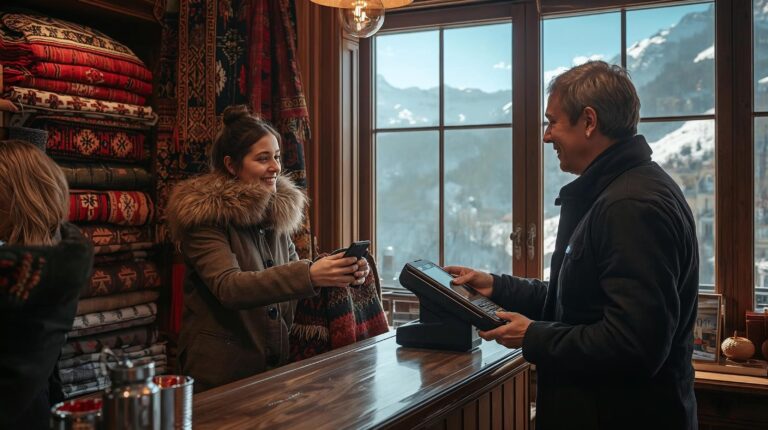
The scene is painfully familiar to every shopkeeper in the Pirin region: A tourist walks into your establishment, takes a fancy to a unique hand-knitted sweater or souvenir, goes to the cash register, and pulls out his phone to pay via Apple Pay or a card. You shake your head and point to the small, crumpled sign “CASH ONLY”.
The tourist rummages through his pockets, finds only a few small coins, apologizes, and says the standard phrase: “I'm going to the ATM and I'll be back in a moment.”. As experienced professionals in Bansko, we both know the truth: He won't come back.
In 2026, in the era of digital wallets and complete transparency, the presence of POS terminal in a store in an international resort it is no longer a luxury – it is a sanitary minimum. In this guide, we will debunk the myths about fees and show you how “modern payment” actually fills your coffers faster than cash.
1. The Myth: “The Bank Eats My Profit”
Many small business owners in the region continue to resist digitalization with the argument: “Why should I give 1.5% to the bank? This is my hard-earned money!”. This is a classic mistake of “short-sighted accounting”.
Let's look at the real math of lost profits. Imagine a typical day in the season when 10 potential buyers want to purchase an item with an average value of 60 BGN.
| Scenario A: Working with only CASH | Scenario B: With a POS terminal in the store |
|---|---|
| 4 customers have no cash and leave immediately. Real turnover: 360 BGN. Bank fees: 0 BGN. Net result: 360 BGN. |
All 10 customers complete their purchase. Real turnover: 600 BGN. Bank fees (average 1.5%): 9 BGN. Net result: 591 BGN. |
The conclusion is brutal: In an attempt to “save” 9 leva in bank fees, you just threw it out the window 231 leva net profit. In the conditions of strong competition in Bansko, this is slow business suicide.
2. Psychology of "invisible money": Why do people spend more with a card?
It has been scientifically proven by behavioral economics that the payment method affects the volume of the purchase. There is a concept called “Pain of Paying”. When a person physically counts and hands over banknotes, their brain activates areas associated with discomfort. This causes them to be cautious and weigh each item.
When using POS terminal in a store, this psychological friction disappears:
- Abstract transaction: Touching the card or watch to the device is perceived as a gesture, not a waste of resource.
- Impulse purchases: The customer is much more likely to add an additional item (“Oh, those socks are nice too!”) if they don’t have to check if they have enough money in their wallet.
- Higher average bill: Statistics show that card payments at tourist sites are on average 25-30% higher than cash payments.
💡 The specifics of Bansko and the Revolut generation
Guests from the UK, Israel and Scandinavia live in a society that is almost 100% “cashless”. Many of them land in Sofia with only a card Revolut or Monzo on their phone. They don't even know what Bulgarian banknotes look like. If your business doesn't accept cards, you become invisible to the most solvent group of tourists.
3. “There’s an ATM on the corner” – The phrase that kills sales
Many marketers think that directing a customer to the nearest ATM is a good idea. In fact, it's the fastest way to send them into a tailspin. Here's what goes on in a tourist's head as they walk to the ATM:
- Cold shower for emotion: Buying a souvenir or a piece of clothing is an emotional moment. A walk to the ATM “cools” that impulse.
- Fee shock: ATMs in resort areas (often owned by independent operators) charge exorbitant withdrawal fees and poor exchange rates. When the tourist sees that the withdrawal will cost him an additional 15-20 leva on top, he abandons the entire purchase.
- Obstacles and distractions: On the way to the money he sees another shop where there is a POS terminal, and buys from there.
4. Innovations 2026: SoftPOS – The Phone as a Terminal
If you are the owner of a small gallery, stall or mobile facility in Bansko and do not want to carry additional devices, the technology SoftPOS is your salvation. You no longer need to pay rent for physical terminals and buy consumables.
All you need is an Android smartphone with an NFC chip. You install a banking app and your phone becomes a fully functional terminal. The customer taps their card to the back of your smartphone and that's it. Fast, easy and extremely professional in the eyes of the Western tourist.
5. Tipping is no longer a problem
The big fear of staff – that paying by card kills tips – is unfounded. Modern payment software includes the function “Add Tip”. Before touching the card, the customer sees options (5%, 10%, 15% or an amount of their choice). The results of the practice in Bansko show that digital tips often exceed cash ones because people are more generous when they don't have to look for pennies.
Your business is ready for the 21st century!
Integrating a POS terminal is just the first step towards high turnover. The next challenge is how to turn a paying customer into a loyal fan through perfect communication.



 English (UK)