

The big fear of every guest house or hotel owner in Bansko: “If I raise the price even by 5 euros, the tourists will go to the neighbor.” This fear is the most expensive emotion you experience. It costs you thousands of euros in lost profits every winter season.
In the new economic reality of 2026, when Bulgaria now operates entirely in euros, the old rules of “undercutting the price” no longer apply. Price is not just a number on Booking.com. It is a signal of quality. If your pricing for hotels is too low, you are not attracting more people – you are attracting the wrong ones people (those who have unrealistic expectations, complain the most and depreciate the base the fastest).
In Part 5 of “Hotelier Academy – Bansko” we go deep into the psychology of the buyer. We will look at proven Revenue Management strategies that make the guest think they are getting a good deal while you increase your bottom line.
What actually is Revenue Management?
Many colleagues in Bansko think that this is just a “price change”. Wrong. The definition is: To sell the right room, to the right customer, at the right time, at the right price, through the right channel.
In our context, this means that an overnight stay on a Saturday in February (peak ski season) cannot and should not cost as much as an overnight stay on a Tuesday in April.
Psychology of Perception: The Anchor Effect
People often have no real idea of how much a night's stay "costs" in euros, especially after the currency change. They don't judge the value in absolute terms, but rather by comparison. This is where the so-called “Anchor Effect” comes into play.
If you only have one room type in your price list for €50, the customer may find it expensive because they compare it to the cheapest accommodation on Airbnb (€30). But if you structure your prices like this:
- Apartment “Pirin Lux” (Kotvata): €130
- Double room Standard: €50
In this context, the price of €50 seems like an extremely good deal. The expensive apartment serves as an “anchor” that pulls the perception of affordability upwards. Even if no one books the apartment for a whole month, its presence on the menu helps to sell the double rooms much easier and faster.
The magic of numbers: “Charm Pricing” in Euro
It may sound trite, but the human brain processes information extremely quickly and “lazily,” reading prices from left to right. Here’s how this looks broken down across the euro currency:
| Price A (Wrong) | Price B (Correct) | What is the brain thinking? |
|---|---|---|
| €50.00 | €49.00 | The left digit effect: The brain codes €49 as “forty-something,” while €50 automatically falls into the “fifties” category. The psychological barrier is enormous. |
| €60.00 | €59.00 | Classic example. Always round down a little to the nearest tenth. Even €59.90 works better than €60. |
| €100.00 | €99.00 | The difference is only 1 euro, but one is a “two-digit” (psychologically) number, and the other is a “three-digit” number. |
Dynamic Pricing: The End of Static Prices
The biggest mistake in Bansko is the “Winter 2026” price list taped to the reception, which does not change from December to March. The market is a living organism and your pricing for hotels I have to breathe with him.
The tricks of the season in Bansko
- Weekend vs. Weekday: In January and February, weekends are packed with Sofia residents and Greeks. Raise the price by 20-30% for Friday and Saturday. Lower it by 15% for Sunday-Thursday. This is the only way to attract the “digital nomads”"from Coworking Bansko the community who are looking for peace and quiet and a good price during the week.
- Events and Holidays: Is there a Ski World Cup? Is there a jazz festival in August? Prices should be at their peak months in advance. Student holiday? Require a deposit and a higher price because of the risk.
- Stay Restrictions: Never sell just 1 night for New Year's or Christmas. Set a rule “Minimum Stay: 3 nights” in Booking. This way you guarantee 100% occupancy, less cleaning for the maids and higher RevPAR (Revenue per Available Room).
The Decoy Effect
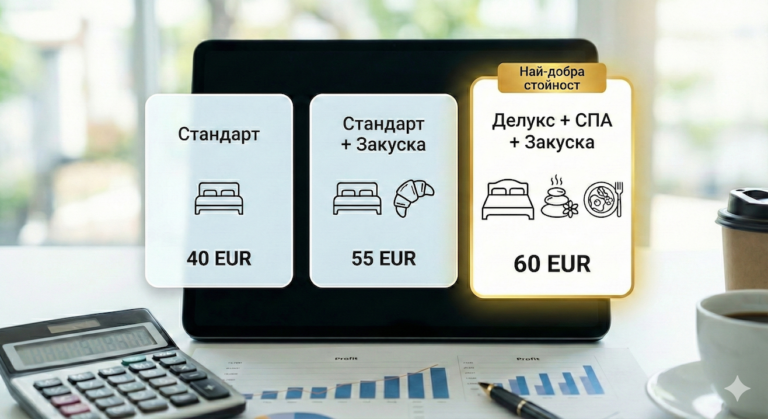
This is the most powerful tool for Upselling (selling a more expensive product). Want to sell the more expensive room? Give the customer a third, intermediate option that serves only as a comparison and is usually illogical.
- Standard room: €40
- Deluxe room with breakfast and spa: €65
The client wonders: “€25 difference… is it worth it just for one SPA?”
- Standard room: €40
- Room + Breakfast (without SPA): €62
- Deluxe with breakfast and SPA: €65
The customer says to himself: “For only €3 more than the average option, I get a SPA? This is a great deal!”
In the second case, the middle option (the Decoy) makes the most expensive option seem like the most logical and “smart” choice. You win €65 instead of €40.
If you manage prices on Booking, Airbnb, Expedia and your own website manually, you waste time and risk overbooking – every hotelier’s nightmare. Invest in Channel Manager software.
It automatically updates prices and availability everywhere with a single click. This gives you the freedom to play with euro prices on a daily basis, reacting to the competition in real time.
ADR vs. RevPAR: What are we measuring?
To be professional, stop looking at occupancy alone. A hotel full at 100% with a price of €20 is often a bigger loser than a hotel full at 60% with a price of €60.
- ADR (Average Daily Rate): Average price per room sold.
- RevPAR (Revenue Per Available Room): Revenue from each available room (regardless of whether it is occupied).
Your goal in Bansko is to maximize RevPAR. Sometimes it's better to turn down cheap groups to save rooms for individual travelers paying a high price at the last minute.
Breakfast as a tool to increase price
Often, customers choose the more expensive option just because of the included breakfast. But many hoteliers in Bansko forgo food because it is a “big toy” and requires staff. This is a missed opportunity.
Is it possible to offer a breakfast that both raises the price of the night by €8-€10 and doesn't break the bank with product costs? The answer is “Yes”, if you rely on the right local products.
The Academy finale is approaching.
You're done with the vision, the welcome, the cleanliness, the crises, and you already know how to price in euros. There's one last piece of the puzzle left - the food that keeps guests coming back.
In the next and final article, we will show you how to make a “Breakfast of Champions” on a minimal budget.
 English (UK)