


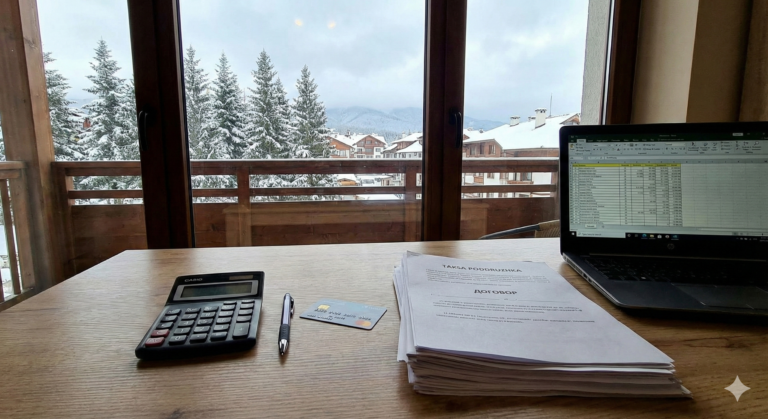
Step 1: Reservation of the property (Stop-deposit Agreement)
The real estate market in Bansko is extremely dynamic, especially in the months before the start of the winter season. To ensure that the property you like will not be sold to another buyer while you organize your finances or the bank is reviewing your loan application, the first step is to sign the Deposit Agreement (Reservation).
- What is it: You pay a fixed amount (typically around 2,000 euros) of the real estate agency or directly to the seller's account. This contract fixes the sales price so that it cannot be increased.
- Effect: The property is taken off the market and advertised for a certain period (most often between 20 and 30 days), during which the seller undertakes to prepare all necessary documents.
- Buyer's risk: If you cancel the deal without a valid legal reason (for example, you simply changed your mind), you lose your deposit.
- Risk for the seller: If the seller cancels (because he has found a client with a better offer), according to Bulgarian law he owes a return of the deposit in double size, as long as this is explicitly agreed upon in the reservation form.
Step 2: Preliminary Agreement (Optional, but recommended)
In transactions that will be finalized very quickly (within 2-3 weeks) with their own funds, the parties often decide to skip this step and go directly to the Notary. However, The preliminary contract under Art. 19 of the Contracts and Employment Act is mandatory in several key hypotheses:
- The property is being purchased “green” (the building is under construction and there is no Act 16).
- You are buying with a bank mortgage loan - every bank will require this contract to start the loan granting procedure.
- It takes more technological time (over 1 month) to issue complex documents, cancel old mortgages, or issue certificates for heirs.
This contract describes absolutely all the details of the future transaction: deadlines, penalties, obligations to pay utility bills until the day of transfer and distribution of notary fees. When signing it, the buyer usually pays up to 10% or 20% from the selling price.
Step 3: Preparing the documents for the Notary
This is entirely the seller's responsibility. Without the full package of up-to-date documents, no notary has the right to witness the transaction. As a buyer (or through your lawyer), you should request copies of them for preliminary inspection:
- Property document: Most often this is a previous Notarial Deed, but it can also be a Voluntary Partition Agreement or a court decision.
- Property sketch / Scheme for a separate site: It is issued by the Agency for Geodesy, Cartography and Cadastre (AGKK). The scheme is valid for 6 months, or indefinitely, if no changes have occurred to the property.
- Tax assessment: Issued by the Directorate of Local Taxes and Fees at Bansko Municipality. This document categorically certifies that there are no unpaid taxes and garbage fees for the property at the time of sale.
- Certificate of Encumbrances (CE): This is the most important document for your legal security! It is issued by the Property Register at the Registry Agency and shows the complete “cleanliness” of the property – are there any mortgages, court injunctions, claims or established right of use.
Step 4: Confessing the Deal (Final Day)
Here we come to a very important regional specificity. Although the property you are buying is physically located in the town of Bansko, the deal is necessarily confessed in the neighboring town of Razlog (5 km away). The reason is purely administrative – the District Court and the Registry Office, which serve the municipality of Bansko, are located in Razlog.
How does a day at the notary's office go?
- Meeting: The Buyer and the Seller appear in person before the selected notary in Razlog (or are represented by authorized persons with an explicit, notarized power of attorney).
- Sworn translator: Bansko is an international resort. If one of the parties is a foreigner and does not speak Bulgarian, the law strictly requires the presence of an independent sworn translator to perform a simultaneous translation and read the notarial deed in a language understandable to the country.
- Reading and consent: The notary reads the Notarial Deed aloud. He/She verifies the identity of the parties, their capacity to act, and their free will to enter into the transaction.
- Declarations: Mandatory declarations under Art. 264, para. 1 of the Code of Civil Procedure (that the parties have no enforceable obligations to the state), as well as declarations under the Anti-Money Laundering Measures Act (AMLA) on the origin of the funds, are completed if the amount exceeds BGN 30,000.
Step 5: Paying the sales price
According to the Law on Restriction of Cash Payments in the Republic of Bulgaria, any payment in a transaction exceeding 10,000 leva (approximately 5,112 euros) must be paid via bank transfer.
The usual practice in transactions in the Bansko area is as follows: the parties sign the notarial deed at the office, after which the buyer orders the bank transfer (often via mobile banking on site). The notary waits for the presentation of a payment order (SWIFT/Bordero) as indisputable proof that the price has been paid, and only then does he go to court to register the transaction.
Step 6: Registration and receipt of the Notarial Deed
Once the deed is signed and payment is confirmed, at the end of the working day the notary takes the documents to the Registry Office at the District Court – Razlog. There, the Registry Judge checks the documentation and records the change of ownership in the Property Register. This entry makes you enforceable against third parties (i.e. protects you from fraud where the property is sold twice in one day).
Usually the technological processing time is short and you will be able to receive your original Notarial Deed with the Registry Agency stamps after 3 to 7 business days. Congratulations, you are now the official owner of a property in Bansko!
Although the process seems straightforward, the devil is always in the legal details. How can you be absolutely sure that along with the beautiful apartment you are not buying someone else's bank debts or foreclosures from private bailiffs?



 English (UK)