


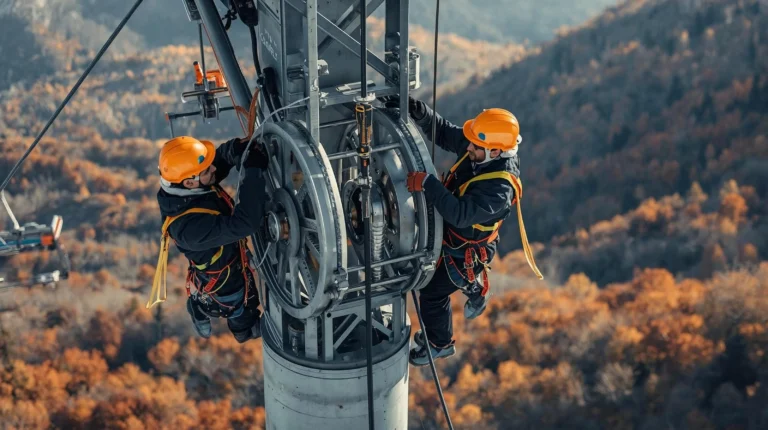
This is the weather of major technical maintenance. If you have ever wondered what happens to the facility outside the active season and how its absolute reliability is guaranteed for the winter, this article will take you behind the scenes of one of the most complex engineering operations in Pirin.
Where the cabins “sleep”: The secrets of the garage depot
Before the actual technical inspection of the 6.2-kilometer route begins, absolutely all of the blue gondolas must be removed from their steel cables. Leaving 165 cabins hanging outdoors during strong autumn storms would lead to unnecessary wear and tear on the delicate mechanisms and a huge risk of damage.
That's why the lift has a large-scale automated parking system. Each cabin is separated from the main rope and guided by special internal guide rails to huge covered garages (depots) located at the stations. There, they are stacked tightly next to each other so as not to take up unnecessary space.
While they are parked in the garage, the work on them is just beginning. Each cabin undergoes a detailed manual cleaning, lubrication of the door closing mechanism and inspection of the polycarbonate glazing. The most important step, however, is the ultrasonic test of the Grip itself – the clip that connects the cabin to the rope. Even the slightest indication of metal fatigue leads to immediate replacement of the component.
Magnetic-inductive control of the steel rope
The steel rope is the backbone of the gondola lift. It carries enormous weight and is subjected to constant tension, bending through hundreds of rollers and extreme temperature amplitudes (from -20°C to +30°C). Visual inspection by mechanics is not enough to guarantee its internal strength.
During major maintenance, a high-tech specialized magnetic flaw detector is used. This is a device that literally “wraps around” the rope and scans it millimeter by millimeter while it moves at a very slow, service speed. The device works on the principle of nuclear magnetic resonance in medicine – it can “see” the inside of the rope and detect even microscopic cracks or broken internal steel threads that are completely invisible to the human eye.
Working at Heights: Changing the Rubber Tires
If you look up at the massive metal poles along the route, you will notice the so-called “balancers” – long arms with many small wheels (rollers) through which the rope passes. Each of these wheels has a special rubber ring (bandage) that ensures the smooth, silent and smooth movement of the device.
Over time, due to the enormous friction and UV radiation, this rubber wears out and cracks. During maintenance, teams of certified industrial climbers climb to the top of each pole. They use special hydraulic jacks to lift the heavy steel cable high into the air, freeing the rollers from its weight. Each worn wheel is dismantled by hand and replaced with a brand new one – extremely hard and dangerous physical labor, which is carried out dozens of meters above the steep cliffs.
The art of “braiding” a steel rope
One of the most impressive maintenance processes is the shortening of the rope. Due to the colossal weight and constant tension, even the highest quality steel ropes have the physical property of stretching and lengthening over the years. To prevent the structure from sagging dangerously low above the forest, this lengthening must be compensated for.
Since the rope must be a continuous, smooth circle (cycle), its shortening is not done simply by cutting and welding with an electric arc. An ancient but technically perfect technique called “splicing” is used. International experts untangle the individual bundles of the rope in lengths of several tens of meters, cut off the excess, stretched part and then manually intertwine the steel strands back together. The friction between the strands in this tangle is so strong that the braided section becomes just as strong as the rest of the factory part of the rope.
The extensive technical maintenance is clear proof that your perfect winter or summer mountain vacation is based on months of tireless work by engineers, mechanics and climbers. When the season officially opens and you settle into the cabin, you can enjoy the ride with complete peace of mind, knowing that every millimeter of this facility has been checked by experts.
Make sure the facility is working before planning a trip!
 English (UK)