


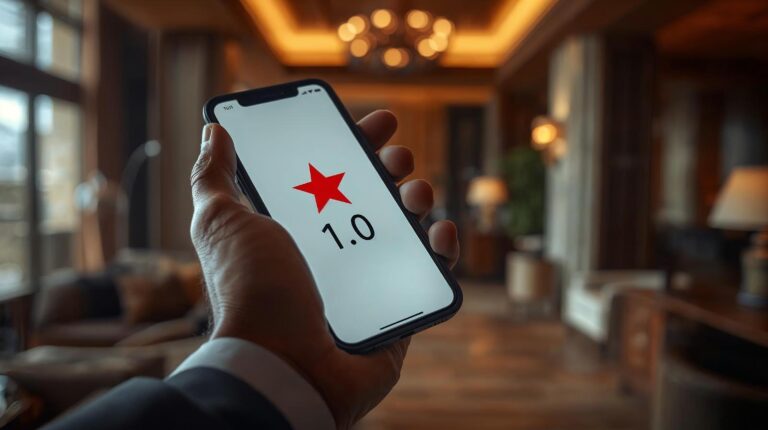
Every hotel owner in Bansko or the region knows this startling feeling: your phone vibrates with a notification from Booking Pulse, you open it with hope, and there you see only a red one. Rating: 1/10. Text: None. Explanation: None. Is this just a sour customer, or is it an "order" from the competition?
In the midst of the busy season, when the battle for every guest is fierce, such fake hotel reviews can destroy your overall rating and cost you thousands of leva in lost profits. This phenomenon, known as “Review Bombing,” is especially painful when the platform doesn’t allow you to defend yourself publicly.
Urgent Analysis: Customer or Competitor?
Before you panic, check the “guest” profile. Fake profiles often have the following characteristics:
- New account: It was created very recently and has no travel history.
- Lack of specificity: They only leave a rating or a generic “Terrible” to avoid a lie that is easily refuted.
- The silence: They don't answer the phone, don't respond to messages, and didn't complain to the front desk during the stay.
Problem Diagnosis: The “Silent Attack” at Booking.com
This is the worst-case scenario for hoteliers. Unlike Google or TripAdvisor, Booking.com often blocks the public reply option, if the guest has left only a numerical rating (Score only) without a text comment. The logic of the platform is questionable – if there is no claim, there is nothing to refute. However, this leaves the owners with their hands tied.
But the situation is not hopeless. Here is your strategic plan of action when the system works against you.
Step 1: Create The Paper Trail
Even if you can't post publicly under the review, you you can and you should write to the guest via Booking's internal chat (Extranet). This is critically important not because we expect a response, but to create proof of Booking support.
Use this template right away:
“Hello, we saw your rating of 1/10. We are extremely surprised, since during your stay with us you did not report any problems, and upon departure you did not share any complaints. We are trying to contact you by phone to understand what happened and compensate for any inconvenience, but we are unable to connect. Please share what went wrong. If we do not receive a response, we will be forced to consider the rating a mistake or malicious action.”
If the guest does not respond within 48 hours, take a screenshot of the chat. This is your proof that the customer is being dishonest and refusing communication.
Step 2: Attack via “Partner Support”
Don't look for a report button in the review itself - there is often no such button in non-text ratings. You need to do this through the admin panel:
- Log in Extranet -> Inbox -> Booking.com Messages.
- Select the Guest Reviews issue option.
- Report for “Fraudulent Review” (Fraudulent review) or “Competitor Attack”.
Your argument to Booking must be legally sound:
“The guest left the lowest possible rating without comment. There is no complaint record during the stay. The guest refuses communication after checking out (attach screenshot). We have strong reasons to believe that this is a fake profile used to manipulate the rating.”
The Battle of Google Maps and TripAdvisor
Here the rules are different and more business-friendly. On Google and TripAdvisor you always have the right to an “Owner Response”, whether there is text or not. Your goal here is not to convince the troll, but to show the future customers, that you are correct.
Fake Google Account Response Template:
“Dear [Name], we have carefully reviewed our reservation system and we do not find a guest with your name for the specified period. Since you have not left a comment and are not answering the phone number provided, we are considering this review as a fake account or spam. Please contact us to prove your stay. Otherwise, we have reported this rating to Google to remove it as it violates our authenticity policy.”
How to “vaccinate” yourself against future attacks?
The best defense against fake hotel reviews It's not about deleting them (which is slow and difficult), but about making them meaningless. If you have 500 reviews, one "unit" is a drop in the ocean. If you have 10 reviews, it's a disaster.
1. The “QR code in the elevator” strategy”
Make it easy for happy guests. Place discreet QR code signs at the reception or in the rooms that say: “Did you enjoy your stay? Support our small business with a rating.” The goal is for one fake unit to be "buried" under 10 new tens within the same week.
2. The 15-Minute Rule (Your Strongest Move)
Introduce an iron standard for the reception. 15 minutes after the guest checks in, the receptionist rings the room bell:
- “Hello, is everything okay with the room? Do you need anything extra?”
If the guest says “Everything is great,”, write it down in the Log Book with the time and name of the employee. If this guest later leaves a 1 star rating claiming that the room was dirty or cold, you have an argument with the platform: “At 2:30 p.m. the guest confirmed that everything was fine. The assessment contradicts the facts.”
3. Require an ID card without exceptions
Saboteurs hate to leave personal information. Never host “incognito” or “just for a while.” Strict registration scares off people with bad intentions and gives you data that you can use in legal actions for defamation.
Conclusion: Consumer Psychology
Let's end on a positive note. Consumers are smarter than you think. Statistics show that when a person reviews a hotel and sees a string of good reviews interrupted by one rating 1/10 without text, he automatically ignores it. Subconsciously, the client perceives it as a mistake or inadequate behavior.
Don't let the "ghosts" demotivate your team. Respond intelligently, report to the platform, and focus on making your real, happy guests speak louder than the haters.
Do you need professional help for your hotel in Bansko?
Managing your online reputation is only part of success. Check out our other business development resources.


 English (UK)