


When temperatures in Bansko and the higher parts of Pirin drop dramatically, there is no better protection than quality down jackets. They are the „gold standard“ for insulation in the world of outdoor gear and fashion, but the market is flooded with terms, numbers, and labels that often confuse the consumer.
What does “Fill Power 700” mean? Why can a thin jacket be warmer than a thick one? Which brand to choose and how to wash it without turning it into a shapeless bag? In this article, we will unravel all the mysteries of down so that you can make an informed choice for the upcoming winter season.
1. The mysterious numbers on down jackets: 600, 700, 800 (Fill Power)
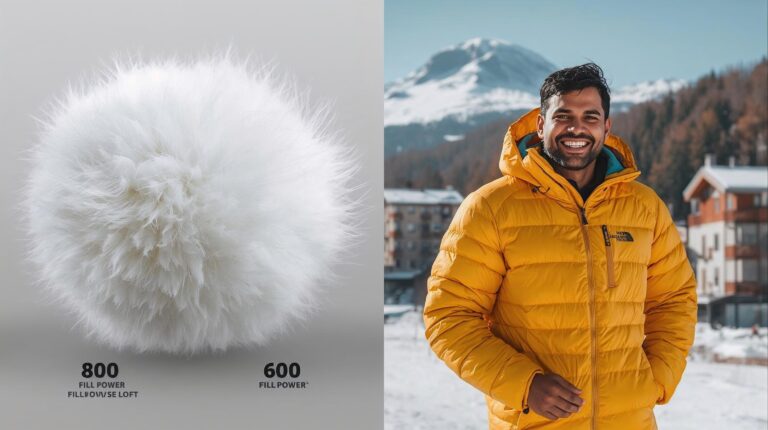
When you look at labels and see a number like 600, 700, or 800, this refers to Fill Power (filling force) or also called CUIN. This IT IS NOT indicator of the amount of down in the jacket, and for its quality and “fluffiness”.
What exactly does it measure?
Imagine taking 1 ounce (about 28 grams) of fluff and putting it in a glass cylinder.
- If this fluff takes up a volume of 600 cubic inches, that's fluff 600 Fill Power.
- If the same weight of down is of higher quality (finer), it will expand more, trap more air and take up a volume of 800 cubic inches. This is 800 Fill Power.
What does this mean to you?
The higher the number, the more efficient the down is. It traps more warm air (body heat) at a lower weight.
- 500 – 600 Fill Power: Standard class. Used in everyday urban use down jackets. They are a little heavier and bulkier, but they do a great job for moderate temperatures and are more affordable.
- 700 – 750 Fill Power: High class. Excellent balance between warmth and weight. Suitable for serious winter conditions or mountain tourism above Bansko.
- 800 – 900+ Fill Power: Premium class (highest quality). These are those ultra-light jackets that fit in your hand but are incredibly warm. They are used for mountaineering and expeditions.
2. Down vs. Synthetics: The Battle of the Fabrics
Natural down (most often from a goose or duck) is an unrivaled insulator, but it's not perfect. Here's how it compares to synthetic insulation (Primaloft, Thinsulate):
Natural down
- Advantage: Unsurpassed warmth-to-weight ratio. Extremely durable – lasts 10-15 years with good care.
- Disadvantage: The Achilles heel is the water. When it gets wet, the down becomes matted and stops providing warmth immediately. It dries slowly.
Synthetic insulation
- Advantage: It stays warm even when wet. It dries quickly, is easy to wash, and is cheaper.
- Disadvantage: It is heavier, does not compress as well, and over the years the fibers break, losing their properties faster than down.
3. Comparison Table: Pros and Cons
| Characteristics | Natural Down | Synthetic Insulation |
|---|---|---|
| Heat to weight | ⭐⭐⭐⭐⭐ (Excellent) | ⭐⭐⭐ (Good) |
| Compressibility | ⭐⭐⭐⭐⭐ (Minimum volume) | ⭐⭐⭐ (Takes up space) |
| Water resistance | ⭐ (Bad) | ⭐⭐⭐⭐⭐ (Excellent) |
| Durability | ⭐⭐⭐⭐⭐ (10-20 years) | ⭐⭐⭐ (5-7 years) |
| Support | Requires attention | Easy (laundry) |
4. What to choose? Specific recommendations
The choice depends on where you will wear the jacket – whether you need it for a walk along Pirin Street or for a hike to Vihren Hut. Here is a breakdown of the market:
OPTION A: For the city (Style and strength)
We are looking for thicker fabrics that don't tear easily and modern cuts.
- Budget class: Uniqlo Ultra Light Down or Zara Premium (always check the label for at least 80% down).
- Golden mean: The North Face (1996 Retro Nuptse) – classic with 700 fill power, very modern and warm. Also the models of Helly Hansen и Columbia (with Omni-Heat technology).
- High class: Canada Goose or Patagonia – a lifetime investment with uncompromising quality and ethically sourced down.
OPTION B: For the mountain (Lightweight and compact)
We are looking for a high Fill Power (over 700) to carry in a backpack or under a ski membrane.
- Budget Champion: Decathlon (Forclaz MT100). With a price of around 100-120 BGN and Fill Power 800, this jacket is unbeatable in terms of price/quality ratio.
- Technical class: Rab (Microlight Alpine) – the favorite jacket of mountaineers, using hydrophobic down (does not absorb moisture).
- Premium: Arc'teryx (Cerium) – the pinnacle of technology, with “smart” distribution of down and synthetics (Mapping technology).
5. How to care for a down jacket: The laundry ritual
Many people are afraid to wash their down jackets. The truth is that dirty fluff (soaked in sweat) loses its volume. Laundry is mandatory., but it should be correct:
- Preparation: Close all zippers and turn the jacket inside out.
- The preparation: Use a special liquid fluff detergent (e.g. Nikwax or Grangers).
- Laundry: Wool/delicate wash program (30°C) with extra rinse.
- Drying (Most Important): Put the jacket in the dryer on low heat. Add inside 3-4 tennis balls. As they spin, they will “beat” the jacket, breaking up the wet clumps of down and restoring its airiness. This can take 2-3 hours.
Conclusion
A down jacket is not just a garment, but a technology perfected by nature. Whether you choose a budget model from Decathlon or a high-end one from Arc'teryx, proper care will guarantee you warmth for years to come on the slopes and streets of Bansko.




 English (UK)