


- „"When will I actually see the full amount from the buyer?"“
- „"What happens if the property is still mortgaged to my bank?"“
- „"Will I have to pay state income tax?"“
In Bulgaria, and in particular in the dynamic resort market in 2026, the moment of transfer of ownership and the moment of net receiving money from the sale of property rarely match up perfectly. The process becomes even more complicated if you yourself are still paying off the mortgage.
In this fundamental guide, we will break down the entire financial cycle – from bank transfer deadlines, through repaying your debt (if any), to next year's tax return.
The Golden Rule of 2026: Only by bank transfer
Before we get into the details, let's clarify something fundamental. According to the laws in Bulgaria (and the Eurozone), any amount for a property must go through a bank transfer. There are no payments “in person” at the notary. All cash flows that we will describe below are bank transactions.
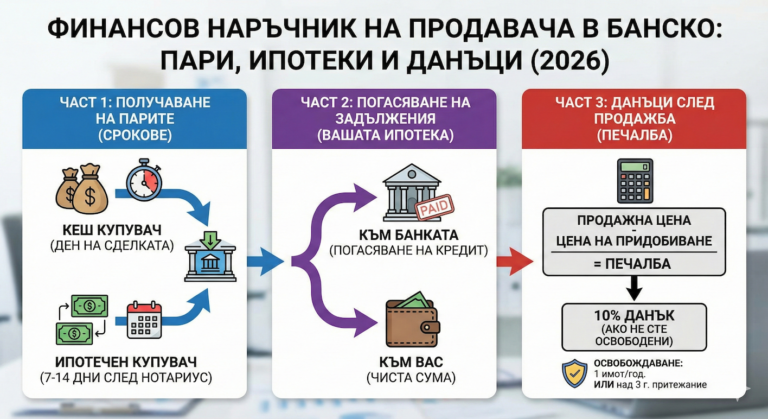
PART 1: Timeframe for receiving the money (Depends on the Buyer)
The speed at which the money will reach you depends entirely on how the buyer finances the deal.
Scenario A: Buyer with “Cash” (Fastest Option)
When the buyer has his own funds, the process is quick. The principle applies: “Money against a Notarial Deed” within the same day.
Payment is being made. ON THE DAY of the deal, BEFORE signing at the notary. The buyer orders the transfer and presents a payment order to the notary as proof. If your accounts are in the same bank, the money arrives immediately. If they are in different banks – usually within the same business day.
Scenario B: Buyer with Mortgage (The Complex Option)
Here's a paradox: You transfer the property today, and the buyer's bank pays in a week. Why? The buyer's bank won't transfer the money until it's sure that the property is already owned by their client and the bank has registered its mortgage as the first lender.
Payment history for a credit buyer:
- DAY 1: Confession of the deal. You sign the deed. You are no longer the owner, but you still have no money.
- DAY 2-7: Registration at the Registry Agency. Technological time for processing documents in court (Razlog District Court).
- DAY 8-10: Issuance of a new Certificate of Encumbrances (CE). It proves that everything is entered correctly.
- DAY 11-14: The bank transfers the money. The credit officer receives the new UAT and issues the money to you.
Conclusion: For a buyer with credit, expect your money between 7 and 14 days AFTER the notary.
PART 2: What happens if I have liabilities on the property?
This is the most common scenario. You sell a property that you are still paying off to your bank. How does the sale happen in this case? Very simple – your bank „eats first“.
Step 1: Certificate of residual debt
Before the transaction, you must obtain an official document from your bank that shows the exact amount for full repayment of the loan as of the date of the notarial transaction.
Example: You sell for 100,000 euros. You have 40,000 euros left to repay to the bank.
Step 2: Splitting the cash flows (Payday)
On the day the buyer (or their bank) pays, the money doesn't come to you all at once. It's divided into two tranches:
- Tranche 1 (To your bank): The amount of the certificate (e.g. 40,000 euros) is transferred directly to a special account at your bank for debt repayment.
- Tranche 2 (To you): The remainder of the sales price (e.g. 60,000 euros – your “net” amount) is transferred to your personal account.
This mechanism is described in detail in the Notarial Deed.
Step 3: Erasing the burden (Critical!)
Once your bank receives its money (Tranche 1), it issues a formal consent to cancel the mortgage. It is your responsibility (or the notary) to take this document to the Registry Agency so that the property can become “clean” for the new owner.
PART 3: Do I owe taxes AFTER all this?
The money (Tranche 2) is in your account. The debts are paid off. Congratulations! But the story does not end here. According to Bulgarian law (ZDDFL), income from the sale of property is subject to taxation.
What is the tax? (Profit tax)
You owe 10% tax, but only on the profit (the difference between the selling price today and the acquisition price according to your old notarial deed). Not on the entire amount!
When are you EXEMPT from tax?
The good news is that most sellers of residential properties are exempt. You do NOT owe tax if:
- ✅ The “One Property a Year” Rule: You are selling a residential property during the calendar year. It doesn't matter when you bought it.
- ✅ The “Over 3 years” rule: You are selling a property owned more than 3 years.
- ✅ Legacy: The property was acquired through inheritance.
Is it complicated? Let us drive the process.
Coordination between your bank, the buyer's bank and the notary is a complex task. We manage the entire financial flow to ensure that your obligations are repaid correctly and you receive the net amount on time.
Conclusion
The successful receiving money from the sale of property is a multi-step process, especially when banks are involved on both sides. The key is to detail the cash flows in the Notarial Deed. Your existing debts to the bank are always paid off first, and you get the difference. And don't forget to check if you owe profit tax next year!






 English (UK)