


There's an old saying in the restaurant business: "Turnover is vanity, profit is reality." You can have a full restaurant every night in the center of Bansko, but if your kitchen throws 20% of the products in the bin, you're working for fame, not money.
In the context of the intense winter season, where rents and wages are high, controlling cash flow is a matter of survival. Many owners try to save money by buying cheaper products. This is a mistake that drives away customers.
The real one reducing costs in the restaurant comes from two places: iron discipline on waste (Food Waste) and smart work with the wealth of our region. Here's how to achieve it in 4 steps.
1. War of the Fury: Where is your money going?
Food waste is not just an environmental problem. Every tomato thrown away, every portion returned uneaten, is a direct drain on your bottom line. The first step to optimization is an audit.
Step A: Back-of-house audit
It sounds unpleasant, but it's a must. For three days, keep track of what is thrown away in the kitchen.
- Incorrect workpiece: Do chefs peel potatoes too thickly? Do they slice meat with too much fat? This is a training problem.
- Poor storage: Are products in the refrigerator spoiling before they can be cooked? This is a problem of overstocking and lack of labeling (FIFO method - First In, First Out).
Step B: Plate Analysis (Front-of-house)
This is the food that customers return. If you notice that 30% of the guests leave half of the rice side dish on the plate, it means two things: either the portions are unnecessarily large, or the rice is not tasty. Reduce the weight of the side dish by 10% - the customer will not notice, but you will save hundreds of leva per month.
2. The Magic of Cross-Utilization
This is a senior management term that means one simple rule: Each product must be included in at least 3 dishes on the menu.
💡 Example from practice:
If you buy an expensive avocado just for a “Fancy Salad,” and no one orders it today, the avocado turns black and goes in the bin. That’s a waste.
But if the same avocado is used for:
- Quinoa salad;
- Guacamole dip for nachos;
- Bruschetta for breakfast;
...then the chance that the product will be realized and bring profit is tripled. Review your menu today and eliminate the "orphans" - the products that are used for only one dish.
3. Local vs. Global: Why is “Bansko” selling?
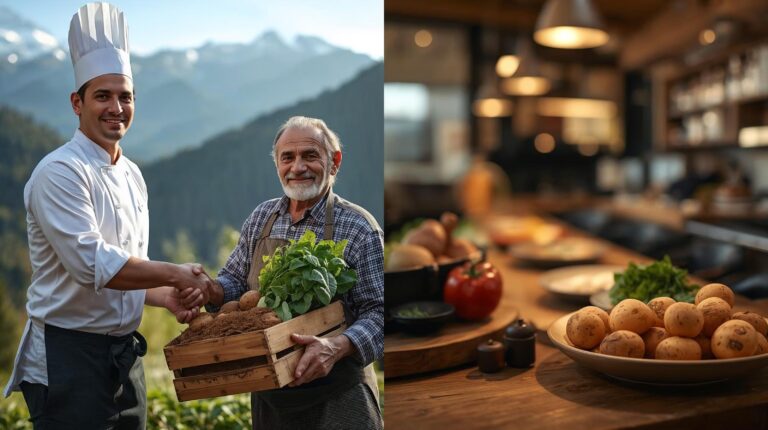
Many restaurateurs prefer large chains (like Metro or Kaufland) because of convenience. But working with local producers from the Razlog region, Bansko, Yakoruda and Gotse Delchev could be key for reducing costs in the restaurant and simultaneously improving quality.
| Local supplier | Big chain |
|---|---|
| Lower logistics: The product has not traveled 2000 km from Poland or Greece. Often the price of seasonal vegetables (potatoes, cabbage, carrots) is lower directly from the producer in the field. | Hidden costs: You pay not only for the product, but also for the transportation, the luxury packaging, the chain's marketing, and the middleman's markup. |
| Longer life: Picked yesterday = lasts longer in your fridge = less spoilage. | Shorter life: The product was picked weeks ago and "lives" thanks to chemistry and refrigeration. It spoils quickly after opening. |
4. Turn the Supplier into an Advertisement
Tourists in Bansko are not looking for frozen convenience foods, like they can eat in Sofia or London. They are looking for authenticity. When writing the menu, use the names of your local partners as a marketing weapon.
💡 The effect on price:
❌ “French fries with cheese”
-> Psychological price in the customer's head: 8-9 BGN.
✅ “Golden potatoes from the village of Yakoruda with homemade cheese from the Razlog Valley”
-> The customer happily pays: 14-16 BGN.
Conclusion: The product is the same (even cheaper for you if it's directly from the manufacturer), but the Perceived Value is much higher.
Bonus: The seasonal menu is the law
The best way to drastically reducing costs in the restaurant is to stop fighting nature. Don't offer tomatoes and cucumbers in January – they are expensive, tasteless and have a lot of spoilage. In winter in Bansko, pickles, root vegetables, sauerkraut and dried meats are king.
Adapt your menu at least twice a year (Winter/Summer). Seasonal products are abundant, their price is low, and the quality is the highest.
Close the profit loop
Optimized your costs? Great! Now it's time to review the entire process from scratch or train new staff.




 English (UK)