


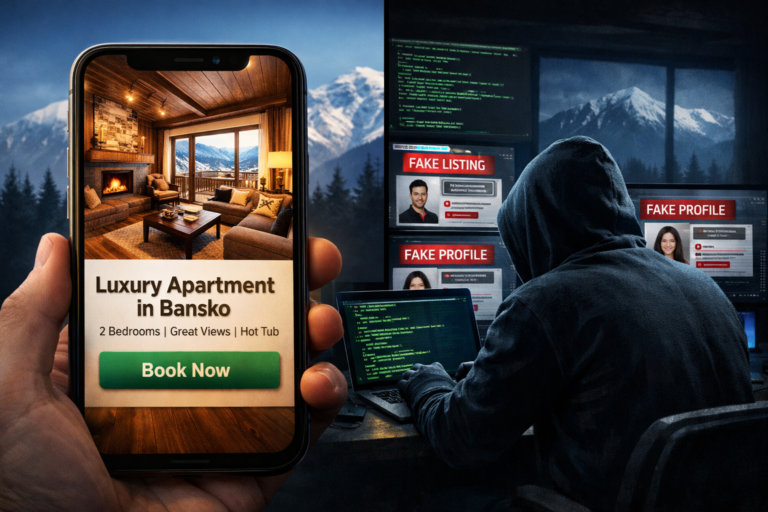
In this detailed guide, we'll look at the anatomy of an internet scam, based on real-life examples from Facebook groups, and give you professional tools to vet any landlord before risking your money.
The “Maria Genova” Case: Classic Red Flags
Recently, a profile appeared in a travel group offering a luxury apartment 100 meters from The Gondola. The offer sounds irresistible: two bedrooms, a free pool and sauna, available dates right at the peak of the season (end of January) and a low price.
When users express doubts, the “landlord” reacts aggressively, claiming to be a “Superhost” on Airbnb, but instead of a direct link to the platform, provides a website on a free domain (WordPress.com). This is a textbook example of a potential attempt to rental scams in Bansko.
Anatomy of Deception: Psychological Tricks
Scammers don't just rely on luck. They use proven psychological tricks to dull your vigilance. Here's how they work:
1. Creating artificial urgency (FOMO)
Phrases like “I only have 3 days off”, “I just turned it on and the phone overheated” or “Surprisingly, everything sold out” They aim to make you panic. The fear of missing out on a great offer blocks rational thinking. In Bansko, where good places really sell out quickly, this trick works flawlessly.
2. The missing digital trail
In this particular example, the landlord claims to have a website: Seaviewapartmentsbulgaria.wordpress.com. A red light should go on here. Serious businesses that own expensive beachfront properties in Bansko invest 20 leva per year for their own domain (e.g. .com or .bg). Free domains in WordPress or Blogspot are a favorite of scammers because they are anonymous and can be deleted within seconds of receiving the transfer.
3. Aggressive Defense and “Social Proof”
If you ask why there is no link to Booking, the scammer often responds with an insult: “"Am I a fraud? Here, I'm sending you pictures!"”. Often, fake profiles (so-called “socks puppets”) are included in the comments, which confirm the correctness of the owner.
Professional proofreading: 5 steps before translation
Before you open your banking app, take 10 minutes of detective work. It could save you hundreds of leva and a ruined vacation.
Step 1: Reverse Image Search
Fraudsters rarely take photos of real objects. They steal photos from luxury chalets in the Alps or from old real estate ads.
- Download the photo of "living room with fireplace" from Facebook.
- Open Google Lens or TinEye.
- If the photo appears on a Swiss real estate site or on a Pinterest board for “Interior Design,” it’s a definite scam.
Step 2: Checking “Superhost” status
The term “Superhost” is a trademark of Airbnb. It’s not just a word, but a digital badge tied to a specific profile. If someone claims to be one:
- Request direct link to the Airbnb account.
- Look at the review dates. Are there any reviews from the last month?
- Compare the price. If an overnight stay on Airbnb is 300 BGN, and on Facebook they offer it for 100 BGN, the difference is too big to be just because of “saved commissions”.
Step 3: Geolocation and Street View
Bansko is a small town, but densely built up. Ask for the exact address. “100 meters from the Gondola” is a stretch. Open Google Maps and use Street View. Does the building exist? Are there signs for a hotel or complex? Often, scammers give addresses to non-existent streets or empty plots.
Safe payment: Where do tourists go wrong?
The biggest risk in rental scams in Bansko It comes from the payment method. Scammers want the money quickly and in an untraceable way.
Golden rule for bank transfers
Never transfer a deposit to:
- EasyPay / FastPay account without reason.
- Mobile wallet by phone number only (Revolut, A1 Wallet) if you don't have a contract.
- A personal account of a person whose name does not match that of the profile.
The safe translation is: Bank transfer to a Legal Entity (Company) or an Individual, where the reason is written: “Deposit for overnight stays, dates XY, Apartment [Address/Name]”. This is the only evidence that counts in court.
Table: Platforms vs. Direct Negotiation
Is it worth the risk to save 15% in commission? Here's an objective comparison:
| Characteristics | Booking / Airbnb | Facebook / OLX |
|---|---|---|
| Security of money | High (Money is held by the platform until check-in) | Zero (Direct translation) |
| Cancellation protection | Clear policies and automatic returns | It depends on the goodwill of the landlord. |
| Reality of the photos | Verified by the platform | Easily manipulated |
| Price | Higher (incl. fees and taxes) | Lower (theoretically) |
What should we do if we have become a victim?
If you nevertheless fall into the trap of rental scams in Bansko, you need to act immediately. Many people give up because the amount is “small” (100-200 BGN), but that’s exactly what criminals are counting on.
- Keep all evidence: Screenshots of the chat (before it was deleted), the scammer's profile, a link to the ad, and the payment order.
- Contact your bank: If the transfer was made recently, the bank may attempt to stop the transaction or request a recall, although success is not guaranteed.
- Report to the GDBOP: The Cybercrime Sector accepts reports online. Even if they don't return your money immediately, accumulating complaints against a specific bank account leads to its blocking and the owner being revealed.
- Warn others: Share your experience in the large groups about Bansko, but be careful not to violate personal data rules by posting only facts.
Conclusion: Cheap comes out expensive
Bansko is a wonderful destination, offering world-class conditions. But as with any popular resort, the rule applies here: if an offer seems too good to be true, it probably is.
Use established platforms or book directly only from websites of hotels and resorts with a history, real address and landline numbers. Be skeptical of “anonymous” Facebook profiles that pressure you for a quick deposit. Your security is in your hands.
 English (UK)