


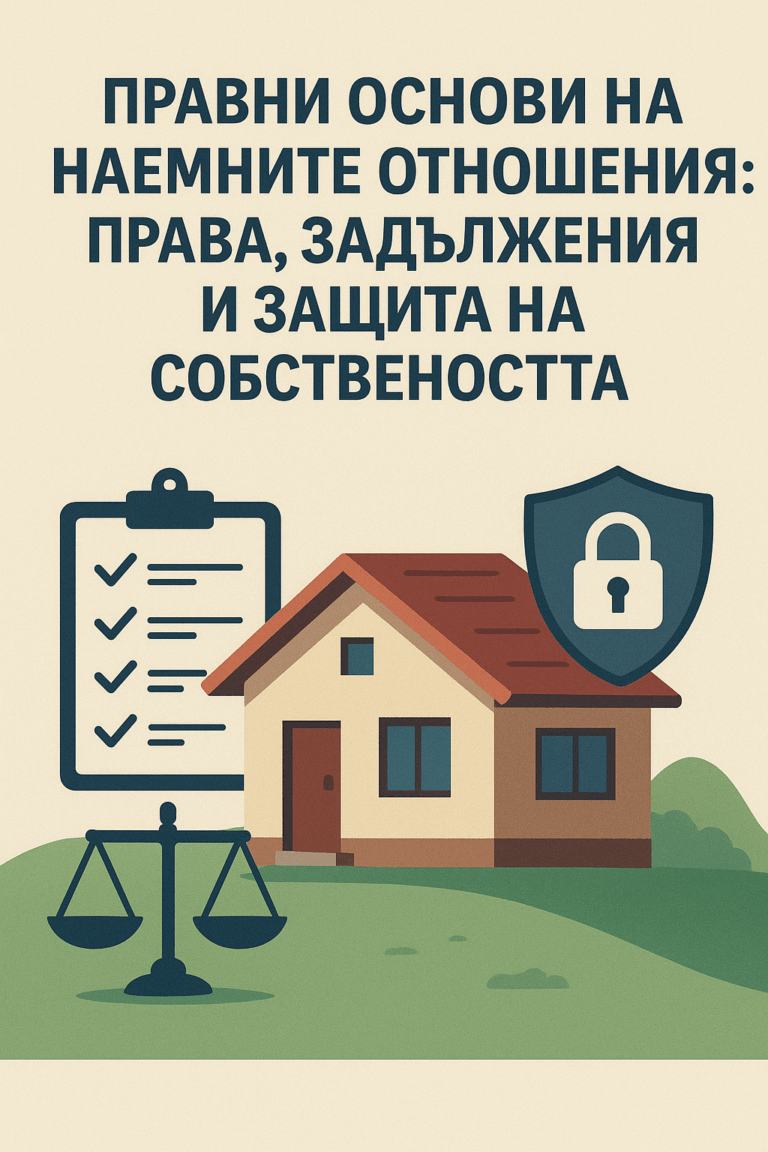
Many apartment owners in Bansko underestimate the need for proper documentation. They often rely on verbal agreements, trust, or the standard terms and conditions of online booking platforms. However, this practice carries serious risks.
In this article we will examine in detail the foundations of rental relations according to Obligations and Contracts Act (OCA), to help you protect your investment, keep your property in excellent condition, and avoid costly and exhausting legal disputes.
1. The Rental Agreement: The Backbone of Your Security
In Bulgarian law, a rental agreement is a bilateral and negotiable act. Although the law does not require a mandatory written form for its validity (even an oral agreement gives rise to legal consequences), a written contract is absolutely essential in order to prove the conditions in the event of a possible dispute before a court or institutions.
Key elements of a proper contract in Bansko
For your contract to be a truly secure instrument, it must contain the following mandatory details:
- Property personalization: Exact address (incl. apartment number and building/complex), exact area according to a notarial deed, adjacent parts (ski locker, parking space) and a general description of the current condition.
- Price and payment terms: Monthly rent amount, currency (usually BGN or EUR), exact payment method (we strongly recommend bank transfer for traceability) and due date (e.g. by the 5th of the current month).
- Validity period: A clear indication of whether the contract is fixed-term (e.g. for 6 months during the ski season) or indefinite, along with specific termination clauses and notice period.
- Cost breakdown (Specific to Bansko): Clear definition of who covers maintenance fee the common areas (which in gated complexes in Bansko can be significant), the costs of electricity, water, heating, cable TV and internet.
- Subletting clause: Be sure to include a clause that explicitly prohibits the tenant from subletting the property through platforms like Airbnb without your written consent.
2. Rights and obligations under the Civil Code: Who pays for what?
The law makes a very clear distinction between the responsibilities of the two parties (in Art. 228 - Art. 239 of the Civil Procedure Act). Knowing these legal norms is key to avoiding the classic and most common dispute: "whose expense is this repair?".
Obligations of the Lessor (Owner):
- Transfer of possession: You are required to provide the property in a condition that is suitable for its intended use. If you are renting it out as a residence, it must have functioning basic installations.
- Major repairs: All damages that affect the structure of the building, the main installations (plumbing failures in the walls, roof leaks, a burnt-out heater) boiler, damage to the central heating system) or are due to natural wear and tear over the years, are entirely at the expense of the owner.
- Ensuring peaceful use: The landlord has no right to prevent the tenant from using the property. This means no unscheduled or sudden visits, except for regular inspections that are explicitly agreed upon in the contract (e.g. once a month with prior notice).
Tenant's obligations:
- Payment of rent and supplies: The tenant is obliged to strictly pay the rental price and all household expenses related to the use within the agreed deadlines.
- Current fixes (Minor repairs): It is the tenant's responsibility to repair, at their own expense, any damage resulting from normal, everyday use. Examples: replacing burnt-out light bulbs, replacing broken locks, repairing pulled-out sockets, cleaning drains, and refreshing heavily soiled walls.
- Care of a good owner: The property must be kept and operated only for its intended purpose. For example, the apartment cannot be used as a warehouse for building materials.
3. The handover protocol: Your insurance against damage
One of the most fatal and common mistakes of property owners is the lack of a detailed Handover and Acceptance Protocol. This document is not just a formality - it is an integral and legally binding part of the rental agreement.
What must the protocol contain?
- Detailed description: List of available furniture and equipment (including brands, models and visible marks at the time of handover).
- Condition assessment: Description of the condition of the walls (e.g. “recently painted, no stains”), flooring, joinery and plumbing.
- Measuring instruments: Accurate readings of water meters, electricity meters and heat meters as of the date and time of taking possession.
- Photographic material: It is highly recommended to take detailed photos of the property on the day of check-in. These photos are printed, signed on both sides of the back and attached as an official annex to the protocol.
4. Security Deposit Management: Rules and Good Practices
A deposit is a sum of money that serves as security for the tenant's obligations - both for paying bills and covering any possible damages.
For long-term rental:
Market practice in Bulgaria requires a deposit of one month's rent. However, for more luxuriously furnished properties in Bansko, equipped with modern and expensive equipment, it is completely appropriate and legal to agree on two months' rent as a deposit.
Attention: The deposit does not represent „"last rent". It is refunded to the tenant only after the official termination of the contract, the return of the keys with an exit protocol and the establishment of the complete absence of unpaid household debts (winter electricity bills are especially important) and material damages. You have the legal right to intercept (withhold) amounts for unpaid bills, shortages or culpably caused damages.
For short-term (holiday) rental:
Platforms like Airbnb and Booking.com have their own mechanisms and programs to protect the host against damage, but practice shows that they are not always unconditional and quick to pay. For direct bookings (outside platforms), always require a deposit or damage deposit, payable in advance by bank transfer, or blocking of the guarantee amount (pre-authorization) on a credit card.
5. Normal Depreciation vs. Actual Damage
The distinction between these two concepts is essential and is the cause of most conflicts when leaving the property. According to the Land Tenancy Act, the tenant not responsible for damages due to ordinary and normal use of the item.
- Normal depreciation (Assumed by the owner): This is the natural waste of the weather. Examples: slight fading of latex, small scratches on parquet from walking, depreciation of mattresses, sagging hinges on cabinets from use.
- Damages and damages (To be borne by the tenant): This is damage beyond normal use. Examples: broken glass or furniture, deep scratches on laminate from ski boots, burns or stubborn stains on upholstered furniture, gnawed door frames from pets, broken light switches.
If the damage is caused by fault, the tenant is liable for compensation. If he refuses to pay voluntarily, the amount is legally deducted from the deposit left. If the deposit is insufficient, the difference can be claimed in court.
6. Termination of the rental relationship
Every contract has its end. According to Bulgarian law, rental relationships can be terminated on several grounds:
- By mutual consent: The cleanest option. It is formed with a written agreement (annex) for termination and a bilaterally signed outgoing handover protocol.
- Upon expiry of the agreed period: For fixed-term contracts. Attention: if after the expiration of the term the tenant continues to use the property with the knowledge and without the landlord's opposition, the contract automatically becomes indefinite (Art. 236 of the Lease Contracts Act).
- With notice: In the case of open-ended contracts, the law provides for one month's written notice from each party. In the case of fixed-term contracts, the term specified in the contract itself applies (often 1 or 2 months).
- Spoilage due to non-performance: If the tenant consistently fails to pay rent, accumulates unpaid bills, or intentionally damages the property, the landlord has the right to terminate the contract. In the case of long-term leases, this usually requires a written warning (notarial summons) with an appropriate period of time for voluntary compliance.
Conclusion
A proper written rental agreement and a detailed handover protocol are not a manifestation of excessive pedantry or distrust. They are a sign of high professionalism. Creating clear, written rules from the very beginning provides peace of mind for both you as a property owner in Bansko and your tenants, building a solid foundation for mutually beneficial relationships.



 English (UK)