


In Bansko and the region, finding quality staff has become a true “Mission Impossible”. Before every active season – be it winter or summer – we hear the same mantra from the owners of establishments: “There are no people! Nobody wants to work! The young are lazy!”.
The truth, however, is a little more uncomfortable and requires an honest look in the mirror: People exist. But they go where they feel valued, safe, and respected. Turnover in our industry is killer, and the cost of training a new person every month is much higher than the cost of retaining the old one.
Many owners believe that the problem of the staffing crisis can be solved just by throwing money at it. “I give them high salaries and they still leave in the second month!” – they complain. This is clear evidence that successful restaurant staff retention It requires more than just a paycheck. It requires culture.
In this final article in our series, we will look at the 5 fundamental factors that make good waiters and chefs remain loyal to an establishment for years, even when the competition offers 100 leva more.
1. Transparent Tipping System (Trun)
Money may not be everything, but fairness is. Nothing demotivates staff faster than feeling like they are being “screwed over” or suspecting that the manager/owner is “messing around” with the tips. In the HoReCa industry, tips are a major daily motivator.
⚠️ Common mistake in Bansko:
Unclear rules like “Put them in the box, and we'll fix them at the end of the month”. This creates enormous tension, intrigue between shifts, and suspicions of theft. When the rules are unclear, trust disappears.
The solution: Ironclad rules and transparency
It doesn't matter which system you choose, the important thing is that it is written in black and white and followed:
- Individual system: Everyone takes home what they earned (plus % for the kitchen/bar). This motivates the sales “sharks.”.
- Pool system (Trun): All tips are pooled and divided based on hours worked or a point system (e.g. Head Waiter – 1.2 points, Assistant – 0.8 points). This encourages teamwork.
Golden rule: The kitchen and the bar mandatory should receive a percentage (usually 15-20% of the total tip). Without delicious food and quick drinks, there is no satisfied customer and no tip. When the waiter shares with the chef, the chef issues his orders with priority.
2. Respect goes through the stomach: Food for staff
It sounds like a small thing, but in the psychology of the restaurant business, this is a huge symbol. You can't expect a waiter to sell expensive steaks and truffles with a twinkle in his eye if before his shift you fed him leftovers from yesterday, pizza "krajštnici" or the cheapest sausage.
The team is the engine of your establishment. The quality, delicious lunch for the staff (the so-called. Family meal) shows respect.
💡 The “Family Dinner” idea:
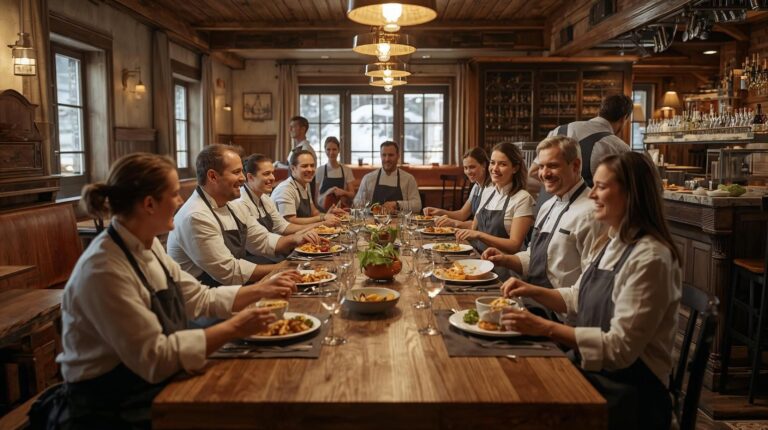
Take 30 minutes before opening, when the whole team sits down together at a table. The chefs have cooked something delicious (albeit simple) especially for their colleagues. This time for conversations and laughter brings the team together more than any expensive team building. A well-fed and respected employee is a smiling employee.
3. “The Boss’s Back”: Protect Your People
In the old school of tourism, the rule was “The customer is always right.” In modern management, for a successful restaurant staff retention the rule is: “Support your employee when they are right so they can take care of the customer.”
During the season in Bansko All kinds of tourists come. Sometimes they are rude, aggressive, drunk or unfair. This is the moment of truth for you as a leader.
If a young waitress is undeservedly insulted and sees the manager or owner step in and defend her (even at the cost of throwing the customer out and losing the bill), she will be loyal to that leader forever. She will know she has “your back.” However, if you let her “take the hit” or make her apologize when she is not at fault, she will be looking for a new job the very next day.
4. The First 7 Days: Don't Throw Them Into the Fire
A huge mistake during the peak season is hiring someone and putting them "on line" right away. “Here's your apron, go to table 5!”. This is a recipe for disaster.
The new employee feels stressed, makes mistakes, the old employees get annoyed with him for delaying them, and on the third day he quits. Invest in Onboarding (introduction):
- For the first 2 days, the new employee only observes (Shadowing) an experienced colleague.
- Give him the menu to take home and test it out before releasing it to customers.
- Assign him a “mentor” from the team to be responsible for him.
5. Seasonality and Perspective: The Bansko Problem
The biggest problem for the region is seasonality. Employees are looking for security. How do you keep good people when the season ends in April?
This is where you need to be creative:
- “Return” Bonus: Negotiate a fixed bonus that is paid at the beginning of the next winter season if the employee returns to you.
- Year-round employment (even part-time): If you have the opportunity, keep the core team (Key staff) during the summer, even on reduced working hours or for maintenance/repairs.
- Investment in skills: Use your dead months for courses. Pay for a sommelier or barista course for your best waiter. When a person sees that you are investing in their development, they feel obligated to return the gesture with loyalty.
Series Finale: The Road to Success
With this article, we conclude our full cycle of restaurant and pub optimization in Bansko. Let's recall the pillars of success that we built together:
- Service and Menu: We optimized sales through “Menu Engineering” and the Spanish service model.
- Marketing: We learned to take pictures of food with our phones and manage our online reputation.
- Atmosphere: We understood how music controls turnover.
- Team: We revealed the secrets of upselling and staff retention.
Now the ball is in your court. Knowledge is power only when applied. Have a successful season!
Do you want to negotiate everything from scratch?
This was the final part of our complete guide to the HoReCa business. Go back and see all the tricks you might have missed.



 English (UK)