

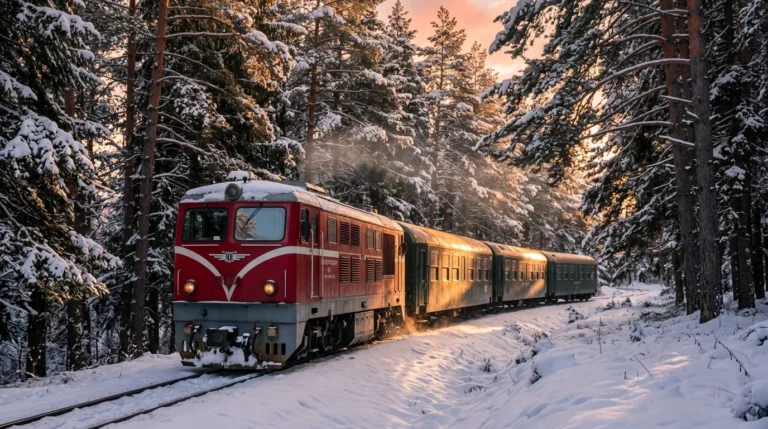
Imagine the end of the 19th century. The Rhodopes are a majestic, but harsh, impassable and almost completely forgotten mountain range. There are no roads, no stable bridges, not even a trace of a railway. People from the mountain towns like Velingrad, Yakoruda and Bansko are cut off from the rest of the world — essential goods are transported by mules and donkeys along narrow, dangerous goat trails.
It was in this era of isolation that the bold idea of what we now proudly call Rhodope narrow gauge railway. In this fundamental research we will follow the history of the Rhodope narrow gauge railway — from the first drawings to the recognition of global media such as The Guardian.
Why was the idea of a narrow-gauge railway born?
At the end of the 19th and beginning of the 20th century, the Rhodope Mountains and the Pirin region held immense wealth—old forests and valuable ores. After the Liberation in 1878, the new Bulgarian state realized that without adequate infrastructure, these lands would remain economically isolated. The new national strategy after World War I urgently required the connection of the Rhodope Mountains and the Mesta Valley with the Thracian Plain.
💡 Did you know?
The choice of a track gauge of exactly 760 mm is not accidental. The terrain is extremely difficult, and the narrow gauge allows for much smaller curve radii and steeper gradients. If you want to see what these tracks look like today, check out our detailed list of all stations and stops along the route.
The Epic of Construction: 24 Years of Engineering Genius (1921–1945)
The construction of the line is a true engineering feat, stretching over 24 years. The line slowly makes its way through the cliffs, becoming the most important artery for the region.
From September to Velingrad (1921–1926)
The first sod was broken in 1921 at Septemvri station. When the train reached Velingrad (then Chepino-Banya) in 1926, tourism and trade in the region flourished for the first time. Today, many tourists still choose this section as their one-day SPA itinerary.
The unique “Snails” and the breakthrough to Avramovo
This is the most difficult stage. Engineers designed unique spiral climbs, called “screws,” to gain height in the steep mountain. In these, the train makes a full 360-degree turn inside the rock itself. These engineering wonders are extremely rare worldwide.
The connection with Bansko and the voluntary work of Dobrinishte
Razlog and Bansko were connected in 1941–1942. But the most inspiring part of the history of the Rhodope narrow gauge railway was the finale in 1945. When state money ran out, the locals of Dobrinishte volunteered to work - men, women, and children carried stones and laid rails by hand to complete the route themselves.
Technical achievements and records
- The tunnels: A total of 35, dug mostly by hand with picks and shovels.
- Avramovo Train Station: Located at 1267 m above sea level, it remains the highest railway station in the Balkans.
- Extreme slopes: The train overcomes slopes of up to 30‰ using traction alone, without gearing.
⚠️ Advice for the modern traveler
Although the story is romantic, the narrow gauge train schedule is strict. The journey from Bansko to Septemvri takes about 5 hours — prepare for a slow and contemplative adventure.
The Golden Age and Powerful Locomotives
In the 1960s, the legendary German Henschel locomotives, which are still the beating heart of the railway today. Although the freight importance of the line decreased in the 1970s, it established itself as a unique cultural heritage.
The Guardian's global recognition
Today, the line is an official cultural monument. The prestigious edition The Guardian placed it among the 10 most beautiful in Europe. Traveling today in the retro narrow gauge railway cars, you are not just moving, but becoming part of a living history, preserving the memory of generations of Bulgarians.
The Rhodope Narrow Gauge Railway is eternal proof that the human spirit and perseverance can carve a path through even the most impassable mountain. The next time you see the little train in Bansko, remember — it’s 125 kilometers of pure willpower.
🚂 Discover everything about the Rhodope Narrow Gauge Railway
Interested in current ticket prices, secret hiking routes, or traveling with children? Check out our main page with all the materials!
 English (UK)