


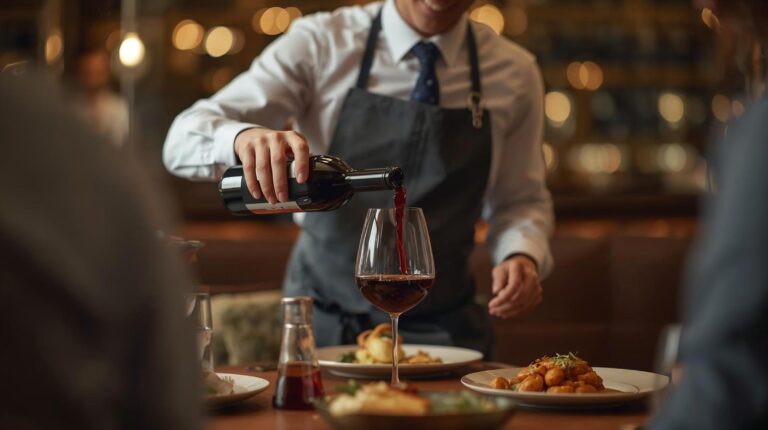
There is a cruel truth in the restaurant business that applies with full force to Bansko – from the small tavern to the 5-star hotel: The customer can forgive mediocre food if the service was brilliant. But they will never forgive perfect food if the restaurant service was arrogant, slow or absent-minded.
At the peak of the season, when the restaurants are full and the pressure is immense, the quality restaurant service becomes the currency of success. In the age of Google Reviews and TripAdvisor, service isn't just a matter of upbringing. It's marketing. It's crisis management. And most of all, pure math for your turnover.
Today we will look at three specific “Front of House” techniques that turn casual tourists into loyal customers. Some are classics, others we borrow from the best schools in Southern Europe.
1. The “Spanish Model”: A Cure for Nervous Customers
Why wait for a customer to get thirsty to take their money? In Spain, Italy, and Portugal, there is a golden rule that every establishment follows: No one sits at an empty table.
The moment the customer sits down, the waiter is there – not just with the food menu, but with a specific question.
“"Good evening! Here are your menus. What would you like to drink while you browse - perhaps a bottle of water or a glass wine from our selection?”
The psychology behind the trick
When one enters a restaurant, especially after a long day on the ski slopes in Bansko, he is often in a “Hangry” state (a combination of hungry and angry). Reading a menu requires time and mental activity. If you leave a customer “out in the cold” for 10 minutes while they choose a salad, the level of irritation rises dramatically.
Why do you win if you serve the drink immediately?
- You relieve tension: The first sip of wine, beer or water acts as a sedative. The customer is already “consuming”, he is served. He is no longer in such a hurry and does not look at his watch.
- You save time in the kitchen: While guests are drinking their aperitifs and chatting, the kitchen has those precious 5-10 minutes to prepare for the order.
- You pick up the average check: Beverages are the highest-margin item. When a drink comes first, the likelihood that a customer will order a second one during the main course jumps by over 40%.
💡 Pro Tip for Managers
Instruct servers to be specific. The question “Would you like something to drink?” often elicits a response of “No, we’ll wait.” A specific offer (“Mint lemonade?”, “Large draft beer?”) sells.
2. The “Mirror” Technique: No more returned plates
“The most expensive food is the one that goes in the bin.”
How many times have you heard: “But I said no onions!” or “I thought the garnish was included”? These mistakes are costly – literally (food spoilage) and figuratively (a disappointed customer who won't return).
This is where technology comes to the rescue. “Mirroring”. This is a mandatory element of professional service in a restaurant. It is not just mechanical repetition, but an act of validation.
| Wrong approach | Correct approach (“Mirror”) |
|---|---|
| The customer orders. The waiter says “OK” and leaves quickly. | The customer orders. The waiter says: “Let me check if I wrote it down correctly: One Shopska without onions, one sach and two draft beers. Is that right?” |
| Result: Risk of error 30%. The client is not sure if he is understood. | Result: Risk of error 0%. The customer feels heard and respected. |
3. The “Five Minute” Rule (Check-back)
Most unhappy customers don't make a fuss at the restaurant. They just keep quiet, pay their bill, don't tip, and... never come back. And an hour later, they write a scathing review online.
The salvation lies in timely verification, known in the industry as Check back.
How does it work?
The waiter must pass by the table. from 2 to 5 minutes after the food is served. That's when customers have taken their first "two bites." This is the critical moment.
⚠️ Warning, error: Don't ask mechanically. “Is everything okay?”. This is a closed question, to which we instinctively answer “Yes”, even if the meat is tough.
✅ The right approach: Ask an open or specific question:
- “How is the steak done?”
- “Do you like the sauce with the fish?”
- “Is the soup okay, is it warm enough?”
If the problem is caught at this point, the kitchen can fix it in minutes. The customer sees care and leaves with a sense of personal attention. If no one asks, the negative emotion goes straight to social media.
Training is the best investment
These three techniques for good restaurant service don't require expensive software or restaurant renovations. They only require training. Managers in Bansko and the region need to understand that 10 minutes of briefing before a shift are more valuable than thousands of leva for advertising.
Role-play these situations with your team today. Have your servers practice offering drinks immediately and repeating the order out loud. The effect on turnover and the atmosphere in the establishment will be felt that very evening.
Want more tips for your business?
Good service also requires good economics. In the next article, we will look at how to stop money leaks in the kitchen.



 English (UK)