


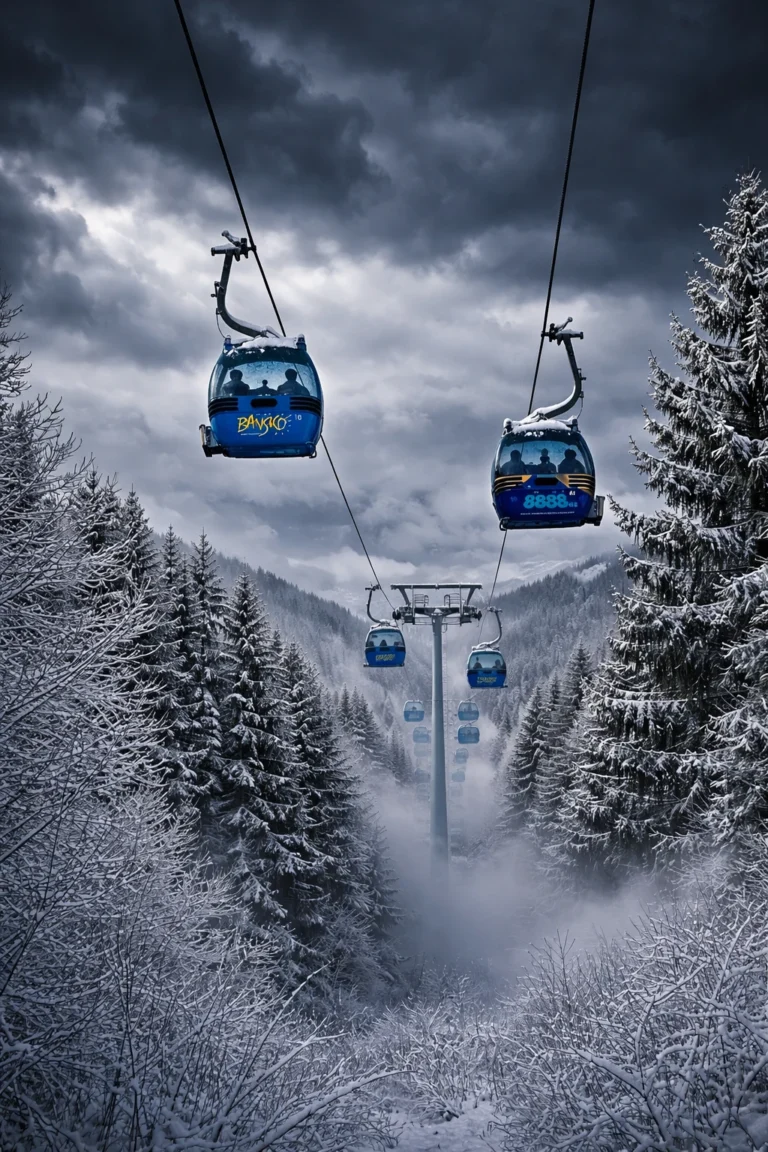
Many people have a natural, primal fear of heights, especially when they find themselves confined to a small cabin suspended dozens of meters above the ground. When we add to this psychological factor the harsh, rapidly changing winter conditions of the Pirin Mountains, the question of cable car safety in Bansko logically comes to the fore.
What happens when a strong mountain wind blows? Is it dangerous if the lift suddenly stops in the middle of the route? Is there a risk of thunderstorms in the summer? In this article, we will take a detailed look at the high-tech safety systems that guarantee your absolute peace of mind on the way to the summit.
The Invisible Guardians: The Anemometers on the Poles
Contrary to expectations, the biggest enemy of cable cars is not cold, heavy snow or even ice, but strong crosswinds. If the speed of the air masses is too high, there is a physical risk that the cabins will start to sway violently, which can lead to serious discomfort for passengers and the risk of the cable derailing from the pulleys.
To prevent this, high-tech wind sensors called wind sensors have been installed on key poles along the route. anemometers. These precision instruments continuously measure both the speed and direction of air masses on the steep slopes of the mountain. The data is transmitted in real time (every second) to the central computer in the engine room. The software of the Austrian manufacturer Doppelmayr is programmed with critical values. When the wind reaches a certain speed (usually gusts above 15-20 meters per second, depending on the specific route profile), the system automatically takes protective actions.
Why does the elevator sometimes stop or move slowly?
Tourists often get nervous and worried when the gondola suddenly slows down or stops completely in the air for a few minutes. The truth is that this is definitely not a technical failure, but quite the opposite – the clearest proof that the safety systems are working flawlessly.
When the sensors detect a sudden, hurricane-force gust of wind, the computer automatically reduces the speed of the steel cable to reduce the kinetic amplitude of the cabins’ swaying. If the gust is extremely strong, the facility stops preemptively, waiting for the dangerous gust to pass, then smoothly resumes its movement. So the next time you stop in mid-air and feel a swaying sensation, don’t panic – you are absolutely safe and the computer is simply protecting you from the turbulence.
Evacuation Plan: Worst Case Scenario
Despite all the complex electronic systems, independent diesel generators and backup hydraulic motors, the ski area management and rescue services are always prepared for the most extreme scenario – a complete technical impossibility of the facility being put into operation.
If the gondola becomes completely blocked (for example, due to a physical jamming of the rope), the extensive alpine rescue protocol is activated. The Mountain Rescue Service (MRS) and specially trained teams of industrial climbers at the lift begin immediate action. The rescuers physically move along the steel rope itself with special roller devices to each blocked gondola. They then open the doors manually, put the passengers in alpine harnesses (called rescue diapers) and lower them one by one safely to the ground using alpine ropes.
Such large-scale evacuations are extremely rare worldwide, and Bansko has never had to evacuate completely using this method. However, the MESS and lift teams conduct mandatory large-scale training before each winter season in order to be able to react quickly, in a coordinated manner and without panic in the event of a possible need.
Ultimately, every technology deployed, weather sensor, and rigorous maintenance procedure has one sole purpose – to make sure your journey to Banderishka meadow It will not only be beautiful and full of emotions, but also protected by the highest global security standards.
Check the forecast and plan your trip safely!
 English (UK)