


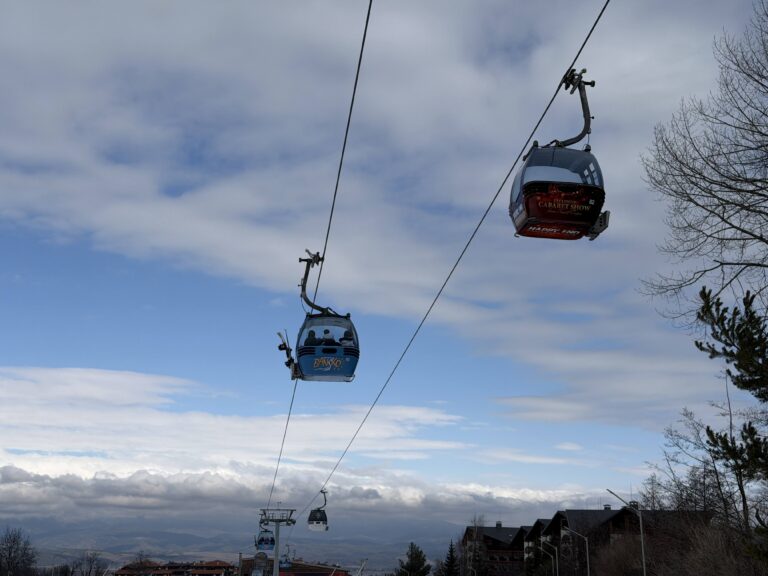
Today we will answer all these concerns honestly, with arguments and technical facts. The truth is that modern cable cars are statistically among the safest means of transport in the world. Let's take a closer look at what the real gondola lift safety in Bansko, what the facility's protective mechanisms are, and why the tragedies we sometimes hear about on the news from other countries have a completely different engineering and human nature.
Why does the elevator stop “for no reason” for a minute or two?
You are traveling calmly, enjoying the snowy view, and suddenly the gondola slows down and stops completely in the air. There is a silence that often causes anxiety among passengers. When the lift stops suddenly and after 60 or 120 seconds starts moving again completely normally, this is definitely it is not an accident. This is absolute proof that security systems are working flawlessly. Here are the three most common reasons for this:
- Boarding of disabled passengers or cargo: The facility moves continuously, and at the stations it simply slows down. But when a person in a wheelchair, a skier with an injury from the piste, a rescue team from the Russian Federation with a stretcher or a family with a bulky baby stroller need to board at the starting station, the operator manually stops the entire line via the control panel. The passengers are waited for to be safely seated and the lift starts moving again.
- Door safety sensor triggered: Each cabin is equipped with a sensor that detects whether the doors are tightly closed before it leaves the station. If a tourist gets a pole, ski boot or backpack strap stuck in the door, the sensor detects an irregularity and automatically stops the system. The operator goes to the problematic cabin, clears the obstacle and restarts the movement.
- Distance adjustment: The central computer constantly monitors the exact distance between the individual cabins on the rope. If it detects a need to synchronize the distance, the system automatically makes a “micro-pause” to correct it.
Communication: How to contact the operator in case of need?
One of the most common fears when suspended in midair is the feeling of isolation – “If something bad happens or someone gets sick while we’re up there, how will they know?”. Engineers have envisioned several levels of communication:
- Intercom system (SOS button): Modern cabins are equipped with a communication module. Pressing the SOS button opens a direct two-way audio connection with the lift control room.
- Mobile coverage: There is excellent mobile phone coverage along the entire length of the gondola route in Bansko. The phone numbers of the Mountain Rescue Service (MRS) are listed in each cabin and on the back of the ski passes. In case of an emergency medical problem, you can call them immediately.
- Video surveillance: All stations are under constant video surveillance, and operators have full visual control over what happens when boarding and disembarking.
Evacuation: How do people leave the lift in case of a serious breakdown?
If there is a massive power outage across the region or the main electric motor fails, there are two clearly written and repeatedly practiced plans of action.
Plan A: Backup diesel generators. Each gondola lift in Bansko is equipped with powerful backup diesel units and hydraulic motors, which are completely independent of the central electrical network. In the event of a power outage, operators start these diesel engines, which slowly rotate the huge drive wheel. The gondolas move at a slow speed to the nearest station, where passengers get off normally. The process of emptying the line takes between 1 and 2 hours.
Plan B: Alpine rescue by EMS. If the facility is physically blocked and even the diesel engine cannot move it, the Mountain Rescue Service is activated. Rescuers descend along the steel cable itself with special rollers to each blocked cabin. They open the doors manually, put each passenger in a rescue harness (called a “diaper”) and lower them safely to the ground on an alpine rope. This large-scale process can take several hours, but it guarantees the extraction of every single person.
Have cabins fallen in Bansko? (The lesson from abroad)
The short, clear, and reassuring answer is: No. Never. Throughout the history of ski area Bansko has not had a single incident with a disconnected or fallen gondola cabin.
You are right to ask why we hear about tragedies around the world on the news. To be objective, we must distinguish between human error and extreme natural factors.
The Italian Tragedy: Human Negligence
In Italy (Stresa-Mottarone, 2021 and Cavalese, 1998) the incidents occurred on suburban cable cars – huge cabins (trams) for 40-100 people. In Stresa-Mottarone, the investigation proved that the emergency brakes were deliberately blocked by the staff with metal clamps (“forks”) so as not to slow down the work in case of false alarms. When the traction cable broke, the blocked brakes did not work. This is criminal human intervention, and not a technological defect of the lift itself. In Cavalese, an American military plane literally cut the steel cable during a low flight.
The Austrian case: The risk of falling trees
One of the few serious accidents involving a single-cable loop system (such as the one in Bansko) occurred in January 2024 in Hochötz, Austria. A gondola fell after a huge tree uprooted by a storm fell directly on the supporting steel cable. The whiplash from the enormous weight pulled the cable off the pulleys.
How does Bansko prevent this risk? To avoid incidents with falling trees, the ski area applies a strict environmental protocol. A wide protective clearing is cut around the entire gondola route. Every fall, teams remove any diseased or dangerously leaning trees (centennial neighbors) near the line. Additionally, when hurricane winds are declared, the ski area management preemptively closes the facility to visitors.
The "Bite" Mechanism: Why doesn't the cabin detach itself?
The cabins in Bansko are connected to the rope by an ingenious mechanism called a grip. When the cabin enters the station, it detaches itself so that passengers can disembark easily, and then reattaches.
This "bite" uses super-strong industrial disc springs. Their natural state is to be closed with enormous force

 English (UK)