


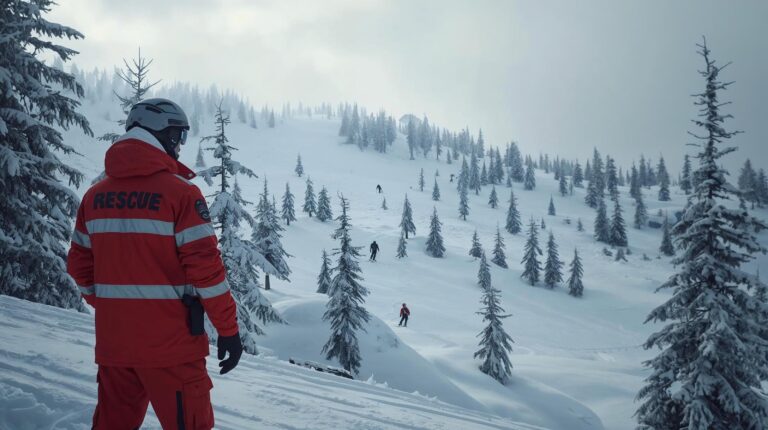
Why do serious skiing accidents occur in Bansko?
The statistics and experience of the Mountain Rescue Service (MRS) clearly show: not the mountain itself, but human errors and underestimation of conditions are the main problem. The most common risk factors among skiers and snowboarders include:
- Inappropriate speed: Riding at speeds that are too high for your skill level and the terrain is a leading cause of injury, especially on narrow sections and areas with sharp changes in slope.
- Leaving the marked trails: As with purposeful freeride, and when "going slightly" off the track, the risks multiply. Outside the outlines lurk trees, hidden rocks, deep bumps and hard ice. snow.
- Underestimating fatigue: Afternoon descents with tired muscles on an already rutted and icy track are a classic scenario for heavy falls.
- Driving in poor visibility: Fog, flat light, alternating strong shadows from trees, and artificial lighting drastically reduce the assessment of the terrain.
- Collisions in busy areas: Intermediate lift stations, narrow sections and intersections of different runs are areas with a high risk of collision between skiers.
Areas with increased caution in the Bansko ski area
Although it is not correct to label a specific track as "deadly", the terrain in the Pirin Mountains is harsh and some sections require much higher concentration.
"Pioneer" track (No. 16, Chalin Valog)
The terrain on this track is narrower, with many sections going directly through the forest and in close proximity to massive trees. If you lose control, going off the track here almost certainly leads to hitting a hard obstacle. At higher speeds and icy snow, mistakes on the Pioneer track are punished extremely severely.
The steep areas around Todorka Peak and Banderishka Polyana
The upper parts of the ski area are not only steeper, but also often subject to strong winds that ice the surface. In the area around Todorka Peak, there are also serious avalanche danger zones. Freeriding there without specialized equipment, experience, and knowledge of the terrain is extremely risky and absolutely not recommended.
How to realistically assess your skills?
Many accidents occur simply because skiers choose trails that exceed their technical capabilities. Here are some practical guidelines to ensure your safety on the ski slopes in Bansko:
- Stop test: If you cannot stop quickly, steadily and in a controlled manner within 10–15 meters, ride on easier terrain and slow down.
- Analyze the falls: If you often fall or have trouble turning on the blue (easiest) slopes, you definitely have no business on red, black or very busy trails.
- Listen to your body: Choose runs based on your daily fitness. If you are sleep deprived, physically tired, or have consumed a heavy lunch (or alcohol), switch to lighter runs.
- Don't follow the group: The fact that your friends are experts doesn't mean you should risk your health trying to keep up with their pace.
What to do if you feel like you're losing control?
The situation from the last fatal accident is a typical result of a person continuing to instinctively "fight" the high speed instead of killing it in time. If you feel that your skis or board are "leading" you:
- Reduce speed immediately! Start taking shorter and more frequent turns, using the full width of the track. This creates natural resistance and slows you down.
- Stay on the marked track. Never try to "escape" into the woods to avoid other people. Hitting a tree is many times more dangerous. Also, on the track, the chance of getting quick medical help is much greater.
- Induce a controlled fall. If you can't stop, it's better to end with a controlled "semi-squat" fall to the side, up the slope (to "bite" the slope). Try to absorb the impact with your hips and side of your body, protecting your head and spine.
Actions in the event of an incident: How to help adequately?
If you witness a fall or a serious impact, your quick and correct response could save a life. Follow these essential steps:
- Secure the place: Stop above the casualty. Drive your skis (or poles) into the snow above them in the shape of a cross (X) to warn descending skiers to go around them.
- Report immediately: Use the telephone number 112 or the direct numbers of the Emergency Services. Explain as clearly as possible: which slope is it, what is the number of the nearest lift pole, what is the approximate height and what is the apparent condition of the injured person.
- DO NOT move the victim: In serious injuries, especially if there is suspected spinal or neck injury, any movement can be fatal. ONLY move the person if they are in immediate life-threatening danger at the scene (e.g. avalanche).
- Stay with him until help arrives: Keep the victim warm (cover them with your jacket), calm them down, and keep them conscious. Even if they appear „okay,“ if you suspect a concussion or internal bleeding, do not leave them alone.
Emergency telephone numbers in Bansko
MES – Central 24-hour post: 02 963 2000 | 088 1470 (for A1 subscribers)
Single European emergency number: 112
Mountain Insurance – Your Best Investment
Always make sure you have active mountain insurance before you set foot on the slopes. Mountain rescue operations (especially those with snowmobiles or helicopters) are extremely expensive if you are not insured. An investment of a few leva per day guarantees you peace of mind and timely, professional assistance without a huge financial burden.
Bansko is a world-class resort that offers unforgettable emotions, but safety should always come first. By following the rules, controlling your speed, and not taking unnecessary risks, you protect both yourself and other winter sports enthusiasts.

 English (UK)