


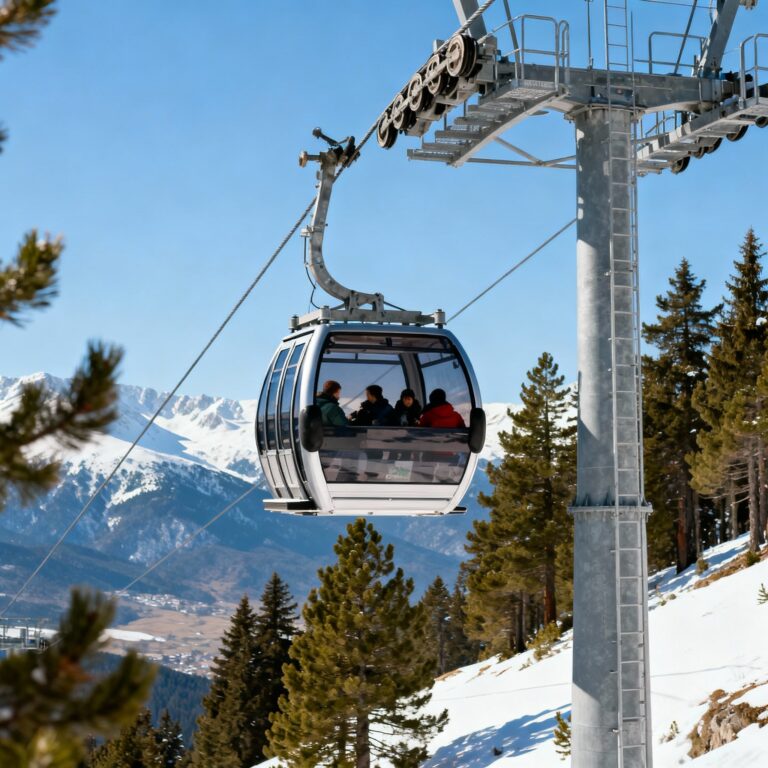
The topic of the long-awaited Second cabin in Bansko has become a decades-long saga filled with protests, lawsuits and disappointment. Every winter season the scenario repeats itself: kilometer-long queues, angry tourists on social media and mutual accusations between environmentalists and the concessionaire. But while everyone is arguing “FOR” or “AGAINST” a new route, the technological world has advanced dramatically.
Could it be that the solution has been right under our noses all along? After a thorough analysis of the technical specifications of leading manufacturers and the legal framework of the Pirin National Park, it turns out that there is a solution. And it is not what has been fought for for 10 years.
The Big Misconception: Why is “Second Cabin in Bansko” a trap?
For years, we have been told that the only solution is to build a new route parallel to the old one. However, analysis shows that this approach is a strategic mistake for two main reasons:
- Legal absurdity: Any new route requires a clearing in a National Park, which is blocked by UNESCO and EU directives. Even with political will, the lawsuits will continue for another decade.
- Economic inefficiency: Maintaining two old technological lines is more expensive and inefficient than one ultra-modern system.
The Solution: Not Expansion, but “Super-Modernization”
Instead of attempting to break new routes, the analysis points to the only possible, legal and quick option: Complete replacement of the current lift with a new generation system (type 3S or TRI-Line) on the same steps.
1. End of queues with triple capacity
The current cab is essentially an 8-seater minibus. New technologies, such as Doppelmayr TRI-Line, use cabins for 20-25 people. They can transport up to 5,000-6,000 people per hour – that’s three times the current real capacity. One such line makes the idea of a “Second Cabin in Bansko”"completely unnecessary.".
2. Victory over the wind
Bansko has a serious geographical problem – strong winds often blow at the top, which stops the lift (at speeds above 18 m/s). The new 3S technology (three-cable system) is literally a train in the air. It operates safely in hurricane winds of up to 100 km/h. This ensures that the ski area will not close on the strongest and busiest days.
The ecological paradox: More lifts, more forest
This is the point where even the most extreme environmentalists would have to agree with the project. The old lifts require a support pole every 100-150 meters. The forest under the lift is now a “concrete forest”.
The new 3S technology allows for huge “flights” between the poles (over 2 km without support). The result is impressive:
- ✅ Removal of about 40-50 old poles from the forest.
- ✅ Replacing them with only 8-10 new high-tech ladders.
- ✅ The land under the removed poles is being reclaimed and the forest is being restored.
This is not logging, but "cleaning concrete" from the park.
Action plan: How not to lose the winter season?
The main fear of business is: “If we push the lift in April and we're not ready by December, the resort goes bankrupt”. This risk is valid, but manageable. Experience from resorts like Kitzbühel shows that the solution lies in phased construction:
| Stage | Period | Action |
|---|---|---|
| Summer 1 | April – December | Dismantling and replacement of only the lower part (Bansko – Chalin Valog). In winter, a transfer is made to an intermediate station. |
| Summer 2 | April – December | Replacement of the upper part using cargo helicopters for rapid installation. |
Conclusion: Time for pragmatism
We have to be honest – this solution is expensive. While a simple “Second Cabin in Bansko” would cost around €40 million, the super-modern 3S system is an investment of around €100-120 million. But Bansko loses millions every year in lost profits and a damaged image.
The analysis is categorical: Option A (new route) is cheap on paper, but legally impossible. Option B (modernization) is expensive, but legal and technically perfect. The technology exists, the plan is there. Instead of waging trench warfare, we simply need to do a complete upgrade.

 English (UK)