


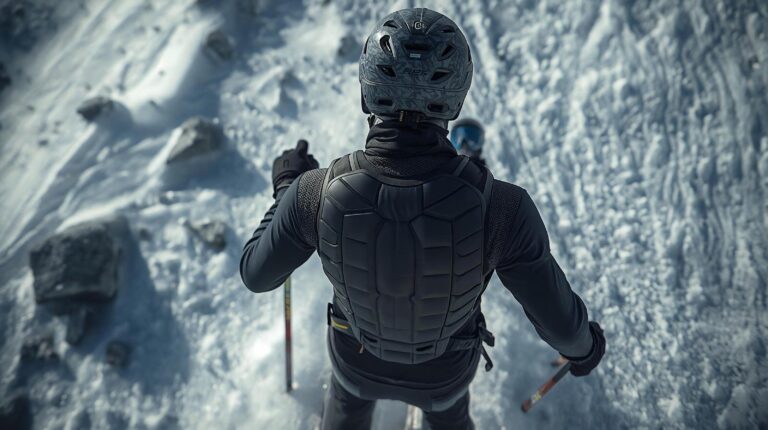
While a ski helmet has long been an absolute must-have on the white slopes, the reliable back protector (often called a “turtle”) is still unfairly overlooked by many enthusiasts. This is a critical mistake. The spine is the most complex and vulnerable system in the human body, and an encounter with hard ice or an uncontrollable skier can have irreversible consequences. The right choosing a back protector is your best insurance for a long and trouble-free season.
In this part of our complete ski gear guide, we'll look at why this "forgotten hero" should be a staple in your arsenal. We'll take you through modern "smart" foams, classic hard shells, the importance of safety certifications, and the specifics of skiing in resorts like Bansko.
Imagine falling on your back at 40 km/h. If you fall on soft “powder”, it will hurt, but you will probably get up. But if there is a hidden rock under the snow, a lump of ice or simply the track is processed to the hardness of concrete (often found on “Tomba” or “Balkaniada” tracks), the surface acts like a wedge, concentrating all the kinetic energy in a single point (the vertebra). The purpose of the protector is to distribute this enormous force over the entire area of the back, reducing local pressure tenfold.
1. Why do you need a back protector in Bansko?
There is a very dangerous myth among tourists: “I ride slowly and carefully, I don't need a protector, that's only for racers and freeriders.”
The reality in busy ski areas is quite different. Even if you have perfect control of your speed, you do not control the people behind you. The most common spinal injury incidents do not occur when you fall on your own, but when another skier or snowboarder, losing control, hits you in the back at high speed. The protector is your shield against other people's mistakes.
2. Types of protectors: Hard vs. Soft
The market today offers two radically different technologies. Both do an excellent job at impact, but the feel of all-day wear is incomparable.
| Protector type | Technology and Features | Advantages and Disadvantages |
|---|---|---|
| Hard shell (Hard Shell) |
Classic plastic or polycarbonate panels (scales) resembling armadillo armor. | ✅ Advantages: Excellent against sharp punctures (rocks/branches). More budget-friendly. ❌ Disadvantages: Heavier, stiffer, restrict movement and put a lot of strain on the back. |
| Soft foam (Viscoelastic / D3O / VPD) |
They use “smart” molecules (Non-Newtonian fluids). They are soft when moving, but harden instantly upon impact. | ✅ Advantages: The modern standard! Extremely comfortable, they follow the curves of the body and are invisible under the jacket. ❌ Disadvantages: Higher price. At very low temperatures they are slightly stiff at first until they warm up from the body. |
3. The safety certificate: What is EN 1621-2?
When you make your choosing a back protector, never rely on appearance or brand alone. Look for the European standard motorcycle and winter protection label EN 1621-2. It guarantees that the product has passed laboratory crash tests. The standard is divided into two levels:
ℹ️ Understanding protection levels:
- Level 1: Basic protection. Tested to withstand an average impact force of up to 18 kN (kilonewtons) to the back. Suitable for slower, recreational riding, for children and beginners.
- Level 2: High professional protection. Passes under 9 kN force. This is the gold standard you should aim for, especially if you are riding fast, jumping in the snowpark or going off-piste (freeriding). Level 2 absorbs over twice as much energy as Level 1!
4. Construction: Vest or Straps?
The way the protector attaches to your body determines how comfortable you will feel during the eight hours on the track.
- Backpack type (with shoulder straps and a wide waist belt): This is the classic option. It's usually cheaper and offers slightly better ventilation on the back. The downside is that it often moves up and down during aggressive riding or falls, and the straps can rub against your shoulders under the jacket.
- Type “Vest” (Vest): The protective foam is embedded directly into an elastic vest (usually made of breathable Lycra or mesh) with a front zipper. This is by far the most preferred and comfortable option today. The vest sits tightly “glued” to your body, does not move under any circumstances and is not felt. As a bonus – it adds a nice thin layer of warmth to your thermal underwear.
5. How to choose the right size?
One of the biggest mistakes when buying online is choosing the right size based on your overall height. When it comes to back protectors, the most important measurement is the length of your torso (the distance from the waist to the 7th cervical vertebra).
The golden rule when sampling: Put on the protector, tighten it and put on your ski helmet. Tilt your head back as far as possible. The protector shouldn't to hit the back of your helmet (this will prevent you from looking forward when descending). At its bottom, the protector shouldn't to go too low below the tailbone – if it's too long, it will push up and kill your neck every time you sit on the chairlift or on the bench in the tavern.
Conclusion: An investment in health
It is a myth that protectors are only for extreme athletes. On a busy track, the risk is real for everyone. A quality back protector with “smart” soft foam (D3O/VPD) is a long-term investment (over 5 years of life), which is literally not felt when worn, but can save your season – and most importantly your health – at a critical moment. Don’t skimp on safety!



 English (UK)