


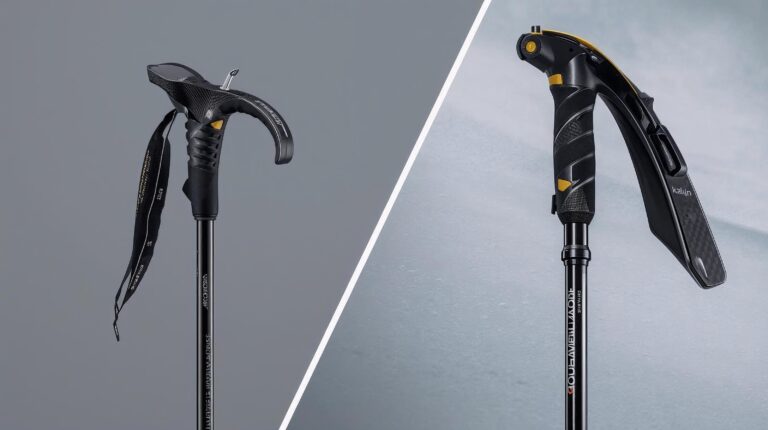
Often overlooked and chosen at the last minute, they are the metronome of your ride. The right choosing ski poles is essential not only for balance, but also for the rhythm of turns, proper body positioning and movement on flat sections of the Bansko.
Many beginners think of poles as just “support sticks,” but advanced skiers know that they are the subtle tool that initiates the turn. In the full ski equipment they hold a special place. In this guide, we’ll look at how to determine the right size, what material to choose, and why the “feathers” (the circles below) matter.
1. How to determine the length? (Table)
Length is the most critical factor when buying or renting poles. If they are too long, they will push you into a “back stance” (sitting back), which is wrong and tiring. If they are too short, you will lean too far forward and lose support.
If you don't have the opportunity to test live with a "cue flip", use this guide table according to your height:
| Your height (cm) | Recommended pole length (cm) |
|---|---|
| 150 – 160 cm | 105 – 110 cm |
| 160 – 170 cm | 115 – 120 cm |
| 170 – 180 cm | 120 – 125 cm |
| 180 – 190 cm | 130 – 135 cm |
| Over 190 cm | 135 – 140 cm |
2. Material: Aluminum or Carbon?
When choosing ski poles, you will come across two main materials. Both have their advantages depending on your budget and riding style.
Aluminum poles
This is the most common and robust choice. They are made of alloys (most often aluminum 5083 or the lighter 7075).
- Advantages: They are cheap and durable. Aluminum bends when hit hard, but rarely breaks (it can straighten out).
- Disadvantages: They are heavier than carbon ones.
- Who are they for: For beginners, amateurs and freestyle skiers (who often fall on them).
Carbon poles (Composite)
Preferred by advanced skiers for their low weight and elegant look.
- Advantages: Extremely lightweight and with a thin profile. They have a better “swing weight” (easier to swing with them).
- Disadvantages: They are more expensive. In the event of a very strong impact, carbon does not bend, but breaks (splinters) and becomes unusable.
- Who are they for: For piste skiers looking for speed and comfort.
3. Handles and Straps: Classic vs. “Click” Systems
The connection between the glove and the stick is key to safety.
- Standard strap: You stick your hand in from the bottom up and grab the handle along with the strap. Cheap and reliable, but sometimes annoying to put on.
- “Trigger” type systems (e.g. Leki): This is a modern innovation where the glove has a small loop that “clicks” directly into the pole handle. This provides perfect control and a safe release in the event of a fall to prevent thumb injuries (“ski thumb”).
4. Baskets: Size matters
That plastic circle at the bottom end of the stick is called a "feather" or rosette.
They are used for groomed slopes. They are small and aerodynamic so that they don't catch snow when turning.
They have a large diameter to prevent the pole from sinking deep into the soft snow. A must if you go off-piste!
Specialized types: Telescopic poles
If you plan to go ski touring (pantene) in Pirin, you will need telescopic poles. They allow you to change the length – shorter when climbing (so that your hand doesn't hang high) and longer when descending.
Conclusion
Don't underestimate your ski poles. The right size will improve your posture instantly, and a comfortable handle will reduce hand fatigue. For the conditions in Bansko, a pair of sturdy aluminum poles or a lightweight carbon model with medium-sized feathers are the all-rounder for every day use.

 English (UK)