


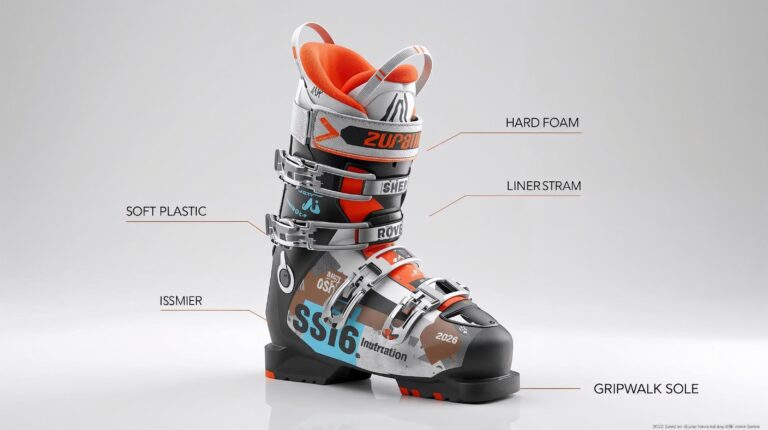
The myth that “ski boots should be uncomfortable”, is probably the biggest lie in the history of winter sports. If your feet hurt, go numb or freeze after two runs down “Tomba” or “The Shiligarnika“", the fault is not in the sport, nor in your physical abilities. The problem lies solely in the wrong choosing ski boots.
For any beginner or advanced skier, boots are the most important piece of equipment—three times more important than the skis themselves. Skis are simply tools that slide across the snow, but boots are your “steering wheel,” “gearbox,” and “brake.” They transmit micro-commands from your brain directly to the edge of your skis. If the binding is loose or painful, control disappears.
This expert guide, prepared with the experience of professionals from Bansko, will guide you step by step through the process of choosing the perfect ski boot. We will turn your vacation in Pirin into a real pleasure, not a struggle for survival.
The most common and fatal mistake we see in ski wardrobes around The Gondola in Bansko, is the purchase or rental of shoes according to the design. The only criterion that matters is the anatomy of your foot. The most expensive racing model on the market will be completely useless (and painful as hell) if it doesn't fit the width of your foot and the height of your arch.
1. How to determine the size (Mondo Point)?
Ski numbering has absolutely nothing to do with your everyday sneakers. It's called Mondo Point and represents the exact length of your foot in centimeters. Never enter a ski shop with the line: “I wear size 43 sneakers.”.
- Place a sheet of paper tightly against a wall on a hard floor.
- Step on it barefoot, with your heel firmly against the wall.
- Shift your weight slightly forward and mark the longest point (usually the thumb or second finger).
- Measure the distance with a ruler in centimeters (e.g. 27.5 cm). This is your Mondo size!
The temptation to go “one size up because of thick socks” is the first step to failure. Ski socks today are thin and high-tech. A ski boot should fit snugly like a glove, not leave empty spaces for your foot to slide around in.
| Foot length (cm) | Mondo Point size | Indicative EU number |
|---|---|---|
| 23.0 – 23.5 | 23.5 | 36 – 37 |
| 25.0 – 25.5 | 25.5 | 39 – 40 |
| 27.0 – 27.5 | 27.5 | 42 – 42.5 |
| 28.0 – 28.5 | 28.5 | 43 – 44 |
2. Width (Last), Stiffness (Flex) and Volume (Volume)
Apart from the length, with the right choosing ski boots You need to consider three more key factors that determine comfort and control.
Flex Index
This is a number that indicates how hard the shoe bends forward (towards the toes). The higher the number, the stiffer the plastic.
- For beginners (Men: 70-90 / Women: 60-80): The softer plastic is more forgiving, more comfortable to walk on, and allows for easy handling at low speeds on light tracks.
- For intermediate and advanced (Men: 100-110 / Women: 85-95): The golden mean. They provide direct control, stability at higher speeds and excellent edge response.
- Experts and competitors (120 – 130+): These boots feel like concrete. They transmit every micro-movement to the skis instantly, but they are not designed for comfortable 8-hour rides.
Shoe Width (Last) and Volume (Volume)
This is the width of the shoe at the widest part of the foot (at the knuckles behind the toes), measured for a base size of 26.5.
- 98 mm (LV – Low Volume): For very narrow feet and skiers looking for an aggressive, precise fit.
- 100 mm (MV – Mid Volume): The universal standard that fits about 70% of people.
- 102-104 mm (HV – High Volume): The best choice for people with wide feet, high arches or bunion problems (Hallux valgus).
3. The Golden Test in the Store (How to Measure Correctly)
The process of choosing ski boots It doesn't end with finding the right box size. You need to test them properly:
- The socks: Try on the boots ONLY with a pair of specialized, thin ski socks (merino or synthetic). Cotton traps moisture and leads to frostbite.
- The correct fastening: Put on the shoe and hit your heel hard on the floor. Tighten first the top two strimmers (on the shin) and the Velcro strap. This pushes your heel tightly back into the “pocket.” The bottom two foot stretchers should only slightly “close” the plastic without cutting off your blood circulation!
- The ski stand: When fully upright (knees straight), your toes SHOULD be lightly touching the front of the boot. However, when you assume a ski stance (pushing your toes hard forward with your knees bent), your heel goes back and your toes should be pulled away from the tip, freeing up millimeters of space. Your heel should absolutely not be lifted up!
Never tuck your thermal underwear (wedge) or ski pants inside your ski boots! Only your ski socks go inside your boots. Any extra edge or seam of clothing will dig into your shin under the immense pressure of the stirrups and cause painful sores on the first day.
4. Bootfitting and Custom Insoles
If the shoe fits well in length, but you feel local pressure (for example, on the knuckle), don't buy a larger size! This is where the magic of Bootfitting.
Modern ski boots have “thermo-formable” shells and liners. In good ski lockers and shops in Bansko, specialists have ovens. They heat the plastic and expand it exactly where it pinches you, creating a boot that is made to fit your foot.
Don't underestimate insoles! Factory insoles in ski boots are completely flat and useless. Investing in an anatomical or custom insole will support your arch, prevent your foot from “splintering” under pressure, and eliminate the burning pain in your feet.
5. Top ski boot brands: Who offers what?
Each brand has its own specifics and “molds”. With your choosing ski boots, test different brands:
- Solomon: Known for their phenomenal out-of-the-box comfort and technology Custom Shell HD for easy thermoforming.
- Atomic: The series Hawx offers extremely lightweight shoes with perfect options for different widths (Ultra, Prime, Magna).
- Lange & Rossignol: A benchmark for precision and sporty riding, Lange often has a narrower and anatomical fit around the heel.
- Dalbello: Famous for their Convertible design (three-component boot), which offers an extremely smooth and progressive flex - a favorite choice of freeriders.
- Head: They use innovative materials (Graphene) for lightness and offer the technology Liquid Fit, in which gel is injected into the sock for perfect sealing around the ankle.
6. Innovations: GripWalk and BOA Fit System
The world of ski gear is evolving rapidly. When buying or renting new boots, pay attention to these two revolutionary technologies:
- GripWalk soles: This is now the industry standard. They have a curved, rocker profile and a thick rubber grip. They allow you to walk normally on the icy Gondola parking lot or to the restaurant on Banderishka meadow, without walking like a robot and without slipping. Important: Your skis must have GripWalk compatible skis (marked with the GW logo).
- BOA® Fit System: Instead of the traditional bottom metal buckles (streimers), many models now use a steel cable and a rotating wheel (familiar with snowboard boots). This system “wraps” the foot much more evenly, eliminating painful pressure points on top.
Conclusion: After-run care
The right one choosing ski boots is a long-term investment. To ensure they last for many years, never dry them directly on a hot radiator or hotel stove! High temperatures will deform the thermo-plastic and the inner sock. Remove the inner sock and dry it at room temperature or use specialized electric dryers with gentle, cool air. Fasten the stretchers loosely when not in use to help the shoes retain their shape.
Don't rush your choice. Spend an hour or two in the store. When your ski boot becomes a natural extension of your foot, you stop thinking about pain and start enjoying the beautiful panorama of Pirin. See you on the slopes!




 English (UK)