


The myth that “ski boots have to be uncomfortable” is the biggest lie in winter sports. If your feet hurt, go numb, or get cold, the fault is not the sport, but the wrong choice of equipment.
For the beginner skier, boots are much more important than the skis themselves. Skis are simply tools that slide across the snow. Boots are the “steering wheel” and the “brake”. They are the connection between your body and the slope. This guide will take you step by step through the entire selection process to make your first days on the slopes a pleasure, not a torture.
The main rule:
Don't buy shoes based on color or brand. The only criterion is the shape of your foot. The most expensive shoe in the world will be useless if it doesn't fit your anatomy.
Step 1: How to determine the size (Mondo Point)?
The first mistake beginners make is to say: “I wear size 43 sneakers, give me size 43 ski boots”. The ski numbering is completely different. It is called Mondo Point and it's actually much more logical – it's the length of your foot in centimeters.
How to measure your foot at home?
- Place a sheet of paper on the floor, pressed tightly against a wall.
- Step on the sheet with your heel resting on the wall.
- Mark with a pencil where your longest finger ends.
- Measure the distance from the edge of the sheet to the line in centimeters (e.g. 27.5 cm).
This is your Mondo size. If you measured 27.5 cm, your ski boot size is 27.5. Do not add “reserve” for thick socks!
| Your foot (cm) | Ski Boot Size (Mondo) | Indicative EU number |
|---|---|---|
| 23.0 – 23.5 | 23.5 | 36 – 37 |
| 24.0 – 24.5 | 24.5 | 38 – 38.5 |
| 25.0 – 25.5 | 25.5 | 39 – 40 |
| 26.0 – 26.5 | 26.5 | 41 |
| 27.0 – 27.5 | 27.5 | 42 – 42.5 |
| 28.0 – 28.5 | 28.5 | 43 – 44 |
Step 2: Width (Last) and Stiffness (Flex)
Size is just the beginning. Shoes also come in different shapes.
Flex Index – How soft should the shoe be?
Flex indicates how much effort it takes to fold the shoe forward when you squat.
- 🟢 For beginners (Men: 70-90 | Women: 60-80): Look for soft shoes. They will allow you to bend your knees easily and maintain proper posture without tiring quickly. A hard shoe will “throw” you backward and you will lose control.
- 🟡 For advanced (Men: 100-110 | Women: 85-95): Stiffer shoes for higher speed.
Width (Last)
This is the width of the shoe at the widest part of the foot (at the knuckles).
- 98 mm (Low Volume): For people with very narrow and weak feet.
- 100 mm (Mid Volume): The gold standard for a normal foot.
- 102-104 mm (High Volume): For people with wide feet or high arches. These are the most comfortable models for tourists.
Step 3: The golden test – how to try?
This is the moment of truth. Many people try on shoes incorrectly by sitting on a bench. Here's how a professional test is done:
1. Wear the right socks
Never try on cotton socks or two pairs on top of each other. Wear one pair of thin ski socks. The ski boot is insulated enough.
2. Fasten properly
Fasten the lower leg (upper) straps first to push the heel back into its “nest.” Then tighten the lower straps, but not too tight – they should just close the shoe, not crush your foot.
3. Stand Up (The Finger Test)
When you stand fully upright, your fingers MUST They should rest lightly in front. If they don't, your shoe is too big. Don't panic.
4. Ski Stand (The Magic)
Now bend your knees forward hard (press the tongue of the shoe with your shin). At this point, your heel will go even further back and your fingers should move away from the front. You should no longer feel pressure on your nails. If this happens – it’s your shoe!
Common mistakes that ruin your vacation
Avoid these traps that beginners fall into with 90%:
- ❌ “I'll get bigger ones so they're roomy”
Huge mistake. The inner sock settles with 30% after a few days. If you buy a wide boot, on the third day your foot will “swim” inside. This leads to toe bumps when braking (“black nails”) and zero control over the skis. - ❌ The pants in the shoe
The leg of your ski pants (and especially the “snow skirt”) should be ON top of your boot, not inside it. Only your sock and foot go inside the boot. Anything else will cause shin sores. - ❌ Borrowing old shoes from a friend
Plastic ages. Shoes that are 10+ years old can fall apart (literally) on the track. Plus, the sock has taken the shape of your friend's foot, which will be torture for you.
Technologies of 2026: What to look for?
Even as a beginner, there are two modern extras worth asking about:
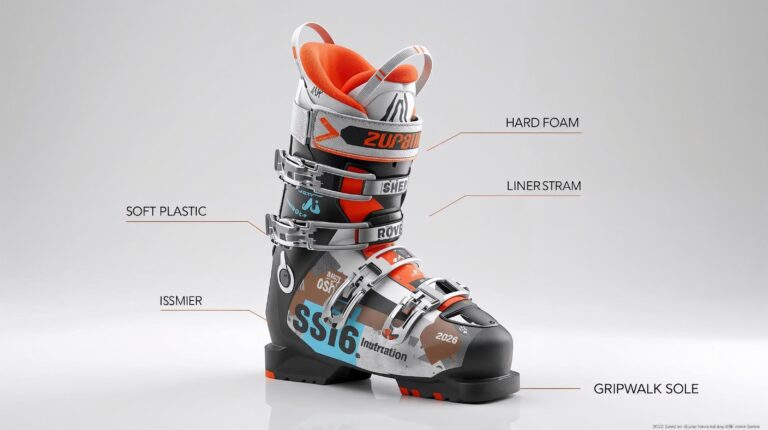
- GripWalk: Rubber gripper sole. Allows you to walk normally to the lift without slipping like on ice.
- BOA system: If you see a shoe with a “wheel” instead of bottom buckles – try it. It tightens the foot much more evenly and is easier for beginners to use.
Remember: A shoe should feel like a “strong handshake,” not a vice or a slipper. Take the time to try them on – at least 20 minutes in the store. Your feet will thank you!



 English (UK)