

In the first part of our complete winter gear guide, we'll look at the classic ski disciplines. Whether you're a beginner who's just starting out on the slopes, The Shiligarnika, or an experienced freerider looking for deep snow, here you will find everything you need to know about the main types of skis that you can use (and rent) at the resort during the 2026 season.
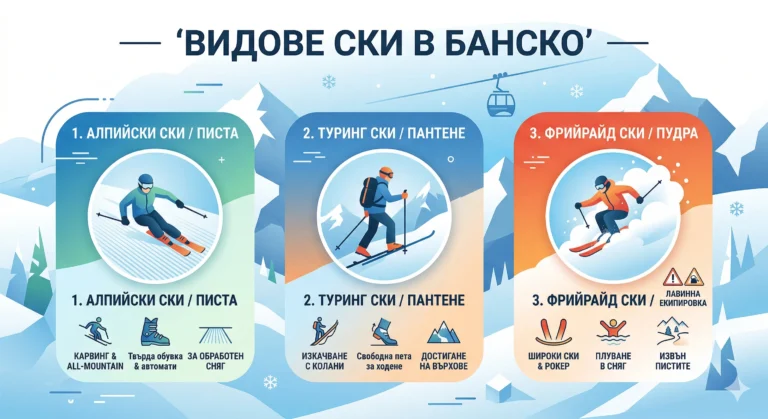
Alpine Skiing (Carving and All-Mountain): The Lords of the Track
Alpine skis are the most common type of equipment you will see around The Gondola and on marked trails. They are designed for speed, control and stability on packed snow.
Carving skis (Piste/Carving Skis)
These skis have a specific hourglass shape – wider at the tip and tail, narrower in the middle. This design, known as a “sidecut”, allows the skier to make sharp, smooth turns on edges without losing momentum.
All-Mountain Skiing
If you are looking for versatility, these are your skis. They are slightly wider under the ski (usually between 80 and 95 mm) compared to pure carving models. All-Mountain skis are perfect for the dynamic conditions in Bansko – in the morning they do great on the hard slopes of the Plateau, and in the afternoon, when the snow softens or the baboons accumulate, their wider platform gives you the necessary stability.
Touring Skis (Skis with Straps): The Freedom to Climb
Ski touring, often called “pantene” in Bulgaria, is experiencing a true renaissance. This style allows you to escape the lift queues and merge with the silence of Pirin.
What makes these skis unique?
- The machines: They allow the heel to be free when climbing (walking) and only lock for the descent.
- The belts: Special strips that stick to the base of the slope. They allow sliding forward, but “lock” when pushed backward, preventing slipping down the slope.
- Weight: Extremely lightweight materials (carbon, light wood) that save energy on long hikes to peaks like Vihren or Polezhan.

Freeride Skiing (Off-piste): Powder Hunters
When Pirin is covered with a thick layer of new snow, Bansko becomes a world-class freeride destination. The terrain under Todorka and the forest belts offer unique emotions, but require specific types of skis.
Freeride skis are significantly wider (often over 100-110 mm under the foot). They have the so-called. “rocker” profile – curved tips and tails that help the skate “float” above the snow instead of sinking into it. The feel is closer to surfing than classic skiing.
⚠️ Important for your safety!
Skiing off-piste carries serious avalanche risks. Never go out without an avalanche kit (peps, probe, shovel) and always check the Bansko Mountaineering and Hiking Association forecast. Hiring a local mountain guide is highly recommended.
Comparison table for choosing skis
| Ski type | Suitable for… | Terrain | Level |
|---|---|---|---|
| Carving | Speed and turn | Treated track | All |
| All-Mountain | Versatility | Mixed | Intermediate |
| Freeride | Deep snow | Off the track | Advanced |
| Touring | Climbing | Wild mountain | Experts/Adventurers |
Telemark skiing: The elegant return to the roots
Although less common, telemark skiers immediately catch the eye. This is the oldest style, in which the heel remains free at all times. The turns are performed through a specific squat (telemark turn). It is a physically demanding but extremely graceful way to feel the mountain.
Expert advice for ski rental in Bansko
If you are a beginner, don't rush into buying expensive equipment. The ski lockers on Naiden Gerov Street and around the starting station of the gondola lift offer a huge selection of current models for 2026.
PRO TIP: Always inform the cloakroom staff about your weight, height and skills. For beginners in Bansko we recommend “soft” skis, which are slightly shorter (to the chin) – they forgive mistakes and make learning more enjoyable.
In the next part of our guide, we will explore the world of snowboarding and the specifics of splitboard gear for the high mountains. Until then – see you on the slopes!
 English (UK)