


The times when riding with a hat was “cool” and a helmet was unnecessary are long gone. In the 2026 season, the right choosing a ski helmet is not just a matter of fashion, but the most important decision before you step on the runway. It is the element of your full ski equipment, whose job is to literally save your life.
Hybrid models and those with built-in visors dominate the market this year. But how do you navigate the hundreds of options? In this guide, we'll look at the most important criteria for 2026: size, MIPS technology, and compatibility with glasses.
1. How to determine the right size?
The most expensive helmet is useless if it's too big for you. If it's too small, it'll give you a headache in minutes. Here's how to measure your head correctly:
- Take a sewing meter (or a string that you can then measure with a ruler).
- Go around your head about 2 cm above the eyebrows and just above the ears (the widest part).
- The result in centimeters is your size (e.g. 56 cm, 58 cm).
The Shake Test
When you try on a helmet in the store, put it on, but do not fasten the strap under the chin. Shake your head vigorously left and right and up and down.
- Correct: The helmet stays still, and the skin on your forehead moves with it.
- Wrong: The helmet slides freely over your hair. This means it is big and will not protect you.
2. Construction and Technology: Why is MIPS the standard for 2026?
At choosing a ski helmet Today, brain protection technologies are no longer an extra, but a necessity.
ABS (Hardshell) vs. In-Mold
- ABS (Injection Molded): Classic hard helmets. They are a little heavier, but extremely puncture-resistant and more budget-friendly. Preferred for freeride and by parents for children.
- In-Mold: The outer shell is fused to the inner foam. The result is an ultra-light helmet with excellent ventilation, ideal for all-day trail riding.
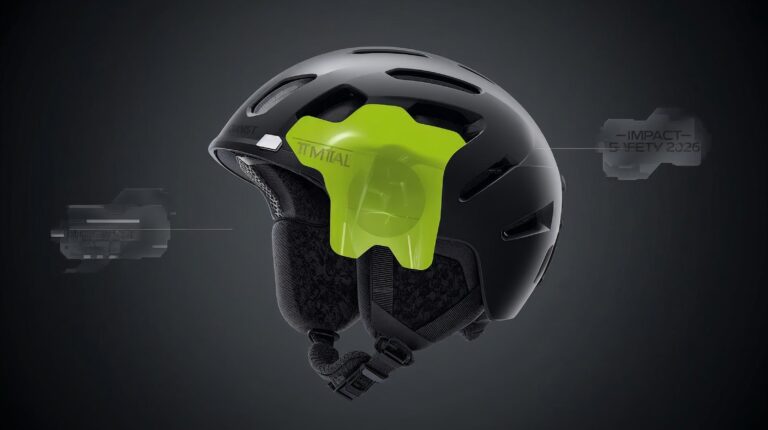
MIPS (Multi-directional Impact Protection System)
If your budget allows, be sure to look for the yellow logo of MIPS. This is a removable layer inside the helmet that allows for a slight slip (10-15 mm) upon impact.
Why is it important? In ski falls, the impact is rarely head-on. You usually fall at an angle, which creates rotational forces on the brain. MIPS absorbs exactly these forces and dramatically reduces the risk of concussion.
3. Ventilation: Active or Passive?
Weather в Bansko is variable – in the morning it can be -15°C, and at noon +5°C.
- Passive ventilation: The openings are fixed. It is good for spring skiing, but you may experience cold in January.
- Active (adjustable) ventilation: It has a slider to open/close the vents. This is the best choice for universal use throughout the season.
4. The trend of 2026: Helmet with a visor
More and more skiers are choosing visor helmets, which eliminate the need for a separate mask.
| Type | Advantages | Disadvantages |
|---|---|---|
| Classic (Helmet + Goggles) | Better face seal; Easy to change glasses when light changes. | Risk of “Gaper Gap” (forehead gap). |
| Helmet with Visor | TOP choice for people with prescription glasses! Huge field of view and convenience. | If you scratch the visor, replacement is more expensive. |
Conclusion
A ski helmet is not just an accessory, it is your life insurance. For the conditions in Bansko in 2026, we recommend a helmet with adjustable ventilation and MIPS technology. Don't compromise on size - it should "hug" you tightly to keep you protected and confident on the slopes.

 English (UK)