

Full comparison of slopes, prices, queues and atmosphere – season 2024/2025
They are separated by only 6 kilometers of asphalt, but represent two completely different philosophies about the mountain. On one side stands Bansko – the winter capital of the Balkans, host of World Cup rounds, a tourism machine on a European scale. On the other is Dobrinishte (Bezbog area) – the last bastion of romantic, rugged and accessible skiing, where the weather flows with the rhythm of the slow chairlift.
Many tourists make the mistake of thinking that Dobrinishte is simply „little Bansko.“ This is not true. These are two different worlds. In this detailed analysis, we will compare the two resorts on every possible indicator – from the length of the slopes and the quality of the snowmaking to the price of tea and the waiting time for the lift.
1. The Arena of Action: Tracks and Scale
The difference here is quantitative and qualitative. Bansko is an industrial giant compared to the boutique (or rather retro) feel of Dobrinishte.
Bansko: 75 km of diversity
The Bansko ski area officially offers 75 km of slopes. This includes everything from the wide and sloping slopes of "Platoto" and "Shiligarnika", to the black challenges like "Tomba". The main advantage here is connectivity. You can ski all day without going over the same combination of runs twice.
- Length of the longest descent: If you start from Todorka Peak and descend to the city along the "Ski Path", you make a continuous descent of 16 km - something that has no analogue in Bulgaria.
- Profile: The tracks are designed in a modern way, with curves and safety nets. There are tracks for every taste.
Dobrinishte: One track, lots of character
Dobrinishte has, practically, one main track – the one from Bezbog hut to Gotse Delchev hut. It is about 5 km long.
- Profile: The track is natural. It follows the mountain's relief, which makes it very picturesque, but also treacherous. The upper part is a wide "glade", the middle part goes through the forest and has flat sections (where snowboarders suffer), and the lower part includes the steep "Wall", which often ices up.
- Variety: After the second descent, you will already know every turn. You don't come here for variety in the terrain, but for repetition and improvement of the same, but long, section.
2. Snow Security: Technology vs. Nature
This is the most critical point for planning a vacation, especially in warm winters.
Dobrinishte relies on God. Snowmaking machines are almost non-existent (there are a few, but they are ineffective for the entire route). The resort is at a higher altitude (2240 m above sea level), which helps, but if there is no natural precipitation, the lower part of the track becomes muddy and rocky. Dobrinishte is a „last minute“ destination – you check the forecast and go if it has rained.
3. Elevators and the „Nightmare of Queues“
The issue of lifts is a battle between "slow calm" and "fast rush.".
Bansko: Modern but Congested
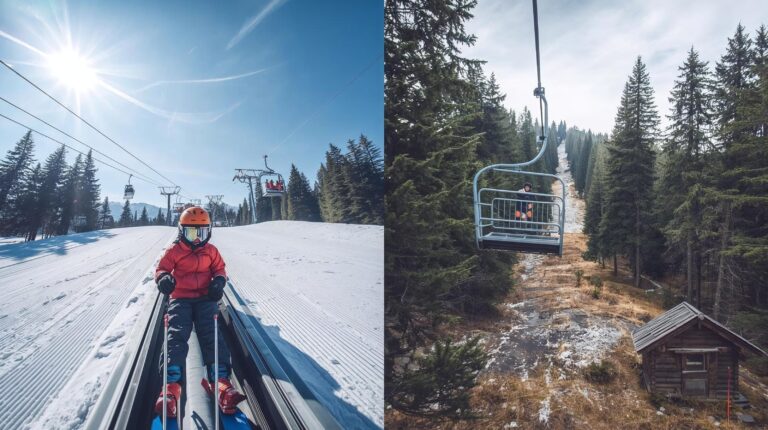
The facilities are Doppelmayr – fast, detachable chairs, some with heating and helmets. The capacity is huge, but the popularity of the resort is even greater.
- The Gondola (Cable Car): This is the „bottleneck“. During peak periods (Christmas, holidays, weekends) between 08:30 and 10:30 the queue can take from 45 minutes to 2 hours. This is time lost from your day.
- Up in the zone: Once you get to the top, the lines disperse quickly and you rarely have to wait more than 5-10 minutes for the lift.
Dobrinishte: Retro romance and cold
The elevator is a two-seater, old, non-detachable one. It moves at a constant (slow) speed.
- Travel time: From Gotse Delchev hut to Bezbog hut it takes about 30 minutes (with a stopover at an intermediate station).
- The chill factor: Since you are sitting still for 30 minutes on an open seat, if the wind is blowing or it is below -10 degrees, frostbite is a real danger.
- Tails: There are almost no queues. Even on the busiest days, the wait downstairs rarely exceeds 15-20 minutes.
4. Financial analysis: How much does pleasure cost?
The price gap between the two resorts continues to widen.
| Service | Bansko (Premium) | Dobrinishte (Budget) |
|---|---|---|
| Day pass (adult) | 96+ BGN (approximate) | ~40-50 BGN. |
| Ski rental (mid-range) | 30 – 50 BGN. | 15 – 25 BGN. |
| Lunch on the track | Burger/Soup + Drink: 30-40 BGN. | Bean soup + Meatball + Tea: 15-20 lv. |
| Parking | 15-20 BGN/day (hard to find) | Paid, but affordable (about 10 BGN) |
5. Who is each resort suitable for?
Absolute beginners
Winner: Bansko.
Despite the price, Bansko offers conditions that Dobrinishte does not have. The "Magic Carpets" and the square of Banderishka meadow are indispensable for the first steps. In Dobrinishte, beginners struggle on a small lift down or risk their lives up top. Learning in Bansko is faster, safer and less traumatic.
Freeriders (Off-piste)
Winner: Dobrinishte.
This is the big secret. When the „powder“ (fresh snow) falls, Bezbog is paradise. The area around the piste and the chutes descending to the hut are legendary among the freeride community. There is no strict Bansko police, who often confiscate passes for riding outside the markings. But beware: the avalanche danger in Pirin is serious in both resorts!
Families with children
Winner: Bansko.
The ski kindergarten, the enclosed warm changing areas, the variety of food and the easy access to toilets make Bansko the logical choice for parents. In Dobrinishte, the conditions are spartan.
Authenticity and budget seekers
Winner: Dobrinishte.
If you want to feel the spirit of the old mountain, eat real beans in the hut, warm yourself by the fireplace with tea made from Pirin herbs, and not hear English and Greek spoken at every turn – Bezbog is your place.
6. Atmosphere and Après-ski
In Bansko, the party starts as early as 2:00 p.m. Restaurants like “Happy Ending”"offer live music, dancing on tables and expensive cocktails. The city is full of taverns, bars, discos and spas. This is a resort that never sleeps.
In Dobrinishte, “apres-ski” means taking off your skis in front of the hut, sitting on a wooden bench in the sun and looking at the peaks in silence. In the evening, the village has wonderful taverns with much lower prices and tastier local food (the famous “kapama” and “chomlek”), but there is no club-type nightlife.
Final verdict
There are no wrong choices, there are wrong expectations.
Choose Bansko, if you want a guarantee of snow, luxury, fast lifts and are willing to pay the price for it - both financially and with your time waiting for the lift in the morning.
Choose Dobrinishte, if you are a confident skier (or at least not an absolute beginner), love nature more than comfort, are looking for freeride thrills, or just want to go on a budget for the weekend without pushing yourself into the crowds.

 English (UK)