


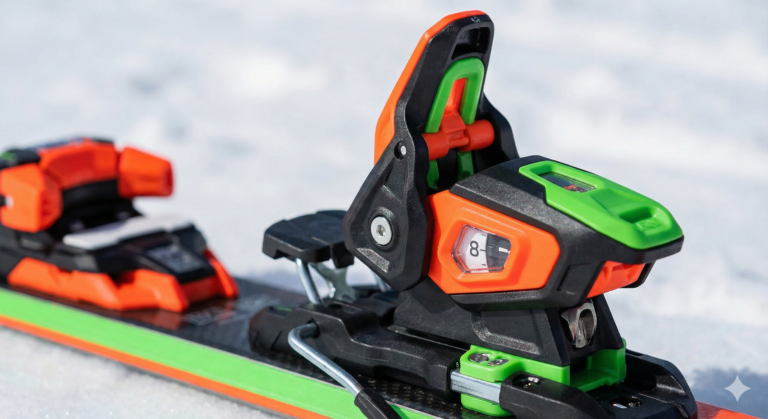
If you have already chosen the right skis, the next step is even more important for your knees and joints. It's about selection of ski machines – the mechanical guardians that decide when to keep your foot fixed and when to release it to prevent injury.
Ski bindings are often underestimated, but they are the only connection between you and your board. In this guide, we'll break down the technical specifications to understand what DIN stands for, what the difference is between the different standards, and why the width of the stopper matters.
What do ski machines actually do?
Their role is dual and contradictory:
- Retention: Keep your shoe firmly attached to the ski while you ride aggressively, jump or go over bumps.
- Release: To open instantly when the forces on the leg become dangerous (when twisting or falling forward/backward) to save the knee ligaments and bones.
1. The mysterious number: What is DIN tuning?
When we talk about selection of ski machines, the first term you'll hear is DIN (Deutsches Institut für Normung). This is the industry standard for the force required to release a gun.
Each slot machine has a range (e.g. 3-10, 4-12, 6-14). Your personal DIN number is calculated based on:
- Weight and height;
- Age;
- Length of the ski boot sole (in mm);
- Skiing skills (Type I – beginner, Type II – intermediate, Type III – aggressive).
2. Types of vending machines according to installation
The market offers two main systems that you should know:
System Bindings
These are the machines that come with the skate. The skate has a built-in rail or plate on which the machine slides.
- Advantages: Perfect flexibility (flex) of the skate, easy adjustment for different shoe sizes (without drilling).
- Usage: Almost all piste and all-mountain skis come like this.
Drill-mount / Flat Skis
They are used on freeride, freestyle (park) and touring skis, which are sold “flat” (without a plate). The automatic is screwed directly into the wooden core of the ski.
- Advantages: Lower weight, closer contact with the snow.
- Disadvantage: Once fitted, changing the shoe size is difficult (requires re-drilling).
3. Brake Width
Stoppers are those “feet” that stop the ski from running away down the slope when you fall. When purchasing individual skis, the width of the stopper is critical.
- The rule: The stopper should be equal to the width of the waist of the skate or up to 15 mm wider.
- Example: If your skate is 90 mm wide at the waist, look for a 90 mm or 100 mm stopper.
- The error: A stopper that is too narrow will not open. A stopper that is too wide will stick out and drag snow in the turns, which is dangerous.
4. Sole compatibility: GripWalk, Alpine and Touring
This is the newest and most confusing topic for 2024/2025. Not all shoes fit in all machines!
| Shoe standard | Compatible machine |
|---|---|
| Standard Alpine (ISO 5355) Classic flat sole |
All Alpine machines, GripWalk machines, MNC (Multi-Norm) machines. |
| GripWalk (GW) Rounded rubber sole for walking |
Only machines with logo GripWalk or MNC. They DO NOT fit old Alpine rifles! |
| Touring (ISO 9523) Touring shoes with rubber |
Only Pin (Tech) machines or MNC/SoleID machines. |
Conclusion
Choosing ski lifts is not a place for compromise. If you ski mostly on groomed slopes in Bansko, a standard alpine ski with GripWalk compatibility and a DIN range up to 11-12 is the universal choice for most men (and up to 9-10 for women).
Remember: Even the most expensive automatic will not work properly if it is not professionally adjusted. Have the springs checked by a service center before each season!



 English (UK)