


Your feet bear all the weight on the track, so the right choosing ski pants is critical to your comfort. You may have the highest-end jacket, but if your pants leak while you're sitting on the snowy seat of the Todorka lift, or if they make you unbearably hot in the spring sun, your ski day ends ingloriously.
The ideal base layer for your ski gear is a delicate balance between complete freedom of movement, optimal warmth and uncompromising water resistance. Modern technologies offer solutions that adapt to the changing weather on the mountain – from freezing blizzards in January to mild, sunny afternoons in late March.
In this comprehensive guide, we'll decode what all those complicated numbers on labels really mean, compare classic models with modern bibs, and give you precise guidance on how to make the best possible investment for the conditions in Bansko and Pirin.
No matter how good your ski pants are, if you wear cotton leggings, jeans, or casual tracksuits underneath, you will be cold. Cotton absorbs and retains sweat, cooling you instantly. A must-have for comfort is investing in specialized thermal underwear (merino wool or high-quality synthetics) that will wick moisture away from your skin.
1. Waterproofness and breathability: The secret of the numbers
When you begin your ski pant selection process, the first thing you'll notice on the label are two numbers, usually written in the format 10,000mm / 10,000g (or 10K/10K for short). These metrics are the backbone of your defense.
Water resistance (Water column in mm)
This number indicates how many millimeters of water one square inch of the material can hold before the liquid passes through it.
- Up to 10,000 mm: Basic protection. These pants are okay for dry snow and mostly clear weather. However, if you spend a lot of time sitting in slush or riding in wet snow, there is a serious risk that they will leak water.
- 15,000 – 20,000 mm: The golden mean for most skiers. These values are ideal for the variable conditions in Bulgaria, easily withstanding heavy snowfall and sitting in deep snow.
- Over 20,000 mm (GORE-TEX® and equivalents): Absolute, impenetrable protection. This is the standard for freeriders, ski mountaineers and professionals who spend whole days off the slopes or in harsh storms.
Breathability (in grams – g)
Breathability measures how many grams of water vapor (sweat) can pass through one square meter of fabric from the inside out within 24 hours. Skiing is an intense sport and if your pants don't "breathe", you'll sweat and then freeze. For normal skiing, look for minimum 10,000g, but if you practice ski touring (pantene) or ride very aggressively, aim for values over 20,000g.
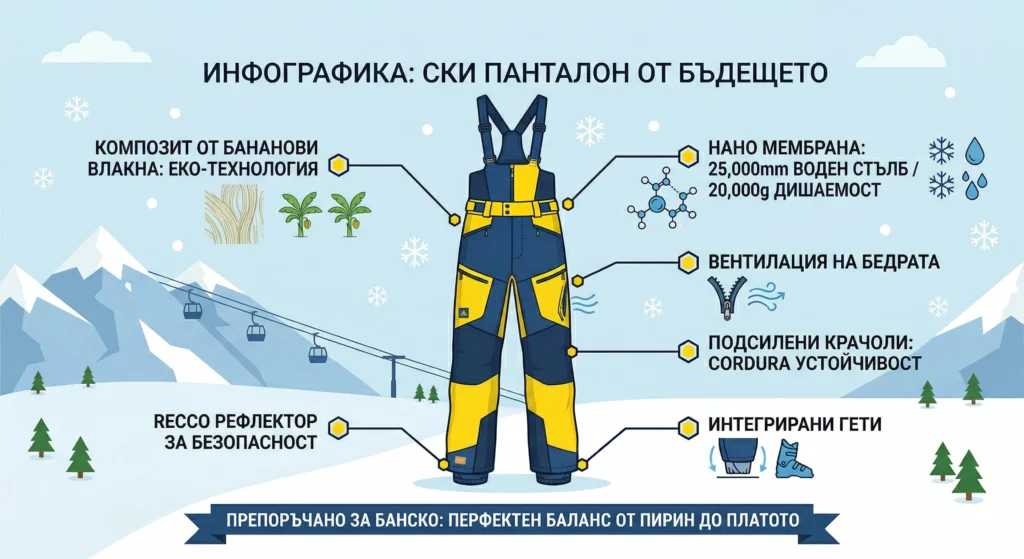
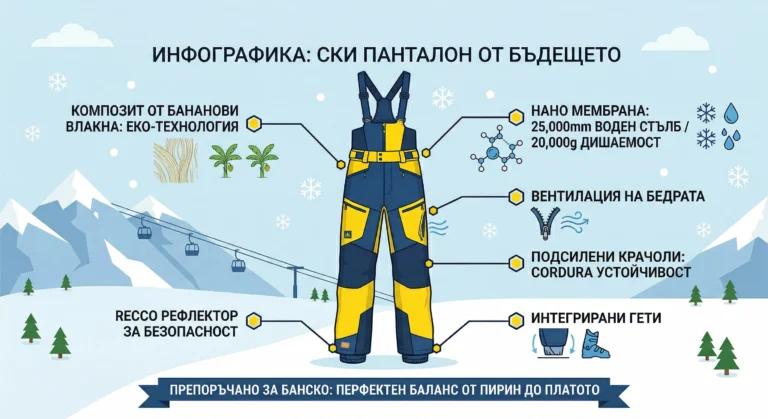
azi infographic presents an innovative ski pant using eco-technology from banana fibers. The model is designed specifically for the conditions in Bansko and includes a nano membrane with extremely high protection class, ventilation on the hips, reinforced legs with Cordura for strength and a RECCO reflector for avalanche safety.
2. Shell (Membrane) vs. Insulated Pants (Insulated)
The right choice of ski pants depends directly on how easily you get cold and what your riding style is. There are two main types of construction:
| Pants type | Who is it suitable for? | Advantages and Disadvantages |
|---|---|---|
| Insulated It has built-in synthetic lining/wadding. |
Beginners, more chilly people, and skiers skiing on the coldest days of January. | Advantages: Extremely warm; often does not require thick thermal underwear. Cons: Bulkier; can lead to overheating on sunny days. |
| Membrane (Shell) A thin waterproof layer, without insulation. |
Advanced, freeriders and ski tourers who prefer layering. | Advantages: Maximum flexibility and lightness; you control the warmth with intermediate layers. Cons: On frosty days, a thick merino underneath is an absolute must. |
3. Bib or classic high-waisted pants?
Over the past few seasons, ski overalls, known as “Bibs”, have made a huge comeback and are taking over the mountains. If you're hesitating about your ski pant choice, here's why many people are switching to overalls:
- End of the snow in the waist: Even on the most epic falls in deep powder, the high panel of the overalls keeps your back and waist completely dry and protected from the wind.
- Exceptional comfort: Since it's held on by straps, there's no need for a tight belt that digs into your stomach after a lunch at the track.
- Additional space: The overalls offer convenient chest pockets that are perfect for safely storing a phone (body heat preserves the battery) or a lift pass.
4. Mandatory details and extras (Don't buy without them)
Regardless of which brand you choose, a high-quality pair of ski pants must have the following structural elements:
- Ventilation zippers (Vents): They are usually located on the inner or outer side of the thighs. They are a must for Bansko, where the temperature amplitudes during the day can be huge.
- Snow Gaiters: The elastic cuff, hidden inside the leg, fits snugly over the ski boot and serves as a physical barrier against snow ingress.
- Reinforced Legs (Scuff Guards): The edges of the skis are razor sharp. The lower inner part of the pants should be reinforced with a cut-resistant material (e.g. Cordura) to prevent tearing.
- Fully Taped Seams: The fabric itself may be waterproof, but the needle leaves microscopic holes when sewing. For complete protection, all seams should be taped with a special waterproof tape.
- Articulated knees: The cut of the pants around the knees should follow the skier's natural posture (slightly bent) so as not to stretch the fabric while skiing.
Absolutely! Snowboard pants are designed with a looser (baggy) cut to allow for deep squats and frequent changes in center of gravity. They have stronger reinforcements in the knees and seat, since boarders often sit on the snow. Ski models are more fitted (slim or regular) for better aerodynamics.
5. Proper maintenance: How to extend the life of the membrane?
A common mistake people make after choosing the right ski pants is poor maintenance. Never wash membrane clothing with regular laundry detergent or fabric softener! Fabric softener clogs the micropores of the fabric and permanently destroys its breathability.
For washing, use only specialized liquid detergents for technical clothing (such as Nikwax Tech Wash or Grangers). After washing, if water no longer “collects in drops” on the surface of the trousers, it is necessary to restore the DWR (Durable Water Repellent) coating using a special impregnation spray or laundry additive.
Conclusion
Don’t compromise when it comes to the comfort of your feet. For the changing conditions of the Bulgarian mountains, the safest and most versatile option is a high-quality Shell pant (or overalls) with a waterproof rating of at least 15,000 mm, combined with excellent ventilation systems and premium merino thermal underwear. With such a combination, you will be perfectly prepared for both the January blizzards on the Plateau and the relaxing spring skiing on the slopes of Bansko.



 English (UK)