


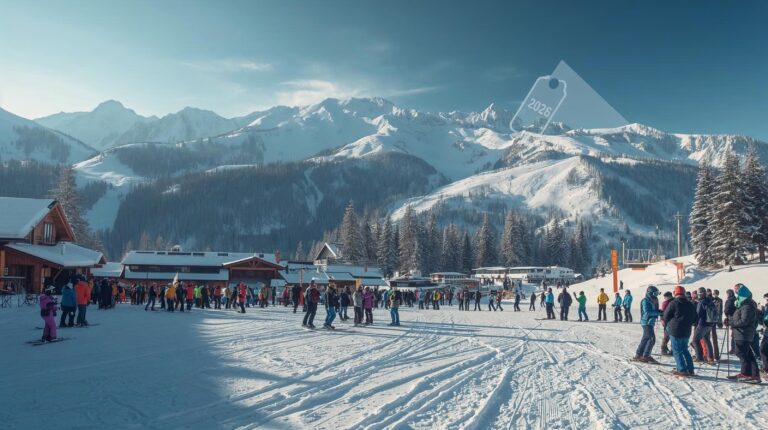
The development of a winter resort Bansko over the past two decades represents one of the most dynamic economic cases in the tourism industry of Eastern Europe. The transformation of the small mountain town at the foot of Pirin into an international ski center is a process inextricably linked to the investment policy of "“Yulen” AD and the evolution of pricing.
The present analysis examines not only the nominal change in current ski pass prices in Bansko, and the deep structural changes – from the introduction of VIP corridors to the response to global crises such as COVID-19 and inflation.
Part I: Genesis of the Modern Ski Area (2003–2008)
The period between 2000 and 2003 was a key one. The construction of the Gondola by Doppelmayr completely changed the logistics, replacing the old bus transfer to Banderishka Polyana. In these early years, the pricing policy sought a balance between return on investment and the still nascent image of the resort.
Seasons 2003/2004: The First Steps
For the 2003/2004 season, the archives indicate a price for a one-day lift pass for an adult of 58.00 BGN. Although high by the standards of the time, it signaled premium quality. Even then, a strategy to retain tourists for long weekends was noticeable:
| Period (2003/2004) | Price Adults | Price Children (up to 7 years) |
|---|---|---|
| 1 Day | 58.00 BGN. | 1.00 BGN. |
| 2 Days | 112.00 BGN. | 2.00 BGN. |
| 3 Days | 170.00 BGN. | 3.00 BGN. |
The following season (2004/2005) saw experiments with flexible pricing – a weekend pass of around 25 Euros and lower prices for weekdays, typical of the market's "finding the groove" stage.
Part II: The Era of Stability – “The 55 Leva” (2008–2012)
This is the “Golden Age” for consumers. Despite the global financial crisis of 2008 Bansko establishes a standard of 55.00 BGN. for a one-day pass, which is valid for several seasons. This predictability establishes the resort as a “Best Value” destination in Europe.
The cheap season pass phenomenon
In the 2009/2010 season, the season ticket costs only 760.00 BGN. This is an extremely low value, equivalent to less than 14 one-day passes. This stimulates mass sales not only among locals, but also among vacation property owners.
Key moments of the period:
- Half-day card: An option for riding after 12:30 p.m. (about 37-41 BGN) has been introduced to fill the afternoon hours.
- Children's category: At that time, it covered everyone up to the age of 12, lacking today's categorical differentiation for the youngest.
- Anti-crisis measures: In the 2011/2012 season, despite inflation, prices were maintained as a marketing tool.
Part III: The Great Restructuring and the VIP Model (2012–2018)
The 2012/2013 season marked a turning point. After years of accumulating tourist crowds and legendary queues in front of the Gondola, the operator took radical measures to segment. This was the end of the era of cheap ski pass prices in Bansko for the entire season.
The season ticket shock
While the daily card increases symbolically to 58.00 BGN, the seasonal card jumps from 760 BGN to 1,450 BGN. – an increase of nearly 91%.
With the drastic increase, the season pass begins to include VIP access (fast lane) to the Gondola. It is transforming from an economical product into a premium service. The operator is essentially saying: “If you want to ride for a whole season and not wait in line, the price is 1450 BGN.”.
Product Innovation (2013–2018)
During this period, two key services were introduced that shaped the market:
- “Bansko Twenty” (Bansko 20): Launched around 2013/2014 at a price of 800 BGN. This card gives 20 days (immediate) of riding – ideal for apartment owners and digital nomads, but without VIP rights.
- Children's card for 1 lev: The practice of children under 7 and pensioners over 75 paying a symbolic fee is being established. This social policy is key to the family image of the resort.
Part IV: The Inflation Cycle and the Pandemic (2018–2022)
The macroeconomic environment – electricity, fuel and labor prices – is putting an end to price containment. Here is the chronology of the price increase:
- Season 2018/2019: First increase in 6 years. The daily card becomes 65.00 BGN.
- Season 2019/2020: The price reaches 70.00 BGN. Active offering of family packages begins.
- Season 2020/2021 (COVID-19): The resort is operating under strict measures. The price remains around 75 leva. Loyal customers are offered bonuses due to the early closure of the previous season.
- Season 2021/2022: With the onset of the energy crisis, the daily chart jumps to 79.00 BGN., and “Bansko Twenty” crosses the 1000 BGN mark.
Part V: Galloping Inflation and the “Premium” Era (2022–2025)
The last three seasons have been characterized by the most aggressive hikes in history, driven by record inflation and electricity costs.
Through 2022/2023 the price jumped to 90 leva, and in 2023/2024 – at 96 leva. This brings us to the present moment.
Season 2024/2025: The breakthrough of the three-digit sum
Bansko officially joins the club of resorts with triple-digit revenues ski pass prices. Here is the full price list for the current season:
| Service | Adult | Student | Child (7-12 years old) | Child (up to 7 years old) |
|---|---|---|---|---|
| 1 Day | 110.00 BGN. | 99.00 BGN. | 55.00 BGN. | 1.00 BGN. |
| 6 Days | 635.00 BGN. | 564.00 BGN. | 305.00 BGN. | – |
| Bansko Twenty | 1,600.00 BGN. | 1,500.00 BGN. | 800.00 BGN. | 20.00 BGN. |
| Season ticket (VIP) | 1,900.00 BGN. | 1,800.00 BGN. | 1,000.00 BGN. | 100.00 BGN. |
Analysis of the new prices:
- Symbolic barrier: 110 leva puts Bansko in direct competition with budget alpine resorts, but it is still 2-3 times cheaper than places like Zermatt.
- Gondola for tourists: The price of 50 leva for a walk (without skiing) is a record and shows an aspiration to monetize each visitor.
- VIP value: The difference between the “Bansko Twenty” and the Season Card is only 300 BGN, but the seasonal card gives invaluable quick access, making it more attractive for regular visitors.
Part VI: Thematic analysis of services
1. Evolution of age categories
The change in definitions is a hidden tool for price adjustments. Students now need a strictly valid ISIC card. However, the most sustainable policy remains the attitude towards the elderly - pensioners over 75 enjoy the privilege of children up to 7 years old (symbolic price of 1 leva).
2. The “VIP” phenomenon and queue management
One of the most characteristic features of the ski passes in Bansko is the integration of VIP rights due to the limited capacity of the Gondola (about 2000-2400 people/hour). Access to the “Fast Lane” is only possible through a season pass or special VIP cards of partner hotels (e.g. Kempinski), which are significantly more expensive.
3. Deposit system and technologies
The deposit of 5 leva for plastic introduced in 2012/13 is a constant. New platforms such as skipoint.info allow online recharge to reduce queues at the checkout, but do not yet offer a price discount compared to buying on site.
Conclusion
The history of ski passes in Bansko is a reflection of Bulgaria’s economic development. From dumping prices at the beginning to today’s premiumization, the strategy is clear – maximizing revenue through segmentation. The daily pass has increased in price by over 90% in 16 years, outpacing official inflation, but this also reflects improved infrastructure.
In the foreseeable future, prices are expected to continue to follow inflationary processes in the Eurozone, and it is entirely possible to introduce dynamic pricing (similar to airlines), which is already being tested in other world resorts.



 English (UK)